Self-Care Tools for Pet Loss Grief: What Actually Helps When Your Heart Is Broken
In the weeks after Charlie died, people kept telling me to "take care of myself." The advice was well-meaning but hollow. What did self-care even mean when my daily routine had a dog-shaped hole in it? When the grief was so heavy that showering felt like an accomplishment?
Here's what I learned, both from my professional background in crisis counseling and from living through it myself: self-care during acute grief doesn't look like bubble baths and face masks. It looks like survival tools that help you get through one day, then another, then another.
If you're in the raw, early stages of pet loss grief—or if you're months in and still struggling—this guide is for you. Let me share what actually helps, grounded in both psychological research and messy, real-life experience.
Redefining Self-Care in Grief
First, let's be clear about what self-care is and isn't during grief.
Self-care is NOT:
Forcing yourself to "stay positive"
Pretending you're okay when you're not
Pushing through pain because "it's just a dog"
Maintaining your pre-loss productivity level
Avoiding all sadness or difficult emotions
Self-care IS:
Meeting your basic needs even when everything feels pointless
Creating small pockets of relief in overwhelming pain
Honoring your grief while also staying functional
Being gentle with yourself when you can't do what you used to
Recognizing that healing isn't linear
With that foundation, let's talk about actual tools that can help.
Physical Self-Care: Meeting Your Body's Needs
Grief lives in your body, not just your mind. Your physical state directly affects your emotional capacity. These tools help address the physical toll.
Sleep Support (Even When It Feels Impossible)
Grief often disrupts sleep—either you can't fall asleep because your mind won't quiet, or you sleep too much because it's the only escape from pain.
White noise machines can help mask the silence left by your dog's absence. That lack of breathing sounds, movement, collar jingles—it's deafening. White noise fills some of that void.
[When you have your affiliate link, insert here: Search Amazon for "white noise machine sleep sounds"]
Weighted blankets provide gentle pressure that can calm your nervous system, making sleep more accessible. The physical weight can also substitute somewhat for the presence of a dog who used to sleep beside you.
[When you have your affiliate link, insert here: Search Amazon for "weighted blanket"]
Sleep masks block light if you're sleeping at odd hours (which many grieving people do). When normal schedules fall apart, giving yourself permission to sleep when you can—and tools to make that happen—is self-care.
[When you have your affiliate link, insert here: Search Amazon for "sleep mask comfortable"]
Nutrition When You Don't Want to Eat
Many people lose appetite during acute grief. Food seems pointless. But your body still needs fuel, especially when managing emotional stress.
Protein shakes or meal replacement drinks aren't ideal long-term, but they're better than nothing when you can't face solid food. Choose ones with protein, vitamins, and minerals.
[When you have your affiliate link, insert here: Search Amazon for "protein meal replacement shakes"]
Easy comfort foods that require minimal preparation can bridge the gap. Instant oatmeal, soup, frozen meals you can microwave. This isn't about nutrition perfection—it's about feeding yourself at all.
Herbal teas can provide comfort, hydration, and ritual when eating feels impossible. Chamomile for calming, peppermint for nausea (which anxiety often causes), ginger for stomach upset.
[When you have your affiliate link, insert here: Search Amazon for "herbal tea variety pack"]
Movement (Not Exercise—Just Movement)
You don't need to hit the gym. You don't need to maintain your pre-loss fitness routine. But moving your body, even gently, helps process stress hormones.
Walking is the most accessible form. The walks you used to take with your dog are probably painful now, but eventually, walking can become a way to honor their memory while also caring for yourself.
Gentle stretching or yoga can release physical tension. Grief often manifests as tight shoulders, clenched jaw, lower back pain. Even 10 minutes of stretching helps.
Consider a yoga mat if you don't have one. Having a dedicated space for gentle movement creates a small ritual of body care.
[When you have your affiliate link, insert here: Search Amazon for "yoga mat non-slip"]
Emotional Self-Care: Tools for Processing
Your emotions need tending just like your body does. These tools help you process rather than just endure.
Journaling for Grief Processing
I've written extensively about grief journals in another post, but it bears repeating: writing externalizes what you're carrying. You don't need fancy prompts—though they can help. Sometimes just dumping thoughts onto paper creates relief.
If you want structured support, my guided journal Charlie's Last Walk includes prompts specifically designed for pet loss grief, organized in a non-linear way that mirrors how grief actually works.
[INSERT LINK: https://a.co/d/5eYkH7U]
Blank journals work too if you prefer unstructured writing. Choose something that feels good to write in—quality paper, a size that feels right, a cover that doesn't annoy you.
[When you have your affiliate link, insert here: Search Amazon for "journal notebook lined pages"]
Quality pens might seem frivolous, but the physical act of writing can be meditative when you have tools that feel good to use. Gel pens or rollerballs that glide smoothly make the practice more inviting.
[When you have your affiliate link, insert here: Search Amazon for "gel pens smooth writing"]
Books That Understand Grief
Reading about grief won't fix it, but it can help you feel less alone and more understood. Look for books specifically about pet loss or about grief more broadly that don't minimize your experience.
Recommended types:
Memoirs by others who've lost pets (you're seeking companionship, not advice)
Psychology-based grief books that explain what you're experiencing
Poetry collections about loss (sometimes metaphor reaches us when prose can't)
Avoid books that promise to "heal" you in X days or that push toxic positivity. Your grief doesn't need to be "fixed."
[When you have your affiliate link, insert here: Search Amazon for "pet loss grief books"]
Meditation Cushions for Grounding Practice
If meditation or breathwork helps you (not everyone finds it helpful during acute grief, and that's okay), having a dedicated cushion can support a consistent practice.
Even just sitting quietly, breathing, and allowing tears—that's meditation. You don't need to empty your mind or achieve zen. You just need to be present with what is.
[When you have your affiliate link, insert here: Search Amazon for "meditation cushion zafu"]
Comfort Items for Hard Moments
These aren't strictly self-care tools, but they provide comfort during grief's hardest moments.
Weighted Eye Pillows
These small pillows, often filled with flaxseed or rice and sometimes infused with lavender, provide gentle pressure over your eyes and forehead. They're particularly helpful during crying spells or when you need to rest but can't fully sleep.
[When you have your affiliate link, insert here: Search Amazon for "weighted eye pillow lavender"]
Soft Robes or Comfort Clothing
When everything hurts, soft clothing can provide a small sense of physical comfort. A robe, soft pajamas, or oversized sweatshirt that feels like a hug—these aren't indulgent. They're tools for getting through hard days.
[When you have your affiliate link, insert here: Search Amazon for "soft fleece robe"]
Heating Pads for Body Tension
Grief often manifests as physical pain—tight muscles, tension headaches, body aches. A heating pad you can use on your neck, shoulders, or back provides relief for physical symptoms of emotional pain.
[When you have your affiliate link, insert here: Search Amazon for "heating pad electric"]
Tissues That Don't Destroy Your Face
If you're crying multiple times daily (which is normal in early grief), having soft tissues instead of scratchy ones protects your skin. Look for tissues with lotion or aloe. Stock them everywhere.
[When you have your affiliate link, insert here: Search Amazon for "tissues with lotion"]
Creating Ritual and Remembrance
Sometimes self-care means honoring your grief and your dog's memory rather than trying to escape the pain.
Candles for Memorial Rituals
Lighting a candle in your dog's memory can become a daily or weekly ritual—a moment to intentionally remember, grieve, and honor the love you shared.
Choose unscented if you're sensitive to smells during grief, or select calming scents like lavender or vanilla.
[When you have your affiliate link, insert here: Search Amazon for "unscented pillar candles"]
Memory Boxes or Keepsake Storage
I've written a full post about creating memory boxes, but having a designated place for your dog's collar, favorite toy, photos, and other items gives your grief a physical container.
[When you have your affiliate link, insert here: Search Amazon for "wooden memory box"]
Memorial Art for Your Space
Visual reminders of your dog can support continuing bonds—the psychological concept that healing doesn't require severing connection, but rather finding appropriate ways to maintain it.
At K9 Hearts, we create custom Legacy Art that celebrates your dog's life through artistic portraits. Our Forest Healing Portrait is specifically designed to bring comfort rather than trigger acute pain—your dog placed in a peaceful forest setting that honors their memory beautifully.
[INSERT LINK: https://www.k9hearts.com/healing-legacy-art]
What to Avoid: Common Self-Care Myths in Grief
Let's address what doesn't actually help, despite common advice:
"Stay busy" - Constant distraction prevents grief processing and often leads to delayed or complicated grief. You need some quiet space to feel.
"Think positive" - Toxic positivity invalidates your pain. You can be grateful for the time you had AND devastated by the loss. Both are true.
"Get another dog right away" - A new dog doesn't replace the one you lost. Rushing into another relationship before grieving usually causes more problems. (When you're ready is a different question, and only you can answer it.)
"Just give it time" - Time alone doesn't heal grief. Time plus active processing, support, and self-compassion heals grief. Don't just wait passively.
When Self-Care Isn't Enough: Seeking Professional Support
Sometimes grief is too big to manage with self-care tools alone. Consider professional counseling if:
Grief is interfering with your ability to function for extended periods (months)
You're having thoughts of self-harm
You're using substances to numb the pain
Grief has triggered or worsened depression or anxiety
You feel stuck and can't seem to move forward at all
There's no shame in needing professional support. Grief counseling, particularly with therapists who understand pet loss, can provide tools and perspective that self-care alone can't.
A Realistic Timeline
People often ask how long grief lasts. The honest answer: it depends. Acute grief—the sharp, overwhelming pain—typically softens over weeks to months for most people. But "softens" doesn't mean "disappears."
You'll likely experience waves of grief for much longer. Anniversary dates, seeing a dog that looks like yours, finding a forgotten toy—these triggers can bring grief rushing back even years later. That's normal.
Self-care tools help you navigate both the acute phase and the long-tail grief that follows. They're not about "getting over it." They're about learning to carry the grief while also living your life.
Final Thoughts: Permission to Be Where You Are
The most important self-care tool is permission. Permission to grieve deeply for a dog. Permission to not be okay. Permission to take as long as you need. Permission to seek support. Permission to cry in public or stay home or cancel plans or just barely function.
Your grief is valid. Your dog mattered. The loss is real. And taking care of yourself through it—however imperfectly—is not only okay, it's necessary.
Charlie taught me that love doesn't end when life does. The love remains, and so does the grief. Self-care doesn't make the grief disappear. It just helps you hold it with a little more grace.
Be gentle with yourself. You're doing the hardest thing.
About K9 Hearts Memorial Services
Based in Port Orchard, Washington, K9 Hearts offers compassionate grief support and healing legacy art specifically designed for those navigating the loss of a beloved dog. Founded by Paige, who holds a B.S. in Psychology and M.A. in Forensic Psychology with nearly 30 years of experience in crisis counseling and trauma support, K9 Hearts combines professional expertise with deep personal understanding of pet loss grief.
Learn more at www.k9hearts.com
How to Display Memorial Photos: Honoring Your Dog's Legacy in Your Home
After Charlie died, I couldn't look at his photos. They were everywhere on my phone, but opening my photo app felt like reopening the wound every time. Eventually, though, I realized something: avoiding his image wasn't protecting me from grief. It was denying me access to the joy and love we'd shared.
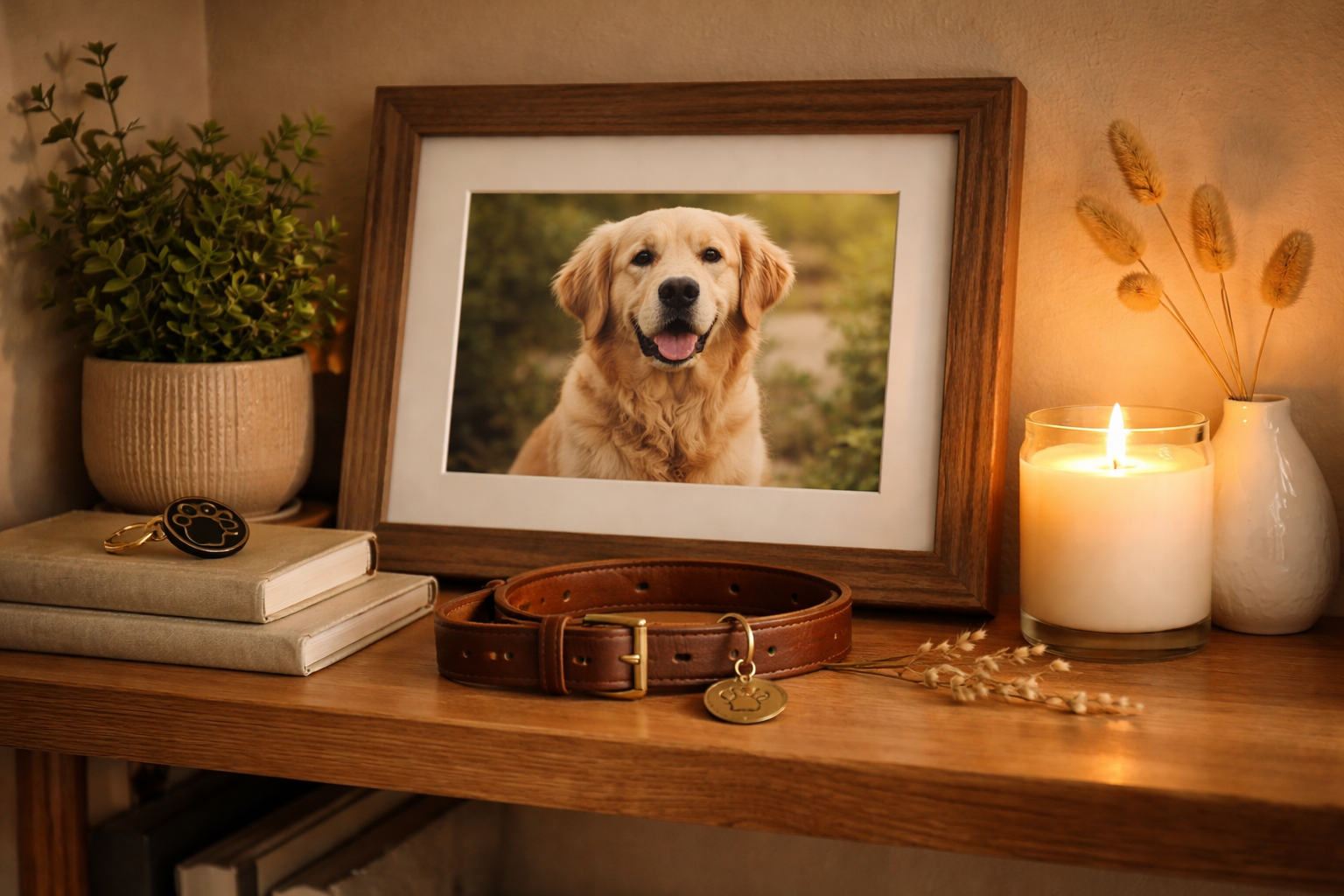
The shift came when I printed one photo—just one—and put it in a simple frame on my desk. Not hidden away in a drawer. Not relegated to my phone where I could avoid it. Right there, visible, part of my daily environment.
That single act changed something. The photo became less about loss and more about presence. Charlie's physical body was gone, but his place in my life remained. The photo honored that truth.
If you're navigating life after losing your heart dog, you might be wondering how to integrate their memory into your home without turning your space into a shrine or triggering constant heartbreak. Let me walk you through practical ways to display memorial photos that honor your dog's legacy while supporting your healing.
The Psychology of Visual Memorials
Before we dive into the practical how-to, let's talk about why displaying photos matters for grief processing.
Continuing Bonds Theory: Modern grief psychology recognizes that healthy healing doesn't require cutting ties with who you've lost. Instead, it involves finding appropriate ways to maintain connection while moving forward. Visual reminders—photos, art, keepsakes—are one way to maintain those bonds.
Environmental Cues for Memory: Our homes are full of triggers, especially after losing a pet. The food bowl you removed, the empty bed, the walk you no longer take. Intentionally placed memorial photos create positive environmental cues instead of just painful absences.
Integration vs. Avoidance: Avoiding all reminders of your dog might provide short-term relief but can complicate grief long-term. Thoughtfully integrating their image into your space allows your brain to process the loss while honoring the love.
Permission to Remember: For many people, especially those whose social circles minimize pet loss, displaying photos is an act of defiance. It says: this grief matters, this love mattered, and I will not hide it.
Choosing Which Photos to Display
Not every photo serves the same purpose in grief. Some capture joy. Others capture the end. Both have value, but they belong in different spaces.
Photos That Celebrate Life
These are the images where your dog looks healthy, happy, engaged. Maybe they're mid-run, tongue out, eyes bright. Maybe they're curled up contentedly, or giving you that look that made you laugh. These photos remind you of who they were at their best.
Best placement: Common areas where you spend time daily—living room, kitchen, office, bedroom.
Why: These images support continuing bonds without triggering acute grief responses. You're remembering joy, not loss.
Photos That Acknowledge the End
Images from your dog's final days or hours can be precious, but they're harder to see repeatedly. A photo of your dog's last moments might be sacred to you, but seeing it every day in your kitchen might not serve your healing.
Best placement: Private spaces like inside a memory box, in a journal, or in a private photo album you can access when you choose.
Why: These images deserve honor but don't need constant visibility. They're for intentional remembering, not daily triggers.
Photos That Tell the Story
Consider creating a small display that shows your dog's life arc—puppy photo, adult photo, senior photo. This acknowledges the full journey, not just the ending.
Best placement: A dedicated shelf or wall space where you can see the progression.
Why: Grief can collapse time, making it feel like all you remember is the loss. A timeline display helps you hold the fullness of your dog's life.
Display Options: From Simple to Elaborate
How you choose to display photos depends on your space, budget, aesthetic preferences, and where you are in your grief journey. Here are options across that spectrum.
Single Frame: The Starting Point
Sometimes one perfect photo in one simple frame is enough. This is where I started with Charlie's photo—a 5x7 frame on my desk. Nothing fancy. Just present.
Recommended frames: Look for simple, quality frames that don't compete with the photo. Wood, metal, or simple black frames work well. Avoid overly ornate frames unless that's your aesthetic.
[When you have your affiliate link, insert here: Search Amazon for "5x7 picture frames simple"]
Where to place: Anywhere you spend time. Your desk, bedside table, living room shelf, kitchen counter. Trust your instincts about what feels right.
Gallery Wall: Multiple Memories
A gallery wall lets you display multiple photos in varying sizes, creating a visual story. This works especially well if you have many favorite photos and want to honor different life stages or moments.
What you'll need:
Multiple frames in coordinating styles (all black, all wood, or intentionally mismatched)
Picture hanging kit with level and hooks
Layout plan (lay frames on the floor first to test arrangements)
[When you have your affiliate link, insert here: Search Amazon for "picture frame set gallery wall"]
[When you have your affiliate link, insert here: Search Amazon for "picture hanging kit level"]
Layout tip: Start with your largest or most important photo as the anchor, then build around it. Maintain 2-3 inches of space between frames for visual breathing room.
Shadow Box: Three-Dimensional Memory
Shadow boxes let you combine photos with three-dimensional items—collar, tags, a favorite toy, paw print. These create depth and texture that flat photos can't achieve.
Look for shadow boxes with at least 2-3 inches of depth. Some have backing you can pin items to; others have shelves.
[When you have your affiliate link, insert here: Search Amazon for "deep shadow box display case"]
What to include:
One or two photos (don't overcrowd)
Collar and tags
A small toy or memento
Written name and dates (optional)
Paw print impression (if you have one)
Where to hang: Shadow boxes are statement pieces. Choose a prominent wall where they'll be seen but not constantly passed (avoiding hallway traffic areas helps prevent accidental bumping).
Digital Display Frame: Rotating Memories
If you have dozens or hundreds of photos and can't choose favorites, a digital photo frame lets you rotate through images. Set it to change photos every few hours or daily.
Considerations:
Choose frames with good resolution (at least 1080p)
Easy upload process (WiFi connectivity or simple USB transfer)
Customizable timing (you control how often photos change)
[When you have your affiliate link, insert here: Search Amazon for "digital photo frame wifi"]
Best for: People who find comfort in variety, who want to see different facets of their dog's personality, or who have so many cherished photos that choosing just a few feels impossible.
Canvas Prints: Artistic Presence
Canvas prints transform photos into art pieces. They have a softer, more integrated look than photos in frames, and they work well for larger displays.
You can upload your photos to printing services through Amazon or other vendors. Choose gallery-wrapped canvas (the image wraps around the edges) for a finished look without needing a frame.
[When you have your affiliate link, insert here: Search Amazon for "canvas print custom photo" or look for printing services]
Size guidance:
8x10 or 11x14 for smaller spaces
16x20 or 20x30 for statement pieces
Multiple smaller canvases can create a cohesive grouping
Floating Shelves: Flexible Display
Floating shelves give you flexibility to rearrange, add items, or change photos without hammering new holes in your wall. You can include framed photos alongside candles, plants, or other memorial items.
[When you have your affiliate link, insert here: Search Amazon for "floating shelves wall mounted"]
Styling tip: Vary heights and depths. Lean some frames against the wall, stand others upright. Add dimension with other objects—a plant, a candle, a small decorative box.
Lit Displays: Gentle Illumination
Adding subtle lighting to your photo displays can create a gentle, reverent feeling. Picture lights mounted above frames or LED strip lights behind shelves add warmth without being overwhelming.
[When you have your affiliate link, insert here: Search Amazon for "picture light LED battery"]
Why lighting matters: Soft lighting draws attention without harshness. It can make evening moments with your memorial display feel sacred and intentional rather than just functional.
Beyond Standard Photos: Creative Display Options
If you want something beyond traditional framed photos, consider these alternatives:
Custom Memorial Art
Transforming your dog's photo into artistic renderings—painterly, watercolor, or stylized digital art—can create memorial pieces that feel less like documentation and more like celebration.
At K9 Hearts, we specialize in creating Legacy Art that honors your dog's memory through custom artistic portraits. Our signature Forest Healing Portrait places your dog in a peaceful forest setting, creating an image that brings comfort rather than triggering acute grief.
[INSERT LINK: https://www.k9hearts.com/healing-legacy-art]
Photo Books as Coffee Table Display
A professionally printed photo book gives you space for dozens of photos plus written memories, stories, and tributes. It becomes both memorial and keepsake, something you can flip through when you choose.
These work well as coffee table books—visible but not always open, available when you want connection.
[When you have your affiliate link, insert here: Search Amazon for "photo book printing services" or check options through Amazon Photos]
Engraved Photo Plaques
Metal or wood plaques with engraved photos create a different aesthetic than paper prints. The image is literally etched into the material, giving it permanence and weight.
[When you have your affiliate link, insert here: Search Amazon for "custom photo plaque engraved"]
Placement Strategies: Where Photos Belong
The "where" matters as much as the "how." Here's guidance on thoughtful placement:
High-Traffic Areas
Photos in spaces you pass through frequently (hallways, stairways, entryways) create brief moments of connection throughout your day. These should be photos that bring comfort, not photos that trigger acute grief.
Best for: Celebratory life photos, not end-of-life images.
Private Spaces
Your bedroom or private office allows for more emotionally complex displays. These are spaces where tears are okay, where you can sit with grief without audience.
Best for: Shadow boxes with collars, more intimate photos, displays that include written tributes.
Communal Spaces
Living rooms and kitchens where guests gather require different considerations. You're not hiding your dog's memory, but you're also creating space where conversation can flow without everyone feeling obligated to discuss your loss.
Best for: Beautiful artistic prints, single statement photos, displays that honor without demanding emotional response from viewers.
When to Create Your Display
There's no "right time" to display memorial photos. Some people do it immediately. Others wait months. I waited until seeing Charlie's photo shifted from painful to comforting—about six weeks for me, but your timeline may be entirely different.
Trust yourself. If looking at photos still feels too raw, that's okay. Keep them safe, and return when you're ready. If you need your dog's presence visible immediately, that's equally valid. Your grief, your timeline.
A Practical Note on Print Quality
If you're printing photos yourself or ordering prints online, quality matters for longevity:
Use high-resolution images (at least 300 dpi for clear prints)
Print on archival-quality photo paper if printing at home
For professional prints, check reviews and order samples first
Store backup digital copies in multiple locations
Your dog's image deserves quality that will last.
Final Thoughts on Visual Memory
Displaying your dog's photos isn't about living in the past. It's about integrating who they were into who you're becoming. The love doesn't disappear. The bond doesn't sever. The photos just remind you that what you shared still matters.
Charlie's photo sits on my desk as I write this. Some days I glance at it and smile. Other days I look longer, feeling the ache. Both responses are right. Both honor what we had.
Your memorial display, however you create it, becomes a touchstone—a visible reminder that your heart dog walked through your life and changed everything. That deserves to be seen.
About K9 Hearts Memorial Services
Based in Port Orchard, Washington, K9 Hearts offers compassionate grief support and healing legacy art specifically designed for those navigating the loss of a beloved dog. Founded by Paige, who holds a B.S. in Psychology and M.A. in Forensic Psychology with nearly 30 years of experience in crisis counseling and trauma support, K9 Hearts combines professional expertise with deep personal understanding of pet loss grief.
Learn more at www.k9hearts.com
Essential Comfort Items for Anticipatory Grief: Supporting Yourself While Your Dog Is Still Here
Anticipatory grief is its own unique suffering. Discover practical comfort items and self-care tools that provide relief when you're grieving while your dog is still alive and facing impossible decisions.
The grief before the loss is a strange, suspended space that few people talk about. You're watching your dog decline, making impossible decisions, and grieving while they're still lying next to you. It's exhausting in ways that are hard to explain to people who haven't been there.
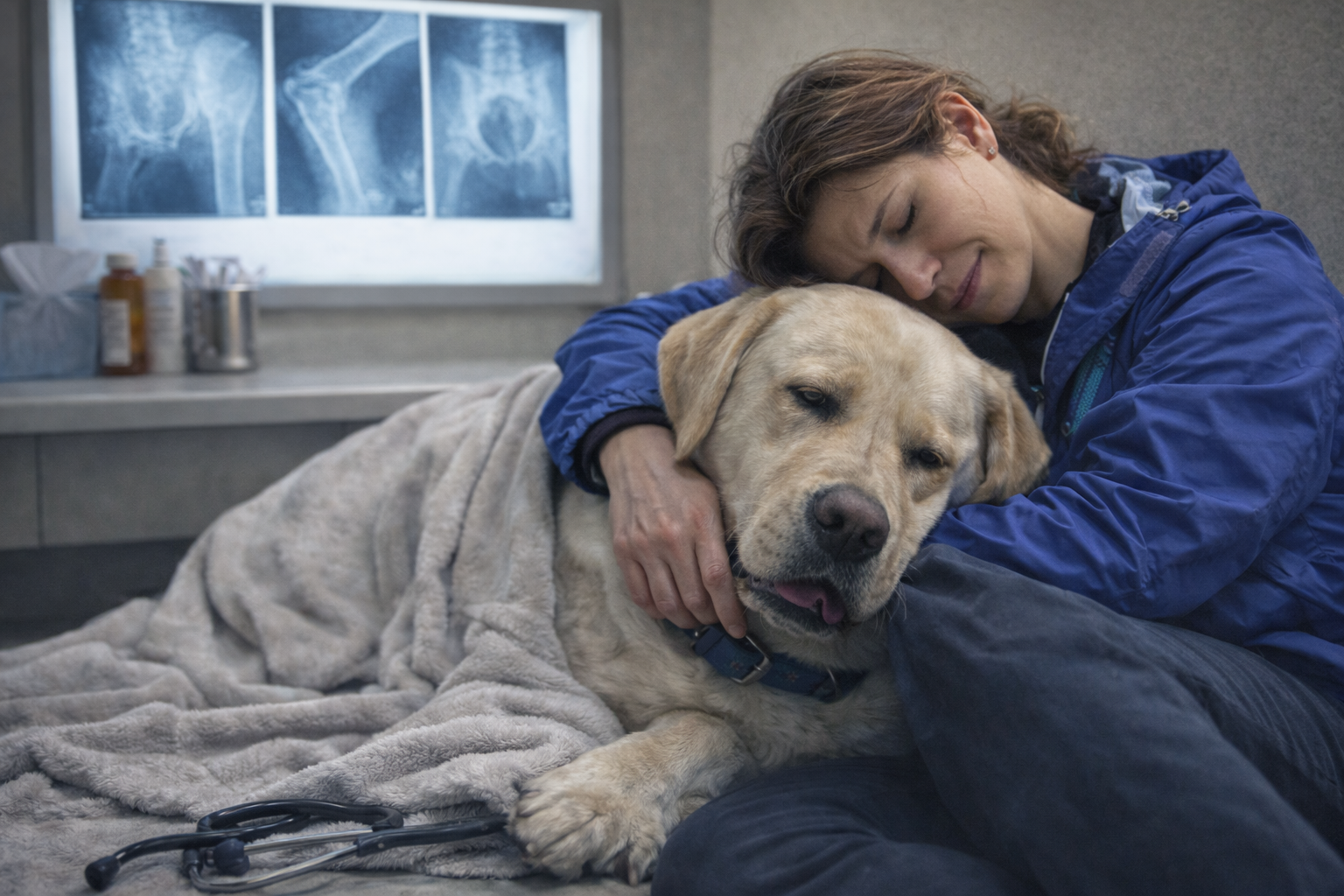
When Charlie's diagnosis came—osteochondritis dissecans, degenerative joint disease, bilateral hip dysplasia, elbow dysplasia—I knew we were on borrowed time. He was only three years old, and all four of his legs were compromised. Every morning I woke up assessing: Is today the day? Does he still have quality of life? Am I holding on too long or giving up too soon?
This is anticipatory grief, and it's its own unique form of suffering. You're grieving the future you thought you'd have while trying to be present for the time you have left. You're emotionally depleted but can't rest because your dog still needs you.
If you're in this space right now, this post is for you. Let me share some practical comfort items that can help support you through this tender, brutal time—not because they'll make it easy (nothing can), but because small acts of self-care matter when everything feels impossible.
Understanding Anticipatory Grief
Before we talk about comfort items, let's acknowledge what you're experiencing. Anticipatory grief isn't "practice grief" or a head start on processing. It's its own distinct experience with unique challenges.
You're grieving multiple losses simultaneously: The loss of your dog's health, the future you imagined, your daily routines, your sense of control, and eventually, your dog themselves.
You're in decision fatigue: Every day requires assessments, choices, and second-guessing. Quality of life scales, medication decisions, euthanasia timing. Your brain is exhausted from constant evaluation.
You're emotionally whiplashed: One moment your dog seems okay and you feel guilty for considering euthanasia. The next moment they're clearly suffering and you feel guilty for not acting sooner. There's no winning.
You're socially isolated: Many people don't understand why you're grieving a dog who's still alive. "At least you still have time together!" they say, not realizing that time is colored by constant fear and impending loss.
This is hard. You need support. Let's talk about practical tools that can help.
Comfort Items for Your Physical Body
Grief lives in your body, not just your mind. When you're in anticipatory grief, your nervous system is likely in a state of chronic stress. These items can provide small moments of physical relief.
Weighted Blankets for Anxiety Relief
Weighted blankets provide deep pressure stimulation, which can calm your nervous system. When you're lying awake at 3am worrying whether tomorrow is the day, or sitting with your dog and feeling overwhelmed, the gentle pressure can help regulate your emotions.
Look for blankets that are about 10% of your body weight. They shouldn't feel restrictive—just gently grounding.
[When you have your affiliate link, insert here: Search Amazon for "weighted blanket adults anxiety"]
Heating Pads for Tension Relief
Anticipatory grief often manifests as physical tension—tight shoulders, jaw clenching, headaches. A heating pad you can use on your neck, shoulders, or back can provide relief when your body is holding so much stress.
Electric heating pads with automatic shut-off are safest, especially since exhaustion might make you forget to turn it off.
[When you have your affiliate link, insert here: Search Amazon for "heating pad shoulders neck"]
Comfortable Blankets for Sitting With Your Dog
You're likely spending a lot of time on the floor next to your dog, or curled up with them on their bed. Having a soft, washable blanket specifically for these moments can make the physical act of being present more comfortable.
Choose something machine washable since it will inevitably get dog hair and possibly other bodily fluids on it.
[When you have your affiliate link, insert here: Search Amazon for "soft washable throw blanket"]
Items for Emotional Regulation
These tools can help you manage the emotional overwhelm when it feels like too much.
Aromatherapy Diffusers and Calming Essential Oils
Scent directly affects your limbic system—the emotional center of your brain. Lavender, chamomile, and bergamot oils can help create a calming environment during this stressful time.
Choose ultrasonic diffusers over heat-based ones, and make sure oils are kept safely away from your dog (some essential oils are toxic to pets, so research before using).
[When you have your affiliate link, insert here: Search Amazon for "essential oil diffuser ultrasonic"]
[When you have your affiliate link, insert here: Search Amazon for "lavender essential oil pure"]
High-Quality Tissues
This sounds absurdly practical, but when you're crying multiple times a day, having soft tissues instead of scratchy ones matters. Your face will thank you.
Look for tissues with lotion or aloe. Stock them everywhere—your car, your nightstand, your dog's favorite spot, your bag.
[When you have your affiliate link, insert here: Search Amazon for "tissues with lotion bulk"]
Journals for Processing
Writing can help externalize some of what you're carrying. You don't need fancy prompts—sometimes just dumping thoughts onto paper creates relief.
If you want more structure, consider a grief journal specifically designed for anticipatory grief. My journal, Charlie's Last Walk, includes an entire section dedicated to this pre-loss period because it's so often overlooked.
[INSERT LINK: https://a.co/d/5eYkH7U]
Items That Honor the Time You Have Left
These aren't strictly "comfort" items for you, but they can bring meaning to this difficult time.
A Memory Book or Photo Album
Consider creating a memory book while your dog is still with you. Gather photos from throughout their life. Write down the stories, the nicknames, the quirks. This can be part of your grief processing and also a keepsake for after.
Choose archival-quality albums if you want the book to last long-term.
[When you have your affiliate link, insert here: Search Amazon for "photo album archival quality"]
Paw Print Kit
If you don't already have your dog's paw print, now is the time. These clay impression kits are easy to use and create a lasting keepsake. Some people do this while their dog is still healthy-ish. Others wait until closer to the end. There's no wrong timing.
[When you have your affiliate link, insert here: Search Amazon for "pet paw print kit clay"]
A Special Blanket or Toy for Your Dog
Sometimes providing comfort for your dog also comforts you. A new soft blanket for their bed or a gentle toy they can still enjoy (if they're able to play) can feel like a small way of showing love during this time.
Self-Care Essentials When You're Running on Empty
You're likely neglecting yourself while caring for your dog. These items can make basic self-care slightly easier.
Herbal Tea for Soothing Moments
When you finally sit down after a long day of caregiving and decision-making, having a soothing tea ritual can create a small pocket of calm. Chamomile, valerian root, or lavender-infused teas can help you relax.
Caffeine-free options are better for evenings, especially if sleep is already difficult.
[When you have your affiliate link, insert here: Search Amazon for "herbal tea sampler caffeine free"]
Bath Products for Self-Care
A warm bath might be one of the few times you can truly relax. Bath salts with Epsom salt and essential oils, or even just a nice bubble bath, can provide physical and emotional relief.
[When you have your affiliate link, insert here: Search Amazon for "bath salts lavender epsom"]
Sleep Support Items
Grief and stress often disrupt sleep. Consider a white noise machine or a sleep mask to help create better conditions for rest when you can manage it.
[When you have your affiliate link, insert here: Search Amazon for "white noise machine sleep"]
What You Really Need (Beyond Things You Can Buy)
Here's the truth: No product on Amazon will make anticipatory grief easier. These items might provide moments of comfort or small doses of relief, but they can't fix what's happening.
What you really need—and what's much harder to find—is permission. Permission to grieve before the loss. Permission to make the decision that feels right even when it feels impossible. Permission to rest even though your dog still needs you. Permission to break down, to be angry, to question everything.
You also need people who understand. If you don't have that in your immediate circle, consider joining online support groups specifically for pet loss. The validation of someone saying "yes, this is as hard as it feels" can matter more than any comfort item.
Additional Support Resources
Beyond physical comfort items, consider these resources:
If you need structured support for processing this anticipatory grief, my guided journal includes prompts specifically for this pre-loss period. It acknowledges the unique pain of grieving while your dog is still with you.
[INSERT LINK: https://a.co/d/5eYkH7U]
If you want to honor your dog's memory in a way that celebrates their life, K9 Hearts creates custom memorial art. Some people commission these pieces while their dog is still alive, as a way of honoring them. Others wait until after. There's no right timing.
[INSERT LINK: https://www.k9hearts.com/healing-legacy-art]
A Final Thought
You're doing the hardest thing. You're loving your dog through their decline, making impossible decisions, and trying to be present while grieving the future you're losing. That takes extraordinary strength.
Be gentle with yourself. Use whatever tools help—whether that's a weighted blanket, a journal, a cup of tea, or just sitting on the floor with your dog and crying. All of it counts. All of it matters.
Charlie taught me that the love we give in the hardest moments is the love that shapes us most deeply. You're in one of those moments now. Feel it, honor it, and know that whatever you're feeling is exactly right for you.
About K9 Hearts Memorial Services
Based in Port Orchard, Washington, K9 Hearts offers compassionate grief support and healing legacy art specifically designed for those navigating the loss of a beloved dog. Founded by Paige, who holds a B.S. in Psychology and M.A. in Forensic Psychology with nearly 30 years of experience in crisis counseling and trauma support, K9 Hearts combines professional expertise with deep personal understanding of pet loss grief.
Learn more at www.k9hearts.com
Creating a Memory Box for Your Heart Dog
Learn how to create a meaningful memory box for your heart dog with this compassionate guide. Includes psychological insights, step-by-step instructions, and recommended materials for honoring your dog's legacy during grief.
When Charlie Brown passed away at just three years old, I found myself drowning in a sea of grief with nowhere to anchor. As someone with a background in psychology and nearly 30 years working with families through crisis and loss, I knew intellectually that creating tangible memorials could help with grief processing. But knowing and doing are two different things when your heart is shattered.
One of the most healing practices I discovered was creating a memory box—a sacred space where I could keep Charlie's collar, his favorite toy, photos, and the countless small things that carried his presence. This wasn't just about storage. It was about intentionally creating a container for my grief, a place where love could live alongside loss.
If you're navigating the grief of losing your heart dog, or if you're in that tender space of anticipatory grief while your dog is still with you, creating a memory box can be a powerful healing ritual. Let me walk you through this process with both the psychological foundation and the practical steps.
Why Memory Boxes Matter: The Psychology Behind the Practice
From a therapeutic perspective, memory boxes serve several critical functions in grief processing:
Externalization of Grief: When grief feels overwhelming and abstract, having a physical container gives it boundaries. You're not trying to hold everything inside yourself. The box holds some of it for you.
Continuing Bonds: Modern grief theory recognizes that healing doesn't mean "letting go" or "moving on." It means finding ways to maintain a connection with those we've lost while also moving forward with our lives. A memory box honors this reality—your heart dog remains part of your story.
Sensory Connection: Grief lives in our bodies, not just our minds. Being able to touch your dog's collar, smell their blanket, or see their photo engages multiple senses and can actually help your nervous system process the loss more completely than words alone ever could.
Ritual and Intention: The act of creating the box itself becomes a ritual—a way of saying "this matters, you mattered, and I'm honoring what we had together."
What to Include in Your Memory Box
There's no right or wrong answer here. Your memory box should reflect your unique bond with your dog. That said, here are some items that many people find meaningful:
Physical Items From Your Dog
Collar and tags (hearing them jingle can be both painful and comforting)
A favorite toy or the last toy they played with
Their leash
A piece of their bedding or a blanket that still carries their scent
Fur clippings (if you have them)
Paw print impressions
Photos and Documentation
Favorite photos from different life stages
Veterinary records or medical cards (these tell the story of their life)
Adoption papers or registration documents
Cards or notes from friends and family after your dog's passing
Memory Items You Create
Letters you've written to your dog
Journal entries about specific memories
A list of all the silly nicknames you called them
Descriptions of their quirks and personality traits
Drawings or artwork inspired by them
Ceremonial Items
A candle you light when you open the box
Flowers or dried petals from their memorial service
A special stone or object from a meaningful place you walked together
Choosing the Right Memory Box
The container itself matters. This isn't just a cardboard box shoved in a closet (though if that's all you have, that's okay too—the contents matter more than the container). When you're ready, choosing a beautiful box can be part of the healing ritual.
Recommended Memory Boxes
For a Classic, Timeless Look:
A wooden memory box with a hinged lid offers durability and dignity. Look for boxes made from solid wood (not composite) that are large enough to hold multiple items but not so large they feel empty. Boxes measuring around 12" x 8" x 6" work well for most people. Many wooden boxes can be personalized with engraving later if you choose.
Click on the link to get this timeless memorial box on Amazon. https://a.co/d/0gl4zKp9
For a Decorative, Display-Worthy Option:
Shadow boxes serve double duty—they're memory boxes that can also be displayed on a wall or shelf. Choose one with enough depth (at least 2-3 inches) to hold three-dimensional items like collars and toys, not just photos. Shadow boxes with a hinged glass front let you see your treasures while keeping them protected.
[INSERT YOUR AMAZON AFFILIATE LINK: Search "deep shadow box hinged glass" on Amazon]
For Protecting Delicate Items:
If you're storing photos, letters, or other paper items in your memory box, consider adding acid-free tissue paper. This prevents yellowing and deterioration over time, ensuring these memories stay preserved. Archival quality matters when you're protecting something precious.
[INSERT YOUR AMAZON AFFILIATE LINK: Search "acid-free tissue paper archival" on Amazon]
For Paw Print Keepsakes:
If you don't already have a paw print, clay impression kits let you create one while your dog is still with you (if you're in anticipatory grief) or can sometimes be used shortly after passing. These become treasured additions to memory boxes. Look for non-toxic, easy-to-use clay that air-dries without baking.
[INSERT YOUR AMAZON AFFILIATE LINK: Search "pet paw print kit clay" on Amazon]
The Process: Making Your Memory Box a Healing Ritual
Creating a memory box isn't just about gathering items and putting them in a container. The way you approach this process matters. Here's how to make it truly therapeutic:
Step 1: Choose Your Timing
There's no "right time" to create a memory box. Some people do it immediately after their dog passes. Others wait weeks or months. Some create one while their dog is still alive, knowing the end is near. Trust your own timeline. If you're not ready, that's okay. The box will wait until you are.
Step 2: Create Space for Your Emotions
Set aside uninterrupted time when you won't be rushed. This isn't a task to squeeze in between errands. Light a candle, play music that feels right, make tea. Create an environment where tears are welcome and memories can surface without interruption.
Step 3: Gather Items Slowly
You don't have to complete your memory box in one sitting. In fact, it's often better if you don't. Gather items over days or weeks. Each item you add can be its own small ceremony of remembrance.
Step 4: Write As You Go
Consider keeping a notebook nearby. As you handle your dog's collar or look at photos, memories will surface. Write them down. These written memories can go in the box or become part of a companion journal where you process your grief more fully.
Step 5: Include Future Items
Your memory box isn't sealed forever. You can continue adding to it. Maybe you'll write a letter to your dog on the anniversary of their passing. Maybe a friend will send you a photo you didn't have. The box can grow as your grief transforms.
Storing and Accessing Your Memory Box
Where you keep your memory box is personal. Some people keep it on a bedroom shelf where they see it daily. Others tuck it away in a closet and bring it out when they need it. Neither approach is better—what matters is what serves your healing.
In the early days after Charlie died, I kept his box on my nightstand. I opened it almost every night. Over time, I moved it to a shelf in my office. Now I open it less frequently, but when I do, the ritual still matters. The grief has softened, but the love hasn't diminished.
If you have other pets or small children, consider where the box will be safe from curious paws or hands. This doesn't mean hiding it away in shame—grief deserves visibility—but protecting sacred items from accidental damage is practical self-care.
When the Box Isn't Enough: Additional Support
Creating a memory box is one tool in grief recovery, but it's not the only one you'll need. Grief is complex, non-linear, and deeply personal. Some days the box will bring comfort. Other days, even opening it feels too hard.
If you're finding that grief is overwhelming your daily functioning, or if you're struggling with decision fatigue about end-of-life choices, consider working through a structured grief journal specifically designed for pet loss. I created Charlie's Last Walk: A Guided Journal for Pet Loss based on evidence-based grief models and my own experience losing Charlie. It walks you through the messy, non-linear reality of pet loss grief with compassion and psychological grounding.
Additionally, if you want to honor your dog's memory in a way that brings more beauty into your daily environment, custom memorial portraits can complement your memory box beautifully. At K9 Hearts, we create Legacy Art that celebrates the joy your dog brought to your life, not just the sadness of their absence.
Your custom memorial portraits can be kept in a frame with their collar. https://a.co/d/06MsxZCY
A Final Thought on Healing
Your memory box is not about "getting over" your grief or "moving on" from your dog. It's about creating a sacred container where love and loss can coexist. It's about giving yourself permission to remember, to grieve, and to honor the profound bond you shared.
Charlie taught me that heart dogs don't leave us—they simply walk ahead, clearing the path with love. Your memory box is a way of keeping that path visible, of remembering that the love you shared still matters, still counts, still shapes who you are.
Take your time with this. Be gentle with yourself. And remember that grief is love that has nowhere to go. The memory box gives it somewhere to live.
About K9 Hearts Memorial Services
Based in Port Orchard, Washington, K9 Hearts offers compassionate grief support and healing legacy art specifically designed for those navigating the loss of a beloved dog. Founded by Paige, who holds a B.S. in Psychology and M.A. in Forensic Psychology with nearly 30 years of experience in crisis counseling and trauma support, K9 Hearts combines professional expertise with deep personal understanding of pet loss grief.
Learn more at www.k9hearts.com
The Best Journals for Pet Loss Grief: Finding Your Healing Companion
Choosing the right grief journal matters. Compare different approaches to pet loss journaling, understand what makes a journal truly therapeutic, and find the companion that fits your healing journey.
When I sat down to write after losing Charlie, I discovered something surprising: most grief journals weren't designed for the reality of pet loss. They either treated it like a minor disappointment or assumed grief followed a neat, linear path from denial to acceptance. Neither reflected what I was actually experiencing.
As someone with a background in psychology and nearly 30 years working with families through trauma and loss, I knew better. Grief doesn't move in straight lines. Pet loss grief, in particular, carries its own unique challenges—disenfranchised grief, decision fatigue around end-of-life care, and the physical void left when your daily routine suddenly has a dog-shaped hole in it.
If you're looking for a grief journal to help you process the loss of your dog, you need one that understands these realities. Let me walk you through what to look for, review different approaches, and help you find the right companion for your healing journey.
Why Journaling Helps With Pet Loss Grief
Before we talk about specific journals, let's address why journaling matters in grief recovery. This isn't just about "writing your feelings down"—there's actual psychological research supporting this practice.
Narrative Processing: When you write about traumatic or emotionally overwhelming experiences, you're helping your brain organize and make sense of what happened. Grief can feel chaotic and fragmented. Writing creates coherence.
Externalization: Getting thoughts and feelings onto paper literally moves them outside of you. This doesn't make them disappear, but it can create psychological space and relief from the constant internal churning.
Tracking the Non-Linear Path: One of the most validating aspects of journaling is being able to look back and see your own patterns. You realize you're not "failing" at grief—you're spiraling through it, which is exactly how it works.
Continuing Bonds: Modern grief therapy recognizes that healing doesn't mean severing the connection with who or what you lost. Journaling lets you maintain that bond while also moving forward with your life.
What to Look for in a Pet Loss Grief Journal
Not all grief journals are created equal. Here's what actually matters when you're choosing one:
Evidence-Based Structure
Look for journals that reference actual grief models—Worden's Tasks of Mourning, Kübler-Ross's stages (but understood as non-linear), or Continuing Bonds theory. Be wary of journals that promise to "move you through" grief in a set timeframe. Grief doesn't work on schedules.
Pet-Specific Content
Generic grief journals don't address the unique aspects of losing a pet: decision-making around euthanasia, anticipatory grief while your dog is still alive, the physical absence in your daily routine, or the social dismissal many people face ("it was just a dog"). Your journal should acknowledge these realities.
Non-Prescriptive Prompts
The best journals offer prompts as invitations, not commands. If a prompt doesn't resonate, you should feel free to skip it or adapt it. Rigid journal structures can add stress when you're already overwhelmed.
Space for Non-Linear Processing
Your journal should allow you to jump around, revisit earlier themes, and circle back to emotions you thought you'd "finished with." Grief isn't linear. Your journal shouldn't be either.
Types of Grief Journals: Different Approaches
Let me walk you through the main categories of pet loss journals available, so you can understand which approach might work best for you.
Guided Journals with Structured Prompts
These journals provide specific questions or writing prompts to help you explore different aspects of your grief. They're helpful if you find blank pages intimidating or if you're not sure where to start.
Best for: People who want direction and structure, those new to journaling, or anyone who feels overwhelmed by open-ended writing.
Watch out for: Journals that are too rigid or prescriptive. You want guidance, not rules.
Many guided journals for pet loss are available on Amazon with varying approaches. Look for ones with good reviews that specifically mention feeling "understood" or "validated" rather than just "helpful."
[When you have your affiliate link, insert here: Search Amazon for "pet loss grief journal guided prompts"]
Memory and Remembrance Journals
These focus primarily on recording memories, stories, and details about your dog's life. They're less about processing grief emotions and more about celebration and preservation.
Best for: People who want to honor their dog's legacy, those who find comfort in remembering happy times, or anyone creating a keepsake for family members.
Watch out for: If you're in acute grief, purely celebratory journals might not give you space to process the harder emotions. They work better as supplements to other grief work.
[When you have your affiliate link, insert here: Search Amazon for "pet memorial journal memories"]
Combination Journals: Memory Plus Processing
Some journals blend both approaches—space for memories alongside prompts for emotional processing. This can be powerful because you're honoring both the joy your dog brought and the grief their loss has left.
Best for: Most people, honestly. The combination approach mirrors the reality that grief and love coexist.
Therapeutic Workbooks
These are more intensive, often based on specific therapeutic models like CBT or narrative therapy. They include exercises, worksheets, and structured activities beyond just journaling prompts.
Best for: People who want a deeper dive, those comfortable with psychological frameworks, or anyone who has found therapy helpful in the past.
Watch out for: These can feel clinical if that's not your preference. Make sure the tone resonates with you before committing.
[When you have your affiliate link, insert here: Search Amazon for "pet loss grief workbook therapy"]
What Makes Charlie's Last Walk Different
I created Charlie's Last Walk: A Guided Journal for Pet Loss specifically because I couldn't find what I needed when I lost Charlie. Here's what makes it different:
Non-Linear by Design: The journal follows the emotional arc of Charlie's story, which means you'll encounter acceptance before denial, hope mixed with devastation, and guilt revisited multiple times. This mirrors how grief actually works, not how we wish it worked.
Grounded in Evidence: Every prompt is informed by established grief theory—Worden's Tasks, Continuing Bonds, and understanding of complicated grief. But I translated the academic framework into compassionate, accessible language.
Anticipatory Grief Included: There's an entire section dedicated to the time before loss, when you're watching your dog decline and making impossible decisions. Most journals skip this entirely.
Excerpt-Based Prompts: Each prompt is preceded by an excerpt from my memoir about losing Charlie. You're not journaling in isolation—you're walking alongside someone who has been exactly where you are.
Permission to Spiral: The journal explicitly gives you permission to skip prompts, return to earlier sections, and move through it in whatever order serves your healing. There's no "wrong way" to use it.
The journal is available on Amazon in paperback, with a digital interactive PDF coming soon.
[INSERT LINK: https://a.co/d/5eYkH7U]
Supporting Your Journal Practice: Additional Tools
Journaling itself is powerful, but a few simple additions can enhance the practice:
Quality Pens That Feel Good to Write With
This might sound minor, but the physical act of writing matters. Using a pen that glides smoothly across the page can make journaling feel less like a chore and more like a ritual. Look for gel pens or rollerballs in comfortable weights.
[When you have your affiliate link, insert here: Search Amazon for "smooth gel pens journaling"]
A Reading Stand or Pillow
If you're working through a guided journal, having a stand to hold it open can reduce physical strain. Grief is exhausting enough—your body doesn't need extra stress from hunching over a closed book.
[When you have your affiliate link, insert here: Search Amazon for "book stand reading pillow"]
A Meaningful Bookmark
Something small, but choosing a bookmark that feels significant—maybe with an inspirational quote or an image that resonates—can make returning to your journal feel like coming back to a sacred space.
[When you have your affiliate link, insert here: Search Amazon for "inspirational bookmarks grief"]
A Dedicated Space
Consider creating a small journaling corner in your home. This doesn't have to be elaborate—a comfortable chair, good lighting, maybe a candle. Having a consistent place to write can signal to your brain that this is protected time for processing.
When to Journal and When to Rest
Here's something important: you don't have to journal every day. Some grief educators will tell you consistency matters, and that's true to an extent. But forced journaling when you're not ready can create resistance.
Listen to your body and emotions. Some days you'll need to write. Other days you'll need to sleep, walk, stare out the window, or just be. All of those are valid parts of grief.
The journal will be there when you're ready. Grief doesn't have a deadline.
Beyond Journaling: Additional Support
Journaling is one tool in grief recovery, but it's not the only one. If you're finding that writing alone isn't enough, consider:
Memorial art that brings beauty into your daily environment while honoring your dog's memory. At K9 Hearts, we create custom Legacy Art that celebrates the joy your dog brought to your life.
[INSERT LINK: https://www.k9hearts.com/healing-legacy-art]
Support groups specifically for pet loss, where you can connect with others who understand the magnitude of this grief.
Professional counseling, particularly with therapists who specialize in grief and loss. There's no shame in needing additional support.
A Final Word on Finding Your Journal
The "best" journal is the one you'll actually use. Trust your instincts. If you flip through a journal and it resonates, that matters more than any expert recommendation.
Your grief is unique. Your healing path will be too. The journal that serves you might not be the one that serves someone else, and that's exactly as it should be.
Charlie taught me that healing isn't about "getting over" grief—it's about learning to carry it with grace. The right journal can be a companion on that journey, holding space for both your sorrow and your love.
About K9 Hearts Memorial Services
Based in Port Orchard, Washington, K9 Hearts offers compassionate grief support and healing legacy art specifically designed for those navigating the loss of a beloved dog. Founded by Paige, who holds a B.S. in Psychology and M.A. in Forensic Psychology with nearly 30 years of experience in crisis counseling and trauma support, K9 Hearts combines professional expertise with deep personal understanding of pet loss grief.
Learn more at www.k9hearts.com