
If you have ever lost a dog and found yourself wondering whether you were overreacting — whether the depth of your pain was somehow embarrassing or excessive — you are not alone. Millions of people ask themselves this same question every year, often in silence, because our culture has not given them permission to grieve openly.
The answer, backed by decades of research, is clear: yes. Pet loss grief is real. It is measurable. It is neurological. And for many people, it is one of the most profound losses they will ever experience.
This post walks through what science actually says — so that the next time someone tells you "it was just a dog," you have more than your broken heart to point to.
Your Brain Does Not Know the Difference
The first thing to understand is that grief is not a choice. It is a biological response to losing an attachment figure — and your brain does not distinguish between species when it comes to forming those attachments.
What Brain Imaging Reveals About the Bond
When we love a dog deeply, it can feel instinctive — almost biological. Research suggests that in many ways, it is.
In a functional MRI study conducted at Massachusetts General Hospital and Harvard Medical School, researchers looked at what happened in the brains of mothers when they viewed photographs of their own child and their own dog. What they found was quietly remarkable. When mothers viewed images of their own dog, key attachment and reward-related brain regions activated — the same regions that respond when they viewed their own child.
Two of those shared regions are worth understanding:
The Amygdala — the part of the brain that processes emotional significance and attachment-related responses. When you feel a surge of love watching your dog sleep, or a wave of protectiveness when something startles them, this is part of what is happening.
The Substantia Nigra / Ventral Tegmental Area (SN/VTA) — the brain's dopamine-based reward circuitry, associated with bonding, caregiving motivation, and deep attachment. This is the same system involved in parental love.

Stoeckel, L. E., Palley, L. S., Gollub, R. L., Niemi, S. M., & Evins, A. E. (2014). Patterns of brain activation when mothers view their own child and dog: An fMRI study. PLOS ONE, 9(10), e107205. https://doi.org/10.1371/journal.pone.0107205
The researchers were careful to note that loving a dog and loving a child are not identical experiences. But what this study shows is something both simpler and more meaningful for anyone who has ever felt the depth of this bond: some of the same neural circuits the brain uses for its closest human attachments also engage when we look at the face of our own dog.
The attachment was not imagined. It was neurologically real.
The Oxytocin Bond: The Biology of Mutual Gaze
A separate line of research helps explain how that attachment deepens over time — through something as simple and ordinary as looking into each other's eyes.
In a 2015 study published in Science, researchers examined what happens biologically when dogs and their owners share mutual gaze. When dogs and their humans looked into each other's eyes, oxytocin levels rose in both — human and dog alike.
Oxytocin is often called the bonding hormone. It plays a well-established role in the attachment between parents and infants. In this study, eye contact between a dog and their owner triggered a remarkably similar feedback loop: the more oxytocin rose in the human, the more affiliative the dog became — which in turn released more oxytocin in the human.

Nagasawa, M., Mitsui, S., En, S., et al. (2015). Oxytocin-gaze positive loop and the coevolution of human-dog bonds.Science, 348(6232), 333–336. https://doi.org/10.1126/science.1261022
Every walk. Every quiet evening on the couch. Every moment your dog rested their head in your lap and looked up at you. Each one of those interactions was reinforcing this loop — deepening an attachment that was woven not just into memory, but into your body's own chemistry.
This was not a brain imaging study. It did not measure neural activation. What it demonstrated was something equally powerful: a biological bonding mechanism — mutual, reinforcing, and real — built between dogs and their humans through the accumulated weight of everyday life together.
Why Both Studies Matter for Grief
Together, these two pieces of research describe something that grieving dog owners have always felt but rarely been given language for.
One shows that attachment and reward-related brain circuitry activates when we look at our own dog — the same circuitry involved in our deepest human bonds. The other shows that a biological oxytocin feedback loop is quietly reinforced through every shared glance, every touch, every ordinary moment of connection over years of life together.
Neither study claims that dogs replace people. Neither suggests all relationships are equal. What they show is something both simpler and more profound: the human brain and body are fully capable of forming deep, biologically supported attachments to the dogs in their lives.
When that bond is broken by loss, the grief that follows is not an overreaction. It is a reflection of the depth of what was real.
For many people, their dog was not "just a pet." The relationship was woven into emotional memory, daily ritual, and thousands of quiet exchanges that build a life together.
Science does not diminish that. It quietly confirms it.
What the Research Says About Grief Intensity
A peer-reviewed study published in Death Studies directly compared grief severity in people who had lost a pet versus those who had lost a person. While human loss scores were slightly higher, the effect sizes were small — and for both groups, the strongest predictor of grief intensity was not the species of the deceased. It was the closeness of the bond. ¹
A 2024 nationally representative study from the United Kingdom found that one in five people who had experienced both a pet loss and a human loss identified the death of their pet as the more distressing of the two. ²
That is not a small or unusual finding. It reflects something that grief researchers have been documenting for years: the purity of the human-dog relationship — uncomplicated by history, conflict, or expectation — can make its loss feel especially acute. There is nothing between you and the love. And so there is nothing between you and the loss.
The Problem Has a Name: Disenfranchised Grief
Despite what science tells us, many people who lose a dog are met with dismissal rather than support. Psychologists have a specific term for this: disenfranchised grief — grief that is not openly acknowledged, publicly mourned, or socially validated.
Research focusing on North American pet owners shows that roughly one in three people experience disenfranchised grief after losing a pet. With over 38,000 people in the U.S. losing a pet every single day, that means more than 12,000 people daily are navigating profound loss without acknowledgment or support. ³
What makes disenfranchised grief particularly painful is not just the loss itself — it is losing the loss twice. First your dog dies. Then the people around you tell you, directly or indirectly, that it should not hurt this much. That compounded isolation can actually intensify and prolong grief beyond what it would have been with proper support.
So Why Does Society Still Dismiss It?
The dismissal of pet loss grief is cultural, not scientific. It stems from a long-standing hierarchy of loss — an unwritten social rulebook that decides which grief is "worthy" and which is not.
But that is changing. A 2024 study published in PLOS One specifically tested whether Prolonged Grief Disorder — a recognized psychiatric diagnosis — can occur following the death of a pet. The data showed that it can, and the researchers called for diagnostic guidelines to be updated to reflect this reality. ⁴
The science is catching up to what grieving dog owners have always known. The culture just needs more time — and more people willing to say it out loud.
What Science Shows About Pet Loss Grief
Grief after losing a dog is not rare. It is not dramatic. It is not "just a bad week."
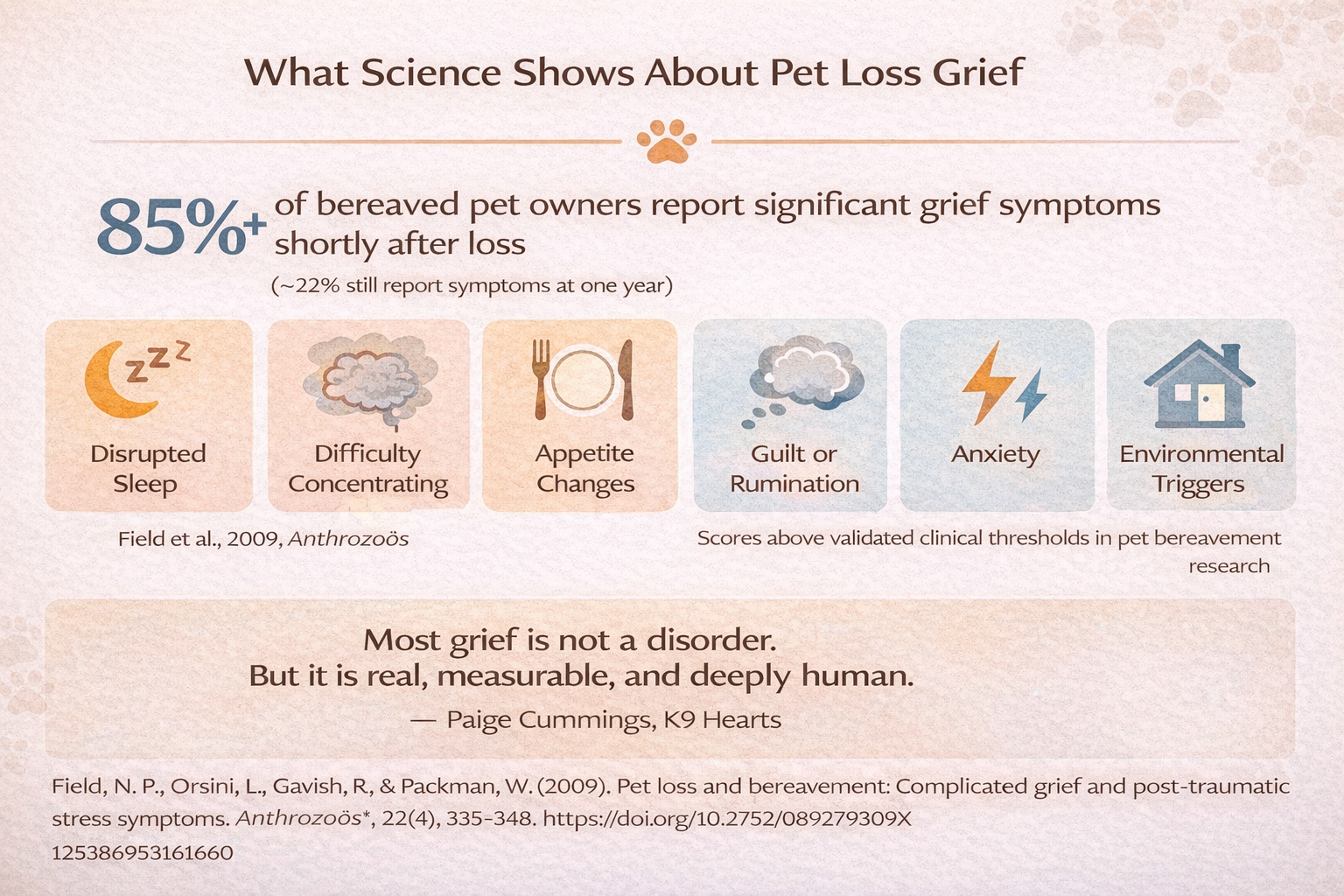
Research consistently shows that the majority of people who lose a pet experience real, measurable symptoms — in their bodies, their sleep, their ability to concentrate, and their daily routines.
In one longitudinal study, more than 85% of bereaved pet owners reported at least one significant grief symptom shortly after losing their pet. About 22% were still experiencing symptoms a year later. The symptoms documented included sleep disturbance, difficulty concentrating, appetite changes, persistent sadness, and social withdrawal. ⁵
Field, N. P., Orsini, L., Gavish, R., & Packman, W. (2009).
Pet loss and bereavement: Complicated grief and post-traumatic stress symptoms.
Anthrozoös, 22(4), 335–348.
https://doi.org/10.2752/089279309X12538695316160
This is not just emotional pain. It is grief expressing itself through the whole person — mind, body, and daily life — exactly the way grief does after any significant loss.
When Grief Crosses a Clinical Threshold
Most people expect to feel sad after losing a dog. What many do not realize is that for some, the intensity of that grief can reach levels used in clinical screening.
In one study examining bereavement following companion animal loss, researchers found that 3.8% of participants scored above the clinical cutoff for Complicated Grief, and 5.7% scored above the clinical cutoff for Post-Traumatic Stress symptoms. ⁵
A clinical cutoff is simply a scoring threshold on a validated psychological assessment — the point at which a person's symptoms resemble patterns seen in diagnosable grief-related or trauma-related conditions. Crossing that threshold does not automatically mean someone has received a diagnosis. It means their distress has reached a level that may benefit from 1:1 professional support — whether in person or through telehealth.
For many people, a dog was woven into every part of daily life — morning routines, evening walks, the quiet presence that made a house feel like home. When that is suddenly gone, the nervous system can respond with symptoms that look very similar to complicated grief or trauma responses following other profound losses in life.
But the fact that some do cross clinical thresholds is a quiet reminder that bonds with our dogs are real, our feelings of loss are significant, and our bond with our dogs impacts our mind and body in a measurable and profound way.
Science does not rank grief by species. It measures symptoms. And those measurements confirm what so many already know in their hearts.
Your Grief Is Not the Problem. The Silence Is.
One of the most damaging things about disenfranchised grief is that it pushes people inward. When the world signals that your pain is not legitimate, you stop talking about it. You grieve alone, at home, in private — often feeling ashamed of the very love that made the loss so devastating.
This silence is not healing. It is the opposite of healing. Grief that cannot be spoken cannot be processed. And grief that cannot be processed has nowhere to go.
If you are in the middle of pet loss grief right now, I want to say something plainly: there is nothing wrong with you. The research is on your side. The neuroscience is on your side. And the thousands of people quietly grieving their dogs alongside you — without a ritual or a bereavement day or a condolence card — are on your side too.
You are allowed to feel this. All of it. For as long as it takes.
Finding Support That Fits Where You Are
If your grief feels overwhelming, prolonged, or difficult to carry alone, speaking with a licensed mental health professional who specializes in grief and loss is a meaningful and valid choice.
Working with a therapist does not mean your grief is abnormal. It means you are choosing support — and that is always the right instinct.
You can search for licensed grief therapists through:
Psychology Today Therapist Directory — searchable by location, insurance, and specialty
Your state's Department of Health provider lookup
Your primary care provider's referral network
Local hospice organizations, many of which offer community grief counseling resources
A note from Paige: As the founder of K9Hearts, my background includes decades of experience in the mental health field and grief-informed work. I am not a licensed therapist in Washington State and do not provide clinical treatment or psychotherapy services. My role here is educational and supportive — to offer research-informed guidance, validation, and a place where your grief is taken seriously. If you need clinical care, you deserve a licensed professional who can work with you directly and confidentially. And if your grief feels heavy but not clinical, you are still welcome here. Support exists on a spectrum. Wherever you fall on it, you are not alone.
If You Are Ready for Support
The K9Hearts Guided Journal was designed specifically for this kind of grief, using structured prompts grounded in established grief frameworks to help you move through loss at your own pace. If you are looking for a way to honor your dog's memory while supporting your own healing, the End of Paw Prints Legacy Portrait offers a lasting tribute to the bond you shared.
You do not have to go through this alone — and you do not have to justify the depth of what you feel to anyone.
📚 Recommended Resource
For a compassionate, research-informed look at pet bereavement, Pet Loss and Human Emotion by Cheri Barton Ross and Jane Baron-Sorenson is one of the most thorough resources available. Written for both grieving pet owners and the professionals who support them, it validates the full weight of this loss with both clinical insight and genuine warmth.
At K9Hearts, we believe that the love you had for your dog was real — and that your grief deserves to be treated that way. Explore our resources and support and find what feels right for where you are.
Sources
Eckerd, L. M., Barnett, J. E., & Jett-Dias, L. (2016). Grief following pet and human loss: Closeness is key. Death Studies, 40(5), 275–282. https://pubmed.ncbi.nlm.nih.gov/26766186/
Redican, E., et al. (2026). No pets allowed: Evidence that prolonged grief disorder can occur following the death of a pet. PLOS One. https://journals.plos.org/plosone/article?id=10.1371/journal.pone.0339213
Love, Baxter. (2026). Why is pet loss grief disenfranchised by society? https://lovebaxter.com/blog/pet-loss-grief-disenfranchised-society/
Redican, E., et al. (2026). No pets allowed: Evidence that prolonged grief disorder can occur following the death of a pet. PLOS One. https://journals.plos.org/plosone/article?id=10.1371/journal.pone.0339213
Field, N. P., Orsini, L., Gavish, R., & Packman, W. (2009). Pet loss and bereavement: Complicated grief and post-traumatic stress symptoms. Anthrozoös, 22(4), 335–348.
Stoeckel, L. E., Palley, L. S., Gollub, R. L., Niemi, S. M., & Evins, A. E. (2014). Patterns of brain activation when mothers view their own child and dog: An fMRI study. PLOS ONE, 9(10), e107205. https://doi.org/10.1371/journal.pone.0107205
Nagasawa, M., Mitsui, S., En, S., et al. (2015). Oxytocin-gaze positive loop and the coevolution of human-dog bonds. Science, 348(6232), 333–336. https://doi.org/10.1126/science.1261022
Heaven At Home Pet Hospice. (2025). The neuroscience of grief and attachment: Why losing a pet can feel like losing a child. https://www.pethospicevet.com/the-neuroscience-of-grief-and-attachment-why-losing-a-pet-can-feel-like-losing-a-child/