

Anticipatory Pet Grief Support
The paw prints haven't stopped yet. You are not alone in this.
Anticipatory grief arrives before the loss — and you deserve support right now, today, while they are still here.
Understanding Your Grief
What Is Anticipatory Grief?
Anticipatory grief in pet owners is the profound sadness, fear, and guilt that begins before a loss— often immediately following a serious or terminal veterinary diagnosis. It lives in the space between the diagnosis and the goodbye — in every medication dose, every car ride, every moment you try to memorize the weight of them beside you.
It is real. It is documented. It is one of the most isolating experiences a pet owner can face — because the world often does not acknowledge grief that begins before death.
“Research shows that nearly 40% of pet owners screen positive for depressive symptoms within weeks of a pet cancer diagnosis — before any loss has occurred. You are not overreacting. You are loving someone who is dying, and that is one of the hardest things a human heart is ever asked to do.”
— Nakano et al. (2020), Journal of Veterinary Internal Medicine (Peer-Reviewed)
The guilt, the fear, the second-guessing — these are not signs of weakness. They are signs of a bond that is real and deep and worthy of grief. You loved them well. You are loving them well right now.
Free Downloads
Free Tools for the Days That Feel Impossible
Created with love for every family navigating a serious pet diagnosis.
No email required. Just open, print, and use.
Daily Care & Observation Journal Sheet
Track medications, daily observations, comfort levels, and your own emotional check-in — all in one place. Bring it to every vet appointment so you never forget a question or a change.
Free · No email required
Download Free — Daily Care Journal (PDF, opens in new tab)Treatment Decision Journal Sheet
When you are facing an impossible treatment decision — radiation, clinical trials, palliative care — this journal helps you organize your thoughts, clarify your values, and carry your questions into every appointment.
Free · No email required
Download Free — Treatment Decision Journal (PDF, opens in new tab)Charlie’s Last Walk: Special Edition for Anticipatory Grief
A guided journal built specifically for the season you are in right now — when your dog is still here, but the fear of losing them has already arrived. Free. Always free.
Free · Set your price at checkout
Get the Free Journal — Delivered to Your Email (opens K9 Hearts digital store)Free at checkout — add Charlie’s Story if you’d like to go deeper.
THE STORY BEHIND THIS PAGE
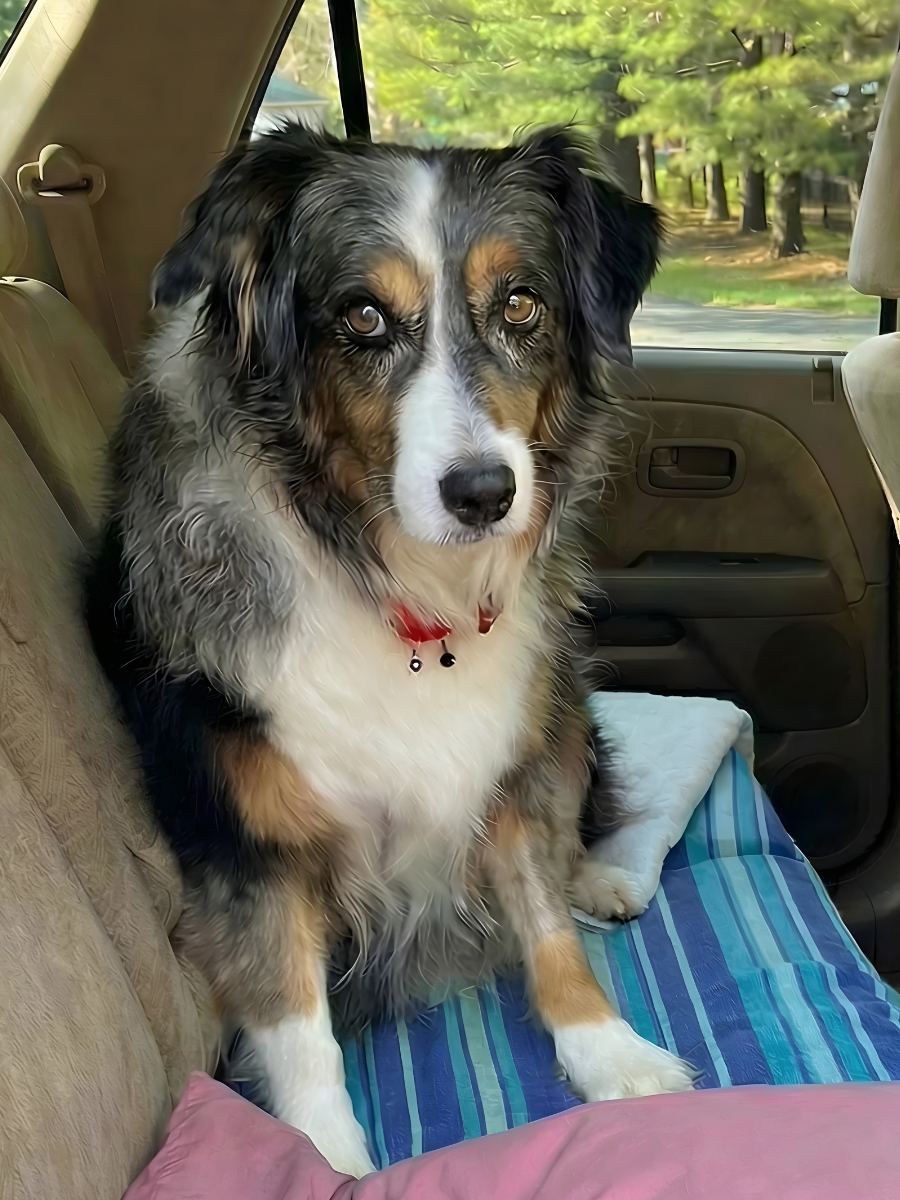
This Page Is Dedicated to Cheyenne
Cheyenne is an 8-year-old Australian Shepherd. He came into his person's life when she needed him most — anxious, recovering, carrying his own wounds. She loved him back to himself. He blossomed into the gentlest, most devoted companion — the dog who goes on three car rides a day, walks every morning with a group, and has never met a person he didn't eventually trust.
Three weeks ago, he had his first seizure without warning. In the six days that followed, he had five more. All grand mal. Three emergency room visits. A neurologist. A diagnosis that changed everything.
His person — my Aunt Cindy — is navigating one of the hardest decisions of her life. This page, and everything on it, was built for her. And for every person who has ever sat beside their dog and tried to memorize the weight of them.
Cheyenne’s story is the reason this page exists. But it was built for yours.

Cheyenne’s Radiation Fundraiser
Cheyenne's radiation treatment with Dr. Gordon at Veterinary Referral Associates in Gaithersburg, MD is estimated at $15,000. Cindy has already spent everything she has getting him to this point. If you have been moved by their story, this is how you show up for them.
Every extra day matters more than words can say.

Frequently Asked Questions
If you are navigating a serious or terminal diagnosis for your dog, you are not alone — and you are not the first to ask these questions. The answers below are grounded in peer-reviewed research and the real experiences of pet owners who have walked this path.
What is anticipatory grief in pet owners?
Anticipatory grief is the grief that begins before a loss. It arrives the moment a veterinarian delivers a serious or terminal diagnosis — and it is every bit as real as the grief that comes after death. For pet owners, anticipatory grief often includes waves of sadness, anxiety, hypervigilance about symptoms, difficulty concentrating, and a profound sense of dread that can make it hard to be fully present even while your dog is still here. Research confirms that anticipatory grief is a documented psychological response, not an overreaction. You are not grieving too soon. You are loving someone who is dying, and your heart already knows it.
Is it normal to grieve before my dog dies?
Yes — completely and documentably normal. Grief does not wait for death. It begins the moment you understand that loss is coming. Many pet owners feel confused or guilty about grieving a dog who is still alive, wondering if they are somehow giving up or being disloyal. They are not. Anticipatory grief is your mind and heart preparing for one of the hardest transitions they will ever face. Feeling it now does not mean you have stopped fighting for your dog. It means you love them enough that the thought of their absence is already changing you.
How do I cope with my dog's terminal diagnosis every day?
One day at a time — and sometimes one hour at a time. The research on anticipatory grief suggests that daily structure, small rituals, and honest emotional processing are the most effective tools available. Practically: keep a daily care journal to track observations and medications so you feel less out of control. Emotionally: allow yourself to feel what you feel without rushing past it. Give the grief somewhere to go — write it down, say it out loud to someone who understands, or bring it here. The K9 Hearts Anticipatory Grief page was built specifically for this season, and the free downloads on this page were created to help you carry it.
How do I decide between radiation, clinical trials, and palliative care for my dog?
This is one of the hardest decisions a pet owner can face, and there is no universally right answer. The right answer is the one that aligns with your dog's quality of life, your own values, and what your veterinary team honestly recommends for your dog's specific diagnosis and stage. Questions worth asking your vet: What does a typical day look like for a dog undergoing this treatment? What are the realistic outcomes? What would you choose for your own dog? The Pet Treatment Decision Journal available as a free download on this page was built specifically to help you organize your thoughts, clarify your values, and walk into every appointment feeling less overwhelmed and more prepared.
What should I track when my dog is seriously ill?
Track the things that change — because change is what tells you how your dog is really doing. Daily observations worth recording include appetite and water intake, energy level and mobility, signs of pain or discomfort, response to medications, quality of sleep, and moments of joy or engagement — the tail wag, the interest in a favorite toy, the willingness to be close to you. Tracking these things serves two purposes: it gives your veterinary team accurate information, and it gives you something concrete to hold onto when your emotions make clear thinking difficult. The free Pet Daily Care and Observation Journal on this page is designed for exactly this kind of daily tracking.
Is pet grief as real as human grief?
Yes. This is not a matter of opinion — it is documented in peer-reviewed research. Studies in bereavement science confirm that the grief experienced after pet loss can mirror the grief experienced after losing a human loved one in intensity, duration, and psychological impact. The bond between a person and their dog activates the same neurological and emotional systems as any deeply attached relationship. What makes pet grief harder in many cases is not the loss itself but the lack of social recognition around it — a phenomenon researchers call disenfranchised grief. Your grief is real. The fact that others may not understand it does not make it smaller.
What is End of Paw Prints (EOP)?
The End of Paw Prints — EOP — is a movement created by K9 Hearts founder Paige Cummings to give every dog the formal recognition their life deserves. Inspired by the End of Watch tradition used to honor fallen first responders and military working dogs, EOP exists for the dogs whose service was to our hearts. Every dog's story reaches the end of its paw prints. EOP says that moment deserves to be marked — with intention, with dignity, and with a permanent place for their memory to live. For families in the anticipatory grief season, the EOP Legacy Portrait can be commissioned while your dog is still here, using photos that capture who they are right now.
How do I talk to my family about my dog's terminal diagnosis?
Honest, age-appropriate conversation is almost always better than protective silence. For adults, name what is happening clearly — a terminal diagnosis means the veterinary team does not expect your dog to recover, and it is important that everyone has the chance to say what they need to say and do what they need to do while there is still time. For children, use simple and truthful language rather than softening phrases that create confusion. Tell them what is happening, invite them to ask questions, and include them in small rituals of care and connection. Grief shared is grief witnessed — and witnessed grief heals differently than grief carried alone.
How do I make the most of the time I have left with my dog?
By being present rather than perfect. The impulse to plan special outings or create elaborate last memories is understandable, but what most dogs need most is simply you — your calm presence, your familiar routine, your willingness to sit beside them. Let them lead. If they want to lie in the sun, lie with them. If they still want to walk, walk slowly. Take photos not for social media but for yourself — the ordinary moments are the ones you will reach for most. Write down what you love about them before memory softens the details. And give yourself permission to say everything you need to say out loud, even if they cannot answer back. They are listening.
CONTINUE YOUR JOURNEY
More Support from K9 Hearts
More from K9 Hearts
Charlie’s Guided Journal for Pet Loss
A companion with prompts that lead you somewhere real — grounded in evidence-based grief frameworks. Available in paperback, hardcover, and digital.
EOP Legacy Art Portrait
Honor your dog’s life while they are still here. A timeless memorial portrait created from your photographs — rooted in continuing bonds research.
Pet Loss Support & Grief Resources
A curated list of vetted resources for pet owners navigating anticipatory grief, euthanasia decisions, and post-loss support.
Financial Assistance Resources & Help
You Should Not Have to Choose Between Your Dog and Your Finances
These verified organizations offer grants, financial assistance, and funded clinical trials for pet owners navigating cancer, neurological conditions, emergencies, and serious illness. All resources are free to apply for and updated regularly.
Cancer-Specific Financial Assistance
The Magic Bullet Fund
Covers: Cancer Treatment — Dogs & Cats
Helps dogs and cats in the US get cancer treatment — surgery and chemotherapy — for families who cannot afford the full cost. Has helped over 918 pets since founding.
CancerCare PAW Program
Covers: Pet Care for Owners in Cancer Treatment
Assists people who are themselves in active cancer treatment with the challenges of keeping their cat or dog at home — covering pet food, boarding, vet care, and medications.
Learn More →Live Like Roo Foundation
Covers: Cancer — Dogs & Cats
Provides grants for dogs and cats with a confirmed cancer diagnosis. Also sends care packages to pets undergoing treatment to help families feel supported through the journey.
Czar's Promise
Covers: Chemo, Radiation & Palliative Oncology
Funds chemotherapy, radiation, and palliative oncology care for pets with a confirmed cancer diagnosis. Requires treatment at select Wisconsin veterinary oncology centers.
Apply Now →Emma's Foundation for Canine Cancer
Covers: Cancer Treatment — Dogs Only
Provides financial funding to dog owners in New England and Florida who cannot afford their dog's cancer treatment. Assistance is based on proven financial need.
Apply Now →Stymie Canine Cancer Foundation
Covers: Uninsured Cancer Treatment — Dogs
Raises funds for families facing uninsured cancer treatment costs for their dogs. Also funds comparative oncology research to help find a cure for canine cancer.
Neurological & Seizure Assistance
Chelsea Hutchison Foundation
Covers: Seizure Response Dogs for Human Epilepsy
Provides grants to individuals and families to purchase trained seizure response dogs. Designed for human patients living with epilepsy who need a trained canine companion.
Apply Now →JoshProvides
Covers: Seizure Response Dogs & Epilepsy Assistance
Provides funding and grants for seizure response dogs and epilepsy assistance animals. Does not breed or train dogs, but connects families with funding to obtain trained dogs.
Learn More →Veterinary Clinical Trials — Brain Tumors
Covers: Brain Tumors, Glioma, Meningioma — Dogs
Universities including Purdue, UC Davis, University of Minnesota, and University of Georgia run funded clinical trials for dogs with brain tumors that often cover the full cost of radiation or surgery.
General Emergency & Critical Illness Assistance
Brown Dog Foundation
Covers: Sick Pets Who Would Respond to Treatment
Provides financial assistance for sick pets whose owners cannot afford the care needed. Focuses on pets that would likely respond to treatment — a wide range of serious conditions.
The Pet Fund
Covers: Cancer, Heart Disease, Endocrine Conditions
Provides financial assistance for non-basic, non-urgent veterinary care — including cancer treatment, heart disease, diabetes, and other advanced conditions requiring specialist care.
Apply Now →RedRover Relief Urgent Care Grants
Covers: Emergency & Urgent Veterinary Care
Provides financial assistance and emotional support for pet owners experiencing financial hardship when their pet needs urgent or emergency veterinary care.
Apply Now →Frankie's Friends Fund
Covers: Life-Saving Emergency & Specialty Care
Grants to assist with the cost of life-saving or life-enhancing emergency or specialty care for pets whose families cannot afford the full cost of treatment.
Paws 4 A Cure
Covers: Illness & Injury — Dogs & Cats
Provides financial assistance for canine and feline owners who cannot afford veterinary care for illnesses and injuries, including cancer. No breed or age restrictions.
Banfield Foundation HOPE Funds
Covers: Life-Threatening Emergencies
Financial assistance for income-qualified pet owners whose pet is suffering from an immediately life-threatening condition. Treatment must be completed at a Banfield Pet Hospital.
VCA Charities HOPE Funds
Covers: Immediate Life-Threatening Conditions
Financial assistance for income-qualified pet owners facing an immediate life-threatening pet emergency. Applications and treatment must be completed at a VCA Animal Hospital.
Senior Pet Assistance
The Grey Muzzle Organization
Covers: Senior Dog Medical Care & Hospice Programs
Provides grants to shelters and rescues specifically for senior dog medical care, dental care, and hospice programs. Does not fund individuals directly, but their grantees provide free or low-cost care.
Find Local Resources →Harley's Hope Foundation
Covers: Vet Care, Cancer Fund, Emergency Boarding
Helps older adults (50+) in Colorado hold onto their companion animals. Offers veterinary care assistance, a dedicated pet cancer fund, emergency boarding, and transportation to vet appointments.
Apply Now →K9 Hearts does not endorse or guarantee any of the organizations listed above. Eligibility, grant availability, and contact information are subject to change. Always verify current details directly with each organization before applying. This list was last reviewed March 2026.