For my Aunt Cindy and Cheyenne: How to Cope Every Day When Your Dog Has a Terminal Diagnosis
This blog is dedicated to my Aunt Cindy and her beloved Australian Shepherd, Cheyenne — and to every person who has ever sat beside their dog and tried to memorize the weight of them.
As an Amazon Associate, I earn from qualifying purchases. This helps support K9 Hearts' mission to provide grief support resources for those who have lost their beloved dogs.
There is a particular kind of grief that doesn't wait for death.
It arrives while your dog is still sleeping at your feet. It arrives in the middle of the night when you check on them one more time just to make sure they're still breathing. It arrives when you pick up their favorite treat at the store and then stand in the aisle for a moment too long, wondering how many more times you'll get to watch their face light up.
This grief has a name. It is called anticipatory grief. And if you are in it right now — if your dog has been given a serious or terminal diagnosis and every single day feels like you are trying to hold water in your hands — I want you to know something before we go any further:
You are not falling apart. You are loving someone who is dying. And that is one of the hardest things a human heart is ever asked to do.
This blog was written for one woman in particular. But if you found your way here, it was probably written for you, too.
Cheyenne's Story: A Living Legacy
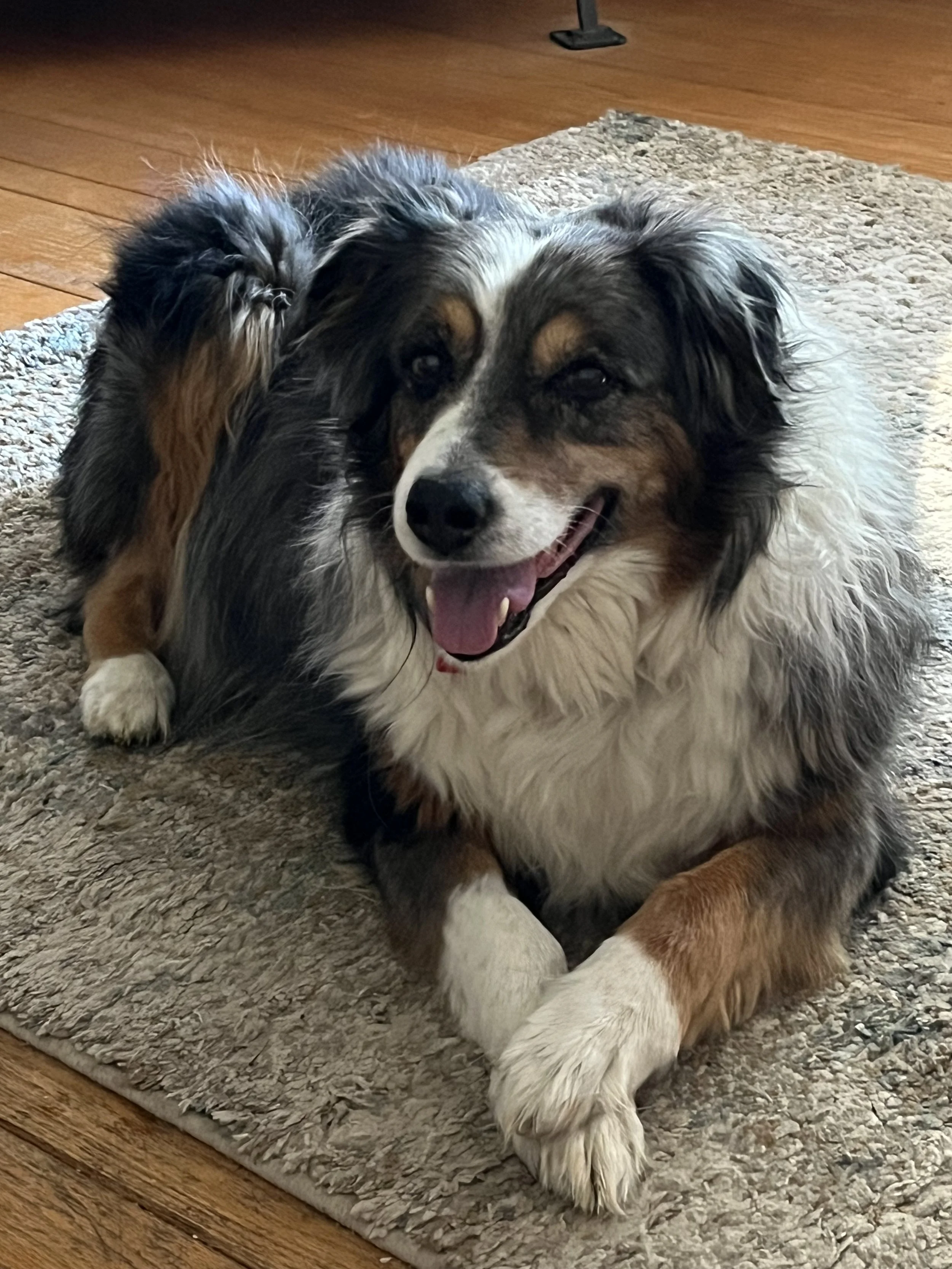
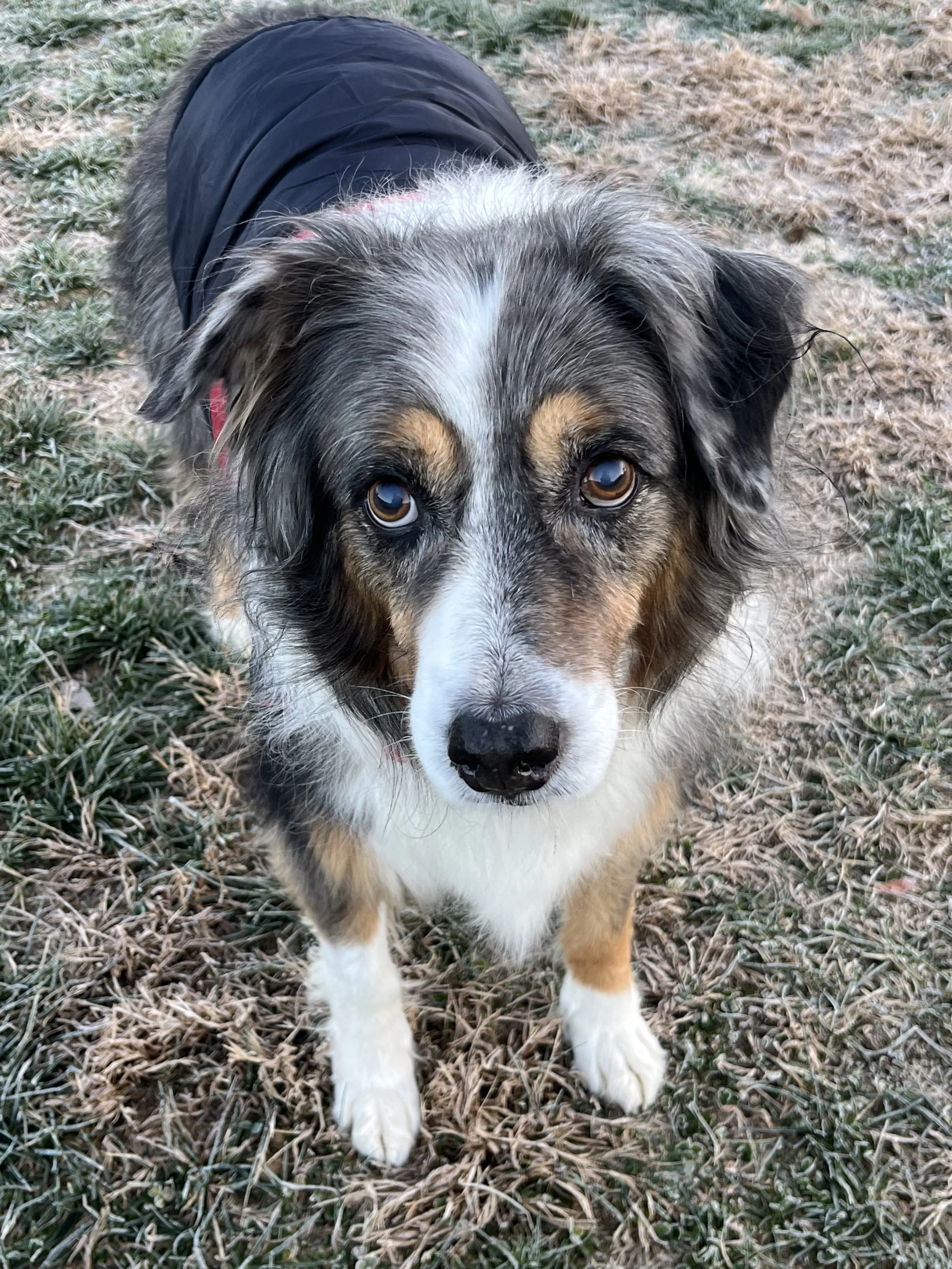
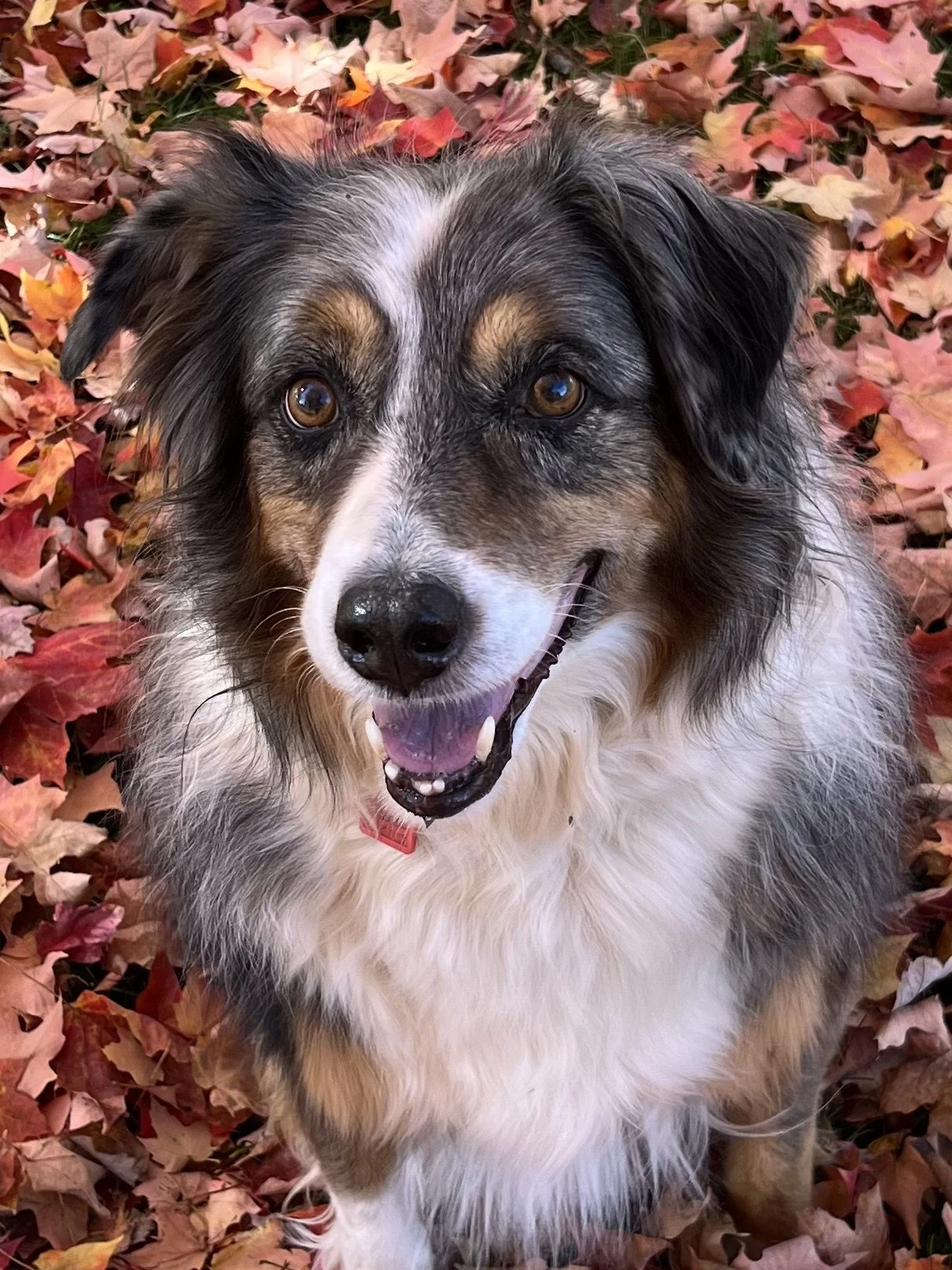
His name is Cheyenne. He is an 8-year-old Australian Shepherd, and from the very first day he came into my aunt's life, he was exactly where he was supposed to be.
Cheyenne came to her after she had already survived things that would have broken most people. He was a quiet, anxious dog — one who had been through his own hard beginnings, recovering from Lyme disease and heartworm treatments, carrying his own wounds into a home that would slowly, gently, heal them. My aunt took one look at this dog and saw something in him she recognized: the need to be loved back to yourself.
She researched everything. She did titers instead of unnecessary vaccines. She took him to the vet for every small concern. She gave him the best food, the best care, the most patient, unwavering love. And Cheyenne blossomed. The anxious, shut-down dog who used to flinch at strangers became a dog who walks in a morning group every day, lets children pet him, goes everywhere with her, and loves car rides so much that she takes him on three or four a day just to see his face.
He loves ham salad from a specific store. He hates thunderstorms. He never barks. He is, by every measure, her heart dog — her constant companion through the loneliest years of her life.
And then, without warning, three weeks ago, Cheyenne had a seizure. In the six days that followed, he had five more — all grand mal seizures. Three emergency room visits. Two regular vet appointments. And by the end of that first devastating week, a neurology referral. From that first seizure to a neurologist's office, Aunt Cindy moved mountains with a broken heart — and she did it in seven days.
The vets have been clear and compassionate. They have also told her what no pet owner ever wants to hear: that with medication alone, the time they have left together is limited. Weeks. Possibly a few months. A decision about additional treatment — radiation, clinical trials, palliative comfort care — sits before her like an impossible weight.
And she cries every day. She questions everything. She asks herself what she missed.
This blog is my answer to her. And it is my answer to you.
"What Did I Miss?" — The Guilt That Comes Before the Loss
Let me say this clearly, and let me say it first, because it is the question that is eating her alive.
You did not miss anything.
I know that is not what the voice in your head says at 2 a.m. That voice — the one that replays every vet visit, every meal, every moment you wonder if you should have noticed something sooner — is not telling you the truth. It is telling you the story that grief tells when it needs somewhere to put its pain.
The oncologist who reviewed Cheyenne's case put it plainly: dogs with brain tumors frequently compensate until a rather abrupt change occurs. There are often no visible signs. There is often nothing a loving, attentive, devoted owner could have seen. The owners who catch it earliest — who rush to the neurologist, who pursue MRIs and specialist consults and every available option — are not catching it early because they are more observant. They are the same person you are. And Aunt Cindy did all of those things.
Research on pet owners facing cancer diagnoses confirms what most of us feel but rarely hear validated. A peer-reviewed study found that in pet owners — the human caregivers — assessed shortly after receiving their pet's cancer diagnosis, close to 40% of those owners were already screening positive for depressive symptoms, and the same proportion were experiencing high anxiety. This was not after their pet died. This was in the weeks immediately following the diagnosis. The grief and despair that you feel right now, as the person who loves this dog, is documented, validated, and shared by nearly half of all people in your position (Nakano et al., 2020).
The guilt, the fear, the second-guessing — these are not signs of weakness. They are signs of a bond that is real and deep and worthy of grief.
You loved him well. You are loving him well right now. The record of your love for Cheyenne is written in every vet receipt, every car ride, every ham salad treat. No diagnosis can rewrite that record.
When Grief Already Has a History: Carrying What Came Before
Some of us come to this moment carrying more than one loss.
Some of us lost a husband during a pandemic and weren't in the room when he took his last breath because we had stepped out for a moment to care for ourselves — to do the small, necessary, human thing that no one should ever have to feel guilty for. Some of us lost our dogs one right after another, in the same season, in the same overwhelming wave of grief. Some of us have been holding other people's pain for so long — a sibling, a friend, a family member in crisis — that we have never once put our own grief down long enough to feel it.
If that is you, I want to say something gently: the grief you are feeling for Cheyenne is not only about Cheyenne. That does not make it less real. It makes it heavier. When we carry losses that were never fully processed — especially losses where there was no time or space or permission to fall apart — they do not disappear. They wait. And when the next loss arrives, they come with it.
Grief researchers call this "bereavement overload" — the accumulation of multiple significant losses that have not had adequate time or support for processing (Kastenbaum, 1969; Stroebe & Schut, 1999). It is not a sign that something is wrong with you. It is a sign that you have been carrying extraordinary weight for a very long time, and you are human, and the body and the heart have limits.
If you are a person who takes care of everyone else — if being the steady one is your identity, your training, your calling — grief can feel like a betrayal of that identity. It is not. It is the most honest thing you can do.
There is no shame in needing to be held, too.
The Decision You're Being Asked to Make
One of the most painful dimensions of anticipatory pet grief — and one that is almost never spoken about honestly — is the weight of having to make treatment decisions while you are already in shock.
Radiation. Clinical trials. Palliative comfort care. Each path has real benefits and real costs. Each path carries uncertainty. And unlike many human medical decisions, you are being asked to make this choice for someone who cannot tell you what they want.
The oncologist who reviewed Cheyenne's case said something worth holding onto: there is no single right choice. The family's values, their resources, and their comfort with risk must drive the decision. He validated that choosing comfort-focused, palliative care — maximizing quality of life without aggressive intervention — is a compassionate and loving choice, not a giving up.
Here is what the research tells us about making these decisions:
Values-based decision-making reduces regret. When owners make treatment decisions that align with their own values — not the statistics, not the guilt, not the pressure to "do everything possible" — they report significantly less regret afterward (Villalobos & Kaplan, 2011). The question is not "what is the most aggressive thing I can do?" The question is "what does love look like for this dog, right now?"
The statistics are not Cheyenne's story. Median survival times are derived from populations of dogs. Cheyenne is one dog. His oncologist was clear: statistics help with decisions, but they do not predict any individual dog's future. Some dogs exceed every projection. Some do not reach the median. Statistics are a map, not a destination.
There is time, and there is not. The medical team recommended that a treatment decision be made within the next one to three weeks, so that options remain open. That window is real. But it does not mean the decision must be made in pain and panic. It means that gathering information — including an upcoming veterinary university hospital consultation — is exactly the right move. You are not out of time. You are using the time you have wisely.
A framework for the impossible decision:
Consider writing down — or using the free journaling tool below — your answers to these three questions:
What does a good day look like for Cheyenne right now?
What am I most afraid of — for him, and for myself?
If I imagine looking back on this time ten years from now, what would I need to have done in order to feel at peace?
There are no wrong answers. There is only your heart, and his.
The Daily Symptom and Care Journal: A Tool for You
One of the things I did for my aunt when this began was create a daily care and observation sheet for Cheyenne. It has two parts: one that tracks his medications, his movement, his awareness, his comfort, and any changes — and one that holds space for her. For how she is doing. For what she needs. For what she wants to ask the doctor next time.
I am making that tool available here as a free download, because I know that Aunt Cindy is not the only one who needed it.
📋 Download: Cheyenne's Daily Care and Observation Journal
Using a structured daily journal like this one serves three purposes that are backed by research:
First, it gives you something concrete to do on days when you feel helpless. Caregiving research consistently shows that structured, actionable tasks reduce anxiety and the sense of powerlessness that accompanies anticipatory grief (Folkman, 2001).
Second, it creates a record of your love. Every entry is evidence that you were there. Every "good day" you noted is proof of a life well lived. These records become something precious after loss.
Third, it helps your vet. When you arrive at an appointment in tears and can't remember what you wanted to ask — which is completely normal and expected — this sheet speaks for you.
Cheyenne's Bucket List: Simple Joys for the Time That Remains
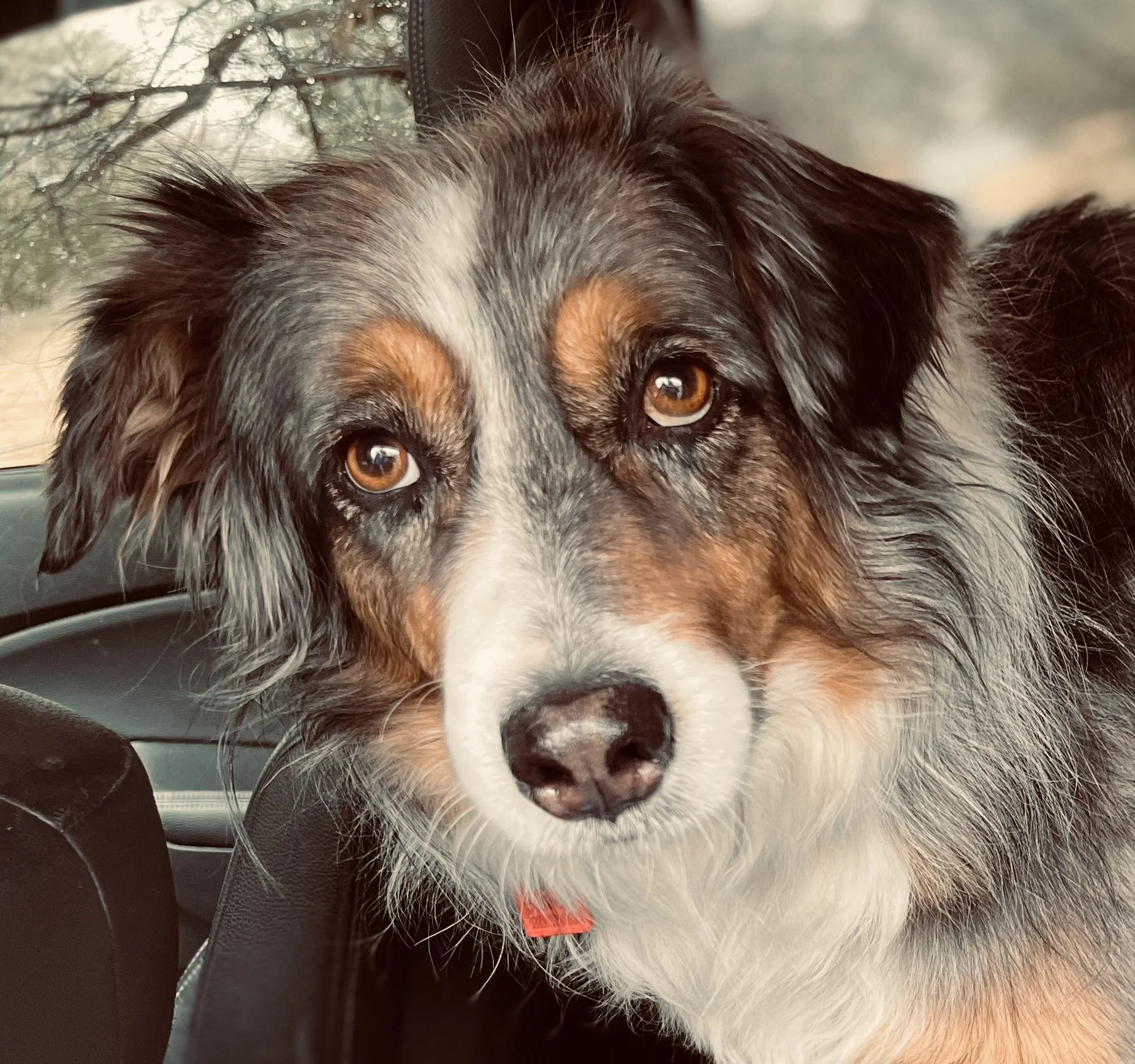
Research on end-of-life care for both humans and animals consistently emphasizes the power of intentional, present-moment connection — what is sometimes called "cherishing time together" — as a form of anticipatory continuing bonds work (Stokes et al., 2021). In plain terms: creating gentle, joyful memories now is not just a nice idea. It is one of the most clinically supported things you can do for your own grief and for your dog.
Cheyenne doesn't need a dramatic bucket list. He needs what he has always loved, offered with full attention and no distraction.
A gentle bucket list for Cheyenne:
☐ An extra-long car ride with all the windows down — just the two of you
☐ A trip to the store for his favorite ham salad
☐ One slow morning walk in the best weather you can find
☐ A phone call to a friend where Cheyenne is the whole subject of the conversation
☐ A photo session — inside, outside, in his favorite spot — just to capture him as he is right now
☐ A quiet afternoon where the only agenda is sitting beside him
☐ A letter written to him — or from him — about what your life together has meant
☐ One perfect treat, offered with both hands, while you tell him exactly what he has been to you
None of these things cost much. All of them cost everything. And every single one of them becomes a memory you carry forward.
Finding Peace in the In-Between: Coping Every Day
The Dual Process Model of grief — one of the most well-supported frameworks in bereavement research — describes how people in anticipatory grief naturally move back and forth between two modes: confronting the grief directly (crying, processing, feeling the fear) and taking a temporary break to tend to ordinary life (making tea, going on a walk, laughing at something small) (Stroebe & Schut, 1999). This oscillation is not avoidance. It is not denial. It is how the human nervous system survives a sustained, impossible weight.
This means that you are allowed to have a good hour. You are allowed to laugh. You are allowed to eat your lunch and feel, for twenty minutes, like a person who is not drowning. That is not a betrayal of Cheyenne. That is how you stay present enough to love him through what is coming.
A few practices that research supports for daily coping during anticipatory grief:
Structured journaling with prompts. Expressive writing has a meaningful evidence base in bereavement research — but the research shows it works best when it is guided, not just open-ended venting (Lichtenthal & Cruess, 2010). This is one reason I built Charlie's Guided Journal for Pet Loss the way I did — not as a blank page, but as a companion with prompts that lead you somewhere real. If you are in anticipatory grief right now, the journal's opening section on this very experience was written for this moment — for exactly the place you are standing.
In honor of Cheyenne, I have created a free mini journal for anticipatory grief — a small, printable companion you can use right now, today, even if you never journal. It asks only what you can answer. It holds what you cannot yet say out loud.
📄 Download the Free Anticipatory Grief Mini Journal — In Honor of Cheyenne
Charlie's Guided Journal for Pet Loss is available in paperback and hardcover on Amazon, or in digital format directly at K9 Hearts.
Gentle physical grounding. Short, slow walks — especially in nature, especially with your dog if he is able — activate the parasympathetic nervous system and reduce the physiological markers of acute stress (Ulrich et al., 1991). Cheyenne's morning group walks may be one of the most healing things in Aunt Cindy's routine right now. Protect them.
Naming what you feel, even just to yourself. Research on emotional labeling shows that simply naming an emotion — "I feel terrified," "I feel guilty," "I feel grateful right now" — measurably reduces its intensity in the brain (Lieberman et al., 2007). You do not have to process everything. You just have to name it.
Allowing help, especially from someone who loves you. Caregivers who have an identified support person — one person who asks not "how are you doing?" but "what do you need today?" — show significantly lower burden scores (Zarit et al., 1980). If there is someone in your life who can be that person, let them.
A Comfort for the Hard Nights
There will be nights that are harder than others. The nights after a new symptom. The nights after a vet appointment that delivered uncertain news. The nights when the fear is bigger than the day was.
For those nights, one of the things I have seen help grieving pet owners most is having something tangible — something to hold — that connects them to their dog and to the truth of their love.
The YnM 15 lb Weighted Blanket is one I trust enough to recommend here. It is soft, washable, and large enough to share on the couch — the kind of blanket you pull over both of you during the quiet evenings while there is still time. At under $25, it is a small and real comfort for the hard nights.
The physical sensation of warmth and weight has documented calming effects on the nervous system (Mullen et al., 2008). And when Cheyenne is beside you under it, it becomes something you will remember.
What Is the End of Paw Prints (EOP)?
Within law enforcement, there is a protocol that has no equal. When an officer — or a K9 who served alongside them — completes their watch, the world stops. The radio call goes silent. The community gathers. EOW — End of Watch — is spoken. It is one of the most sacred honors in existence, and it belongs, without question, to every officer and K9 who gave their life in service. That honor is irreplaceable. It is not something that can be borrowed or paralleled. It stands alone.
But it did something else, too. It showed us what it looks like when a community decides that a life of service deserves to be formally named, witnessed, and remembered.
Our dogs — the ones who sat beside us through pandemics, through grief, through the loneliest and hardest years of our lives — gave a different kind of service. They were not on patrol. They did not wear a badge. Their service was quieter, and it was given freely, and it was given every single day of their lives. They steadied us. They got us up in the morning. They held vigil beside us in the dark.
They have never had a formal name for the day their service ended. Until now.
The End of Paw Prints (EOP™) is K9 Hearts' answer to that absence. It is a designation for the day a beloved dog's paw prints stop — not a clinical term, not a service, but a language. A way of saying: this dog mattered. This loss is real. This love lives forward.
Cheyenne, when his day comes, will be welcomed into the EOP Legacy Gallery — a place where he will live, virtually, for anyone who wants to visit him. His portrait, his name, the date his paw prints stopped. Not a goodbye. A permanent record of a life that changed someone's world.
The paw prints stop. The love never does.
You can learn more about EOP at https://www.k9hearts.com/about-eop.
Preserving Him While He Is Still Here
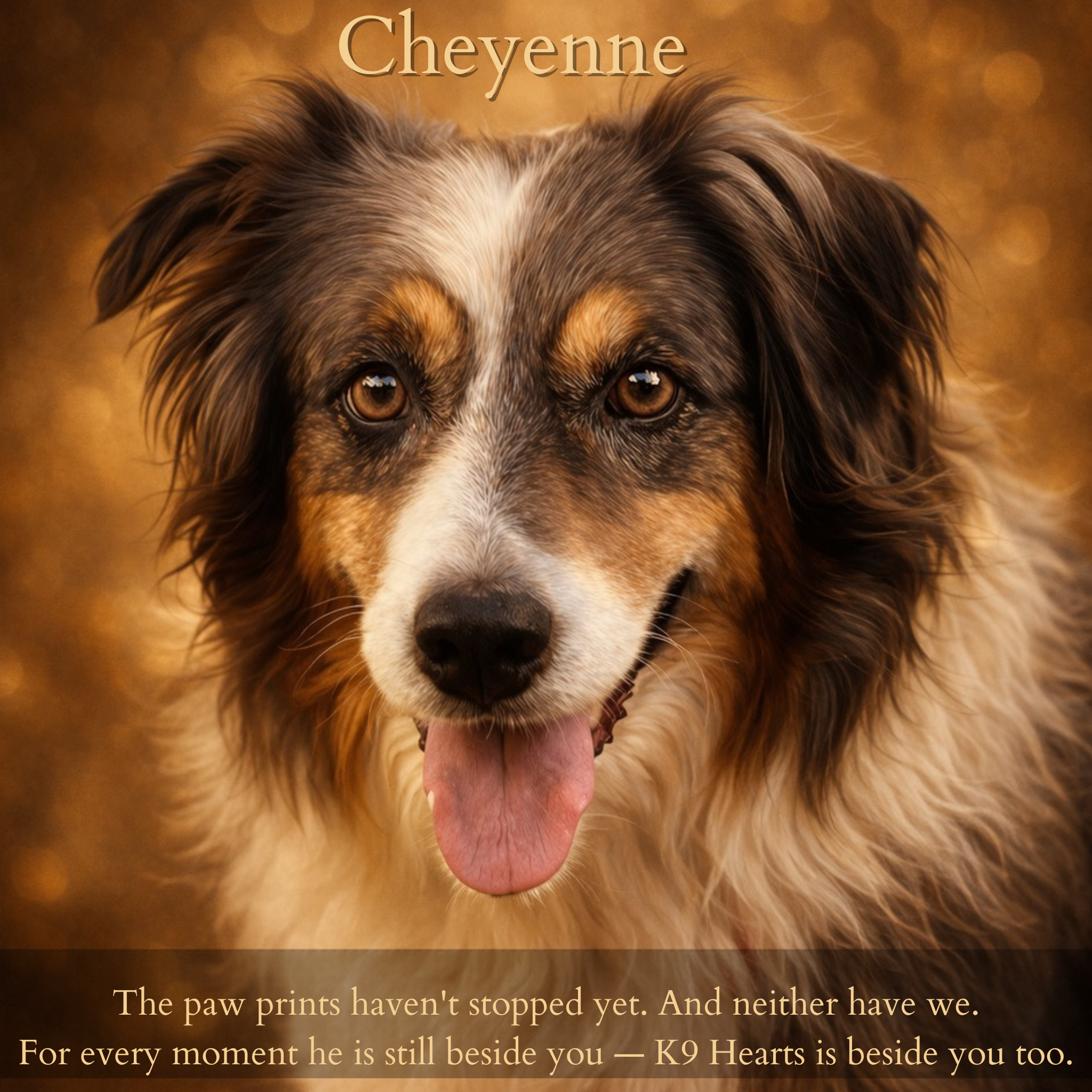
Cheyenne · K9 Hearts Legacy Portrait
One of the things grief researchers describe most consistently is the role of continuing bonds — the ways in which we maintain a living connection to the ones we have loved and lost (Klass et al., 1996). This work can begin before the loss. In fact, beginning it now is one of the most powerful things you can do.
A memorial portrait — created from a photo of Cheyenne as he is right now, while his eyes still hold that quiet calm that is entirely his — is not about preparing for death. It is about honoring the life that is happening. It is a way of saying:
I see you. I am paying attention. You will not be forgotten.
K9 Hearts Legacy Art portraits are created from your photographs and transformed into a timeless piece that captures not just what your dog looked like, but what they felt like. You can learn more and see examples at https://www.k9hearts.com/dog-memorial-portrait-art.
For the Person Who Takes Care of Everyone Else
You spent your life walking into the hardest rooms. You held other people's hands through their worst moments. You knew, professionally or personally — or both — how to hold steady.
No one taught you how to be the one who needs holding.
If you are the strong one in your family, the caregiver, the person everyone calls when things fall apart — grief can feel like a betrayal of your own identity. You are supposed to be the one who holds it together. Falling apart, crying every day, not knowing what to do — that does not fit the role you have always filled.
Here is what I want you to hear: you are not crying every day because you are weak. You are crying every day because you have loved this much, this many times, and the accumulative weight of that love is something that no human being is built to carry alone.
You do not have to carry it alone.
If you have drifted from your faith since your last great loss — if the church pew has felt too far away, or God has felt too quiet — you do not have to go back to have a conversation. That presence has been in every walk you took with your dog. In every treat offered with both hands. In every moment that anxious, uncertain animal looked at you and finally felt safe. You gave that. That was not nothing.
The faith that held you through everything it has held you through — it is still there. And it does not require you to be okay before it will receive your grief.
You are allowed to say: I don't know what to do. I am afraid. I am not okay. That is not the end of faith. That is, often, where it begins again.
The Gift Cheyenne Gave You
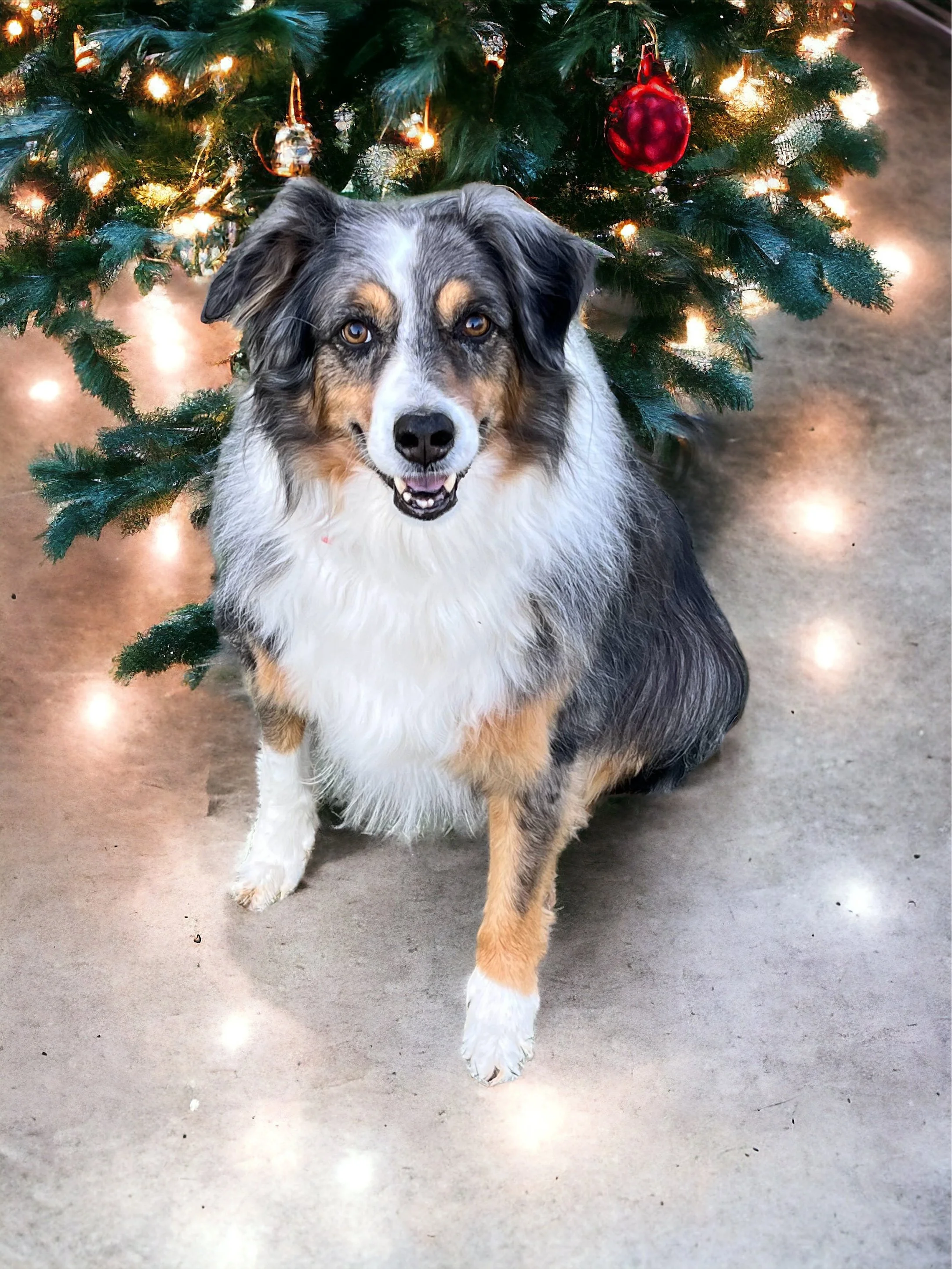
A Letter to my Aunt Cindy
From Paige and Nova
Aunt Cindy.
I started K9 Hearts because I lost Charlie. Because I sat in the wreckage of that loss and realized that the world had no real place for what I was feeling — and that I couldn't be the only one.
I never imagined that one of the first people I would be writing for would be you.
You have held so much. You held Uncle Gary through the unimaginable. You held Shadow and Chloe through their final years. You hold friends and family members when the world becomes too loud for them. You have been the steady one, the strong one, the one who shows up — for everyone, always, without being asked.
You are allowed to be the one who needs holding now.
Cheyenne came to you broken and became whole. He came to you grieving and learned to trust again. He walks every morning with his head up. He goes everywhere with you. He loves his car rides and his ham salad and the particular warmth of your presence. He blossomed — not in spite of everything you have been through together, but because of everything you brought to him.
You did not miss anything. You did not fail him. You loved him the way a person only loves once or twice in a lifetime — completely, without reservation, with everything you had.
Whatever path lies ahead — whatever decision you make, whatever days remain — you are not walking it alone.
Nova and I are right here. K9 Hearts was built for exactly this moment. And Cheyenne — this quiet, gentle, car-ride-loving, ham-salad-adoring boy, who chose you when he needed someone to believe in him — he is seen here. He is honored here. He will be remembered here, long after the paw prints stop.
The paw prints stop. The love never does.
With love from my whole heart — Paige and Nova 🐾
K9 Hearts does not provide clinical mental health services. If you are experiencing grief that significantly impacts your daily functioning, please reach out to a licensed mental health professional. If you are in crisis, call or text 988. K9 Hearts updates their Resources page for additional resources at https://www.k9hearts.com/pet-loss-and-grief-support.
Frequently Asked Questions
Q: What is anticipatory grief in pet owners? Anticipatory grief is the grief that begins before a loss — when a beloved dog receives a serious or terminal diagnosis. It includes fear, guilt, sadness, hypervigilance, and the weight of impending decision-making. Research confirms it is clinically real and can be as intense as post-loss grief.
Q: Is it normal to feel this devastated when my dog is still alive? Yes. Peer-reviewed research shows that nearly 40% of pet owners screen positive for depressive symptoms within weeks of a pet cancer diagnosis — before any loss has occurred. Your grief is not a sign that something is wrong with you. It is proportional to your love.
Q: Why do I keep asking myself what I missed or what I did wrong? This is one of the most universal experiences in anticipatory pet grief. Research on guilt and self-blame in pet illness consistently finds that devoted, attentive owners are the most likely to second-guess themselves — precisely because they are so invested. The guilt is not evidence of wrongdoing. It is evidence of love.
Q: How do I decide between radiation, clinical trials, and palliative care for my dog? There is no single right answer. Veterinary oncologists recommend making decisions that align with your values, your dog's current quality of life, and your comfort with risk — not with statistics alone. A second opinion at a veterinary university hospital can help clarify options without pressure. A values-based framework reduces regret regardless of which path is chosen.
Q: What is a dog bucket list, and is it helpful? A gentle bucket list — focused on your dog's favorite simple joys rather than grand experiences — is a research-supported form of anticipatory continuing bonds work. It keeps you present, creates memories to carry forward, and shifts focus from the fear of loss to the reality of love.
Q: What is a daily symptom tracker for a sick dog? A daily care and observation journal tracks your dog's medications, comfort level, movement, awareness, and any new symptoms. It also includes space for your own emotional check-in and a list of questions for the next veterinary appointment. It reduces anxiety, supports caregiving, and creates a record of love. Download the free K9 Hearts version above.
Q: What is End of Paw Prints (EOP)? EOP — End of Paw Prints — is a ceremonial designation created by K9 Hearts for the day a beloved dog's paw prints stop. It honors the dog's life, validates the depth of the loss, and preserves their legacy in the K9 Hearts EOP Legacy Gallery. Learn more at https://www.k9hearts.com/about-eop.
Q: What is a K9 Hearts Legacy Art portrait? A Legacy Art portrait transforms a photograph of your dog into a timeless memorial piece. It is a way of honoring your dog's life while they are still here — or after they are gone — and has roots in the grief research around continuing bonds and meaning-making. Learn more at https://www.k9hearts.com/dog-memorial-portrait-art.
Q: How do I cope with anticipatory grief when I have also experienced other significant losses? Multiple stacked losses — sometimes called bereavement overload — can make anticipatory pet grief significantly heavier. The grief you are feeling may include unprocessed sorrow from earlier losses. This is normal, and it is one of the reasons that grief support designed specifically for this experience can help. Consider the K9 Hearts guided journal, and if your grief is significantly impacting your daily functioning, please reach out to a licensed mental health professional.
Q: Is pet grief as real as human grief? Yes. A 2026 peer-reviewed study found that 21% of people who had experienced both pet and human losses named the pet death as their most distressing, and prolonged grief symptoms manifested in the same way for pet and human bereavements. Your grief for your dog is not lesser. It is legitimate.
References
Folkman, S. (2001). Revised coping theory and the process of bereavement. In M. S. Stroebe, R. O. Hansson, W. Stroebe, & H. Schut (Eds.), Handbook of bereavement research: Consequences, coping, and care (pp. 563–584). American Psychological Association.
Kastenbaum, R. (1969). Death and bereavement in later life. In A. H. Kutscher (Ed.), Death and bereavement. Charles C. Thomas.
Klass, D., Silverman, P. R., & Nickman, S. L. (Eds.). (1996). Continuing bonds: New understandings of grief. Taylor & Francis.
Lichtenthal, W. G., & Cruess, D. G. (2010). Effects of directed written disclosure on grief and distress symptoms among bereaved individuals. Death Studies, 34(6), 475–499. https://doi.org/10.1080/07481181003765023
Lieberman, M. D., Eisenberger, N. I., Crockett, M. J., Tom, S. M., Pfeifer, J. H., & Way, B. M. (2007). Putting feelings into words: Affect labeling disrupts amygdala activity in response to affective stimuli. Psychological Science, 18(5), 421–428. https://doi.org/10.1111/j.1467-9280.2007.01916.x
Mullen, B., Champagne, T., Krishnamurty, S., Dickson, D., & Gao, R. X. (2008). Exploring the safety and therapeutic effects of deep pressure stimulation using a weighted blanket. Occupational Therapy in Mental Health, 24(1), 65–89. https://doi.org/10.1300/J004v24n01_05
Nakano, Y., Matsushima, M., Nakamura, M., Kobayashi, K., Ohira, M., Morita, T., & Kizawa, Y. (2020). Mental health in owners of pets with cancer. Journal of Veterinary Internal Medicine, 34(4), 1621–1628. https://doi.org/10.1111/jvim.15832
Stokes, J., Plimpton, E. H., & Packman, W. (2021). Anticipatory grief and continuing bonds in companion animal loss. Omega: Journal of Death and Dying.
Stroebe, M., & Schut, H. (1999). The dual process model of coping with bereavement: Rationale and description. Death Studies, 23(3), 197–224. https://doi.org/10.1080/074811899201046
Ulrich, R. S., Simons, R. F., Losito, B. D., Fiorito, E., Miles, M. A., & Zelson, M. (1991). Stress recovery during exposure to natural and urban environments. Journal of Environmental Psychology, 11(3), 201–230. https://doi.org/10.1016/S0272-4944(05)80184-7
Villalobos, A., & Kaplan, L. (2011). Canine and feline geriatric oncology: Honoring the human-animal bond. Wiley-Blackwell. (Veterinary clinical reference text — not a peer-reviewed journal article, but a widely used and professionally recognized resource for quality-of-life and end-of-life decision frameworks in veterinary practice.)
Zarit, S. H., Reever, K. E., & Bach-Peterson, J. (1980). Relatives of the impaired elderly: Correlates of feelings of burden. The Gerontologist, 20(6), 649–655. https://doi.org/10.1093/geront/20.6.649