
Do Pets Grieve? What Science Says About Animal Loss
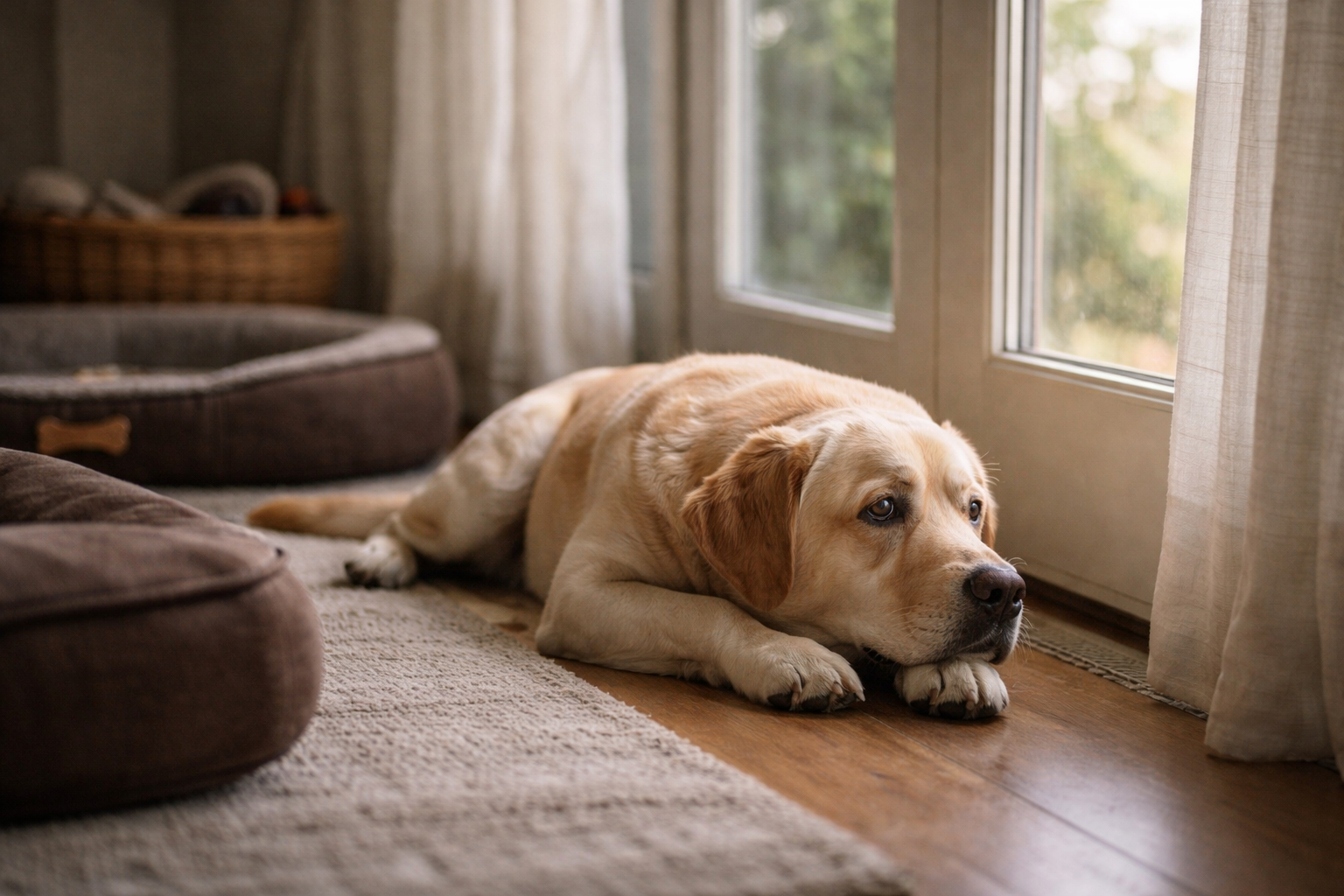
Yes — pets grieve. When a dog loses another dog they lived alongside, the grief response is real, measurable, and documented by peer-reviewed research. If you are watching your surviving dog move through your home like something is missing since your other dog died, you are not imagining it. Science has a name for what you are seeing — and it matters.
As an Amazon Associate, I earn from qualifying purchases. This helps support K9 Hearts' mission to provide grief support resources for those who have lost their beloved dogs.
You may have noticed it the day after your dog died. Your surviving dog standing at the door, waiting. Sniffing the bed where the other one used to sleep. Eating less. Playing less. Following you from room to room more than usual, as if they are trying to hold the household together with their presence.
You may have wondered — do they know? Do they feel it?
The answer, as best as science can currently tell us, is yes. Not in the way we grieve with words and memory and meaning — but in a way that is real, measurable, and deserves your attention and care.
And here is something the research confirms that most people are not told: your grief and your surviving dog's grief are connected. What you are carrying affects them. And what they are going through is something you are not meant to navigate alone.
What the science says about dogs and grief
Dogs are wired for attachment. Biologist Barbara King, in her foundational academic work How Animals Grieve, documented grief-like responses across multiple species — dogs, cats, horses, elephants, chimpanzees, and birds. Her work established that grief-like behavior is not uniquely human. It is a natural response in social animals whose neurology supports deep attachment. When that attachment is disrupted by loss, the disruption shows.
For dogs specifically, researcher Adam Miklósi's work on canine cognition and behavior established that dogs share neural pathways with humans for processing social bonds. They are built for relationship. They track the presence and absence of those they are bonded to. When someone disappears — whether a human or a canine companion — their nervous system registers it.
The most significant peer-reviewed study on dog grief was published in Scientific Reports in 2022 by Pirrone and colleagues. The researchers surveyed 426 Italian dog owners whose dog had died while they also owned at least one other dog. What they found was striking.
86% of owners observed negative behavioral changes in the surviving dog after the death of their companion. The most common changes were increased attention-seeking in 67% of dogs, reduced play in 57%, and reduced activity in 46%. In 32% of cases these behavioral changes lasted between two and six months. In 25% of cases they lasted longer than six months.
Science cannot yet say with certainty that dogs grieve the way we do. But it can say their behavior changes significantly after losing a companion — and that those changes look a lot like grief.
What grief looks like in a surviving dog
Every dog expresses grief differently — just as every person does. But the Pirrone study and veterinary observation point to a consistent pattern of changes that may appear in the days and weeks after a companion dog dies.
You might notice your dog eating less or more slowly. They may sleep more than usual, or sleep in different places — sometimes where the other dog used to sleep, sometimes avoiding those spots entirely. They may vocalize more — whining, howling, or making sounds they did not make before. They may search the house, sniffing in corners, checking familiar spots, looking for the one who is gone.
Some surviving dogs become more clingy — following their owner everywhere, reluctant to be left alone. Others become more withdrawn — less responsive, less interested in play, quieter than their normal selves. Some dogs show increased fearfulness or anxiety, particularly around routines that used to involve their companion.
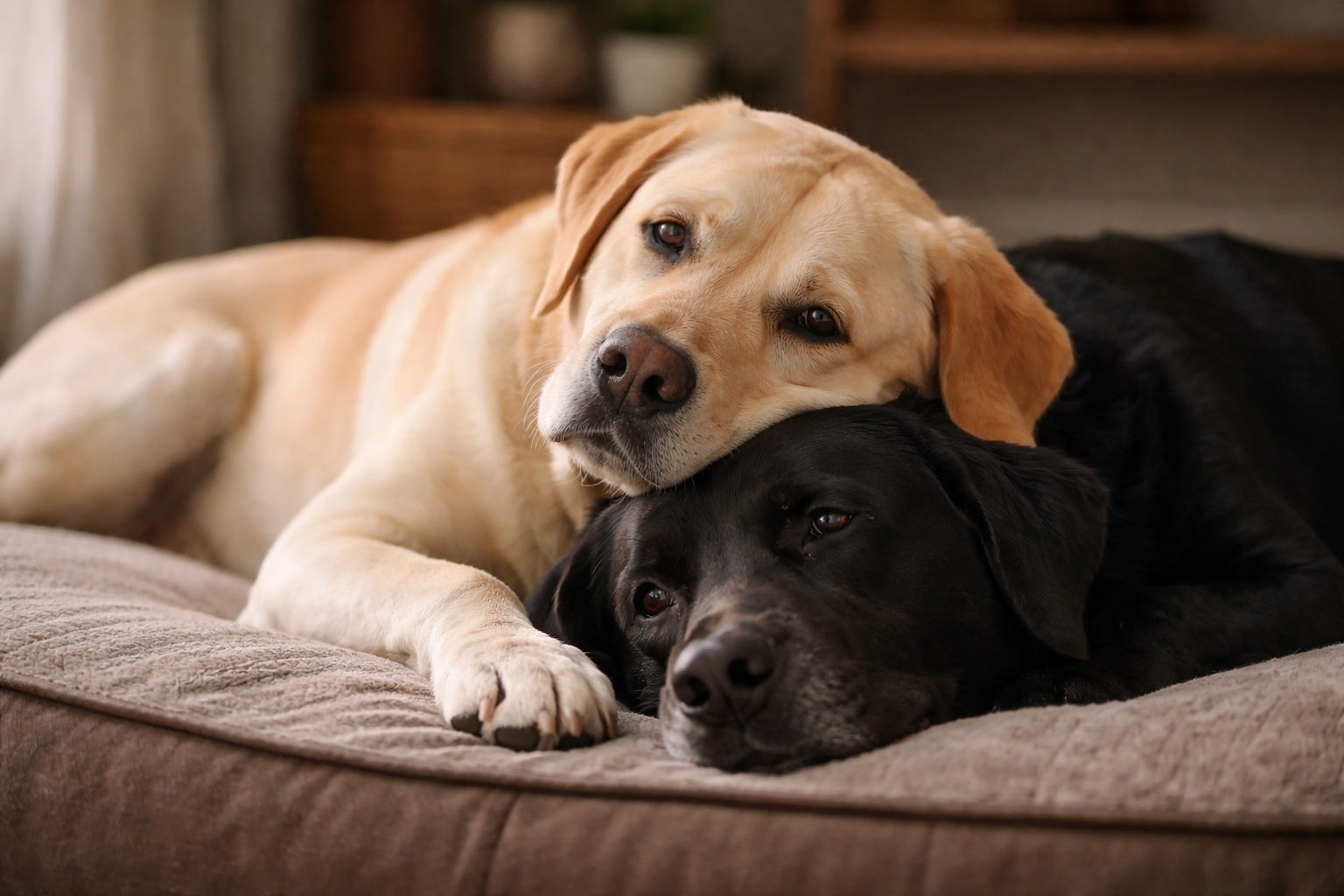
The Pirrone study found something especially important here: the quality of the relationship between the two dogs mattered more than how long they had lived together. Dogs who had a close, friendly bond with the deceased companion showed more significant behavioral changes. Dogs in more distant or neutral relationships showed less. The grief was proportionate to the love — which is something we understand deeply as humans too.
Your grief is affecting your dog — and that is not your fault
This is the finding from the Pirrone study that most people are not told — and it is one of the most important things in this blog.
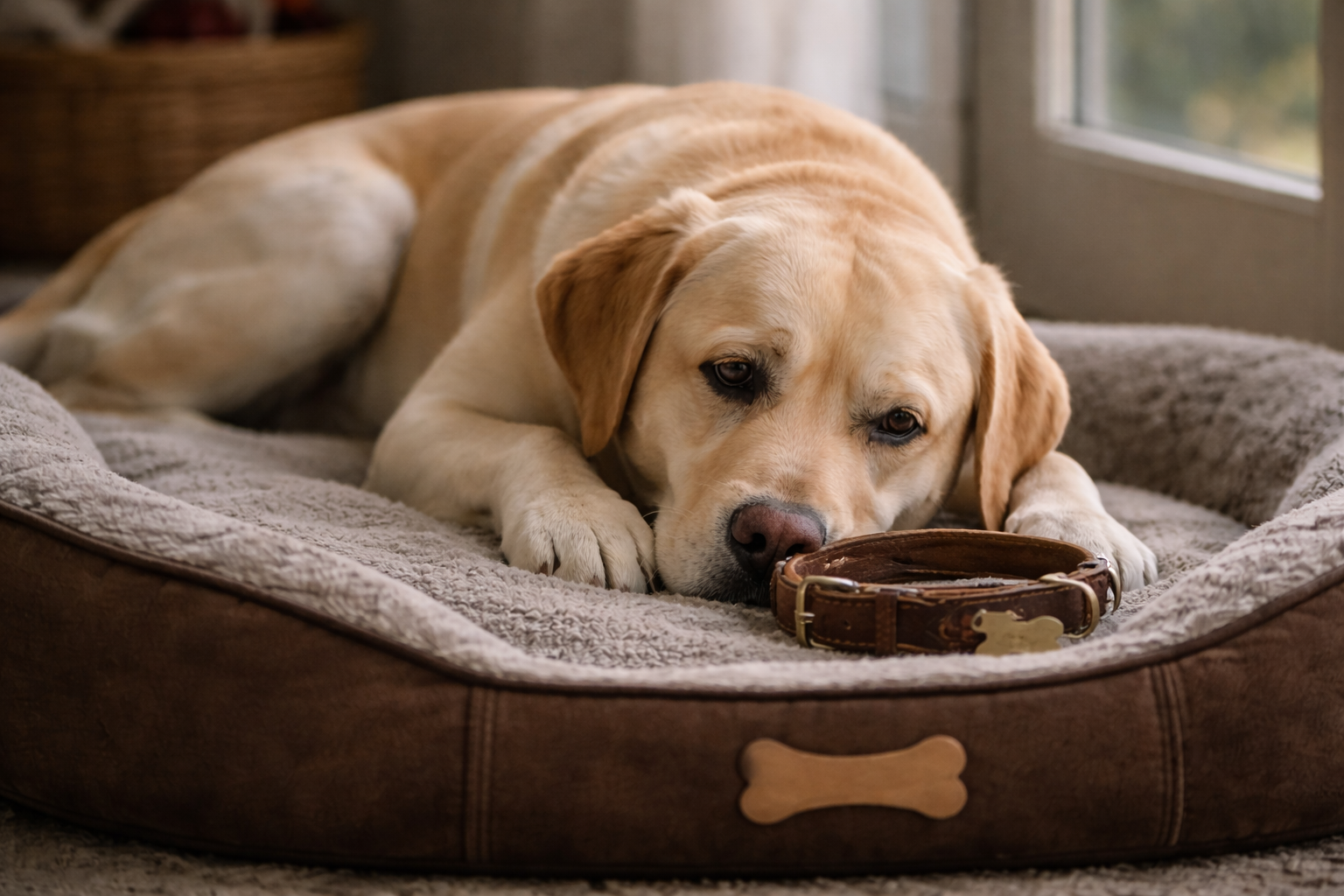
The researchers found that surviving dogs whose owners were experiencing higher levels of grief showed increased fearfulness and behavioral changes. The owner's emotional state was directly correlated with the surviving dog's distress.
This does not mean you need to hide your grief from your dog. That is neither possible nor healthy. What it means is that your dog is paying close attention to you. They are reading your body language, your routine, your energy. When you are devastated — and you are allowed to be devastated — they feel it too.
You are both grieving. And the most loving thing you can do for your surviving dog is to also take care of yourself.
This is one of the reasons K9 Hearts exists — not just to support you in your grief, but to help you understand that your grief and your dog's wellbeing are not separate things. They are woven together. When you have a place to put your grief — a journal, a book that witnesses it honestly, a memorial that honors the dog you lost — you carry it differently. And your dog feels that too.
How to help your surviving dog
You cannot explain to your dog what happened. You cannot sit them down and tell them that their companion is not coming back. What you can do is offer consistency, presence, and gentle support while they find their footing again.
Maintain routine as much as possible. Feeding times, walk times, the rhythm of the day — these are anchors for a grieving dog. When routines dissolve, anxiety increases. Keeping what you can consistent gives your dog something stable to return to.
Increase gentle enrichment. A dog who is grieving often has a disrupted appetite and reduced interest in play. A puzzle feeder can help — it engages their nose and problem-solving instinct, encourages slower eating, and provides mental stimulation when their motivation for physical play is low. Even five minutes of sniffing and searching activates the parts of a dog's brain associated with calm and reward.
Give them extra closeness without creating new anxiety. More time together — walks, quiet sitting, gentle physical contact — is genuinely comforting. But be careful not to reinforce anxious behaviors. If your dog is following you everywhere and showing signs of separation anxiety, a slow and gentle return to normal independence will serve them better over time than constant reassurance.
If your dog's behavioral changes are severe or prolonged — significant appetite loss for more than a couple of days, extreme lethargy, persistent vocalization, or signs of physical decline — contact your veterinarian. Grief and illness can look similar, and ruling out a medical cause is always the right first step. Your veterinarian may also discuss whether a calming supplement — one carried by many veterinary offices and formulated for situational stress and anxiety — might help your dog through the adjustment period. Always check with your veterinarian before starting any new supplement.
Honoring the dog who died — for both of you
There is something that happens when you give the loss a name, a ritual, a place.
For you, it becomes real in a way that helps the grief move — not disappear, but move. For your surviving dog, the routines of grief that you create — returning to a photograph, visiting a memorial space, sitting quietly with their memory — become part of the new rhythm of the household. Dogs are exquisitely attuned to ritual and repetition. When the loss has a place in your home and your life, it settles differently than when it is carried silently.
For your own grief during this time, Charlie's Last Walk — written from inside the experience of watching a beloved dog decline and die — offers something that clinical resources cannot. It offers honest company. It is not a self-help book. It is a real account of what this grief actually feels like, including the part where you are still carrying it while trying to show up for the living.
Charlie's Guided Journal for Pet Loss was built alongside the memoir, with prompts that help you process both the loss and the ongoing experience of living with a surviving dog who is also adjusting. Writing through it — even a few sentences at a time — is one of the most evidence-supported tools for moving through grief.
If you are also sitting with the broader weight of loss and looking for a grief companion that speaks to every kind of loss, Good Grief by Granger Westberg has offered comfort to more than three million readers over fifty years. It is short, gentle, and honest — and fits in a pocket or a bag for the moments when grief surfaces unexpectedly.
The End of Paw Prints Legacy Portrait — a K9 Hearts initiative — creates an AI-enhanced memorial portrait of your dog and places it permanently in the EOP Legacy Gallery and Virtual Resting Place. It is a tribute for you. And it is also something your surviving dog will notice — a photograph on a wall, a presence still held in the space of your home.
The paw prints stop. The love never does.
A note on what your surviving dog needs most
With a B.S. in Psychology and an M.A. in Forensic Psychology, plus nearly 30 years of working with children and families through the hardest parts of their lives, I have seen grief expressed in every form. And I have learned that the most healing thing — for people and for dogs — is not the absence of grief but the presence of witness.
Your surviving dog does not need you to be okay. They need you to be present. They need routine, gentleness, and the knowledge that you are still there — that the household, though changed, is still home.
And you need the same things.
Permission to grieve.
Permission to take time.
Permission to honor the one you lost without rushing toward being fine.
That is what K9 Hearts exists to offer. For you. And for the dog still at your side.
Where losing your best friend is understood.
If you are grieving the dog you lost while also trying to care for the one still beside you, Charlie's Last Walk was written to sit with you in both.
Frequently Asked Questions
Do dogs really grieve when another dog dies?
Research suggests yes — or at least something that looks and functions very much like grief. A peer-reviewed study published in Scientific Reports in 2022 surveyed 426 dog owners and found that 86% observed significant negative behavioral changes in their surviving dog after the death of a companion dog. These changes included reduced appetite, less play, increased attention-seeking, and altered sleep patterns. While science cannot yet confirm that dogs experience grief exactly as humans do, the behavioral evidence is clear and documented.
How long does a dog grieve the loss of another dog?
The Pirrone et al. 2022 study found that behavioral changes lasted between two and six months in about a third of surviving dogs, and longer than six months in about a quarter of cases. Every dog is different. The quality of the relationship between the two dogs — not the length of time they lived together — was the strongest predictor of how significantly the surviving dog was affected.
What are the signs that my dog is grieving?
Common signs include reduced appetite or eating more slowly, decreased interest in play, sleeping more than usual, searching the house or waiting near doors, increased clinginess or attention-seeking, withdrawal, and in some cases increased vocalization or fearfulness. These behaviors can also indicate illness, so if they are severe or prolonged, a veterinary visit is always the right first step.
Does my dog know that our other dog died?
Dogs have a strong awareness of absence. They track the scents, sounds, and routines associated with those they are bonded to. When a companion disappears permanently, dogs respond to that absence — searching, waiting, changing their behavior. Whether they understand death in the way humans do is not something science can currently confirm, but they clearly register that something significant has changed.
Can my own grief make my dog's grief worse?
The Pirrone 2022 study found a direct correlation between owner grief levels and behavioral changes in surviving dogs. Dogs whose owners were grieving more intensely showed increased fearfulness and distress. This does not mean you should hide your grief. It means your dog is deeply attuned to you — and that taking care of yourself during this time is one of the most loving things you can do for them as well.
How can I help my surviving dog after losing our other dog?
Maintain routine as consistently as possible. Offer extra gentle closeness and enrichment. Watch for signs of illness that can look like grief. Consider consulting your veterinarian if behavioral changes are severe or prolonged. And give both yourself and your dog the time and space to adjust — there is no fixed timeline for grief, for you or for them.
Do other animals grieve, or is it just dogs?
Grief-like behavior has been documented across many species — not just dogs. Biologist Barbara King's research documented grief responses in cats, horses, elephants, chimpanzees, and birds. Elephants have been observed returning to the remains of deceased companions. Chimpanzees have been documented caring for deceased young. The capacity for grief-like response appears to be a feature of social animals with strong attachment bonds — not a uniquely human experience.
References
Pirrone, F., Albertini, M., Uccheddu, S., Ronconi, L., Farina, L., Faustini, M., & Vigo, D. (2022). Domestic dogs (Canis familiaris) grieve over the loss of a conspecific. Scientific Reports, 12, 1. https://doi.org/10.1038/s41598-022-05669-y[Peer-reviewed | Published in: Scientific Reports | Indexed on PubMed and PMC] Plain-language summary: Surveyed 426 dog owners whose dog had died while they also owned at least one other dog. Found that 86% of surviving dogs showed negative behavioral changes after the death of their companion. The most common changes were increased attention-seeking, reduced play, and reduced activity. Quality of the relationship between the dogs — not duration of cohabitation — was the strongest predictor of behavioral change. Owner grief levels were correlated with increased fearfulness in surviving dogs. Used in this blog as the primary research anchor for all claims about dog grief behavior and the owner-dog grief connection.
King, B. J. (2013). How animals grieve. University of Chicago Press. [Peer-reviewed academic press publication | Widely cited in animal cognition and grief literature] Plain-language summary: Documented grief-like behaviors across multiple animal species including dogs, cats, horses, elephants, chimpanzees, and birds. Established that grief-like responses are a feature of social animals with strong attachment bonds — not uniquely human. Used in this blog to provide broader scientific context for why dogs are capable of grief-like responses.
Miklósi, Á. (2015). Dog behaviour, evolution, and cognition (2nd ed.). Oxford University Press. [Peer-reviewed academic text | Standard reference in canine cognition research] Plain-language summary: Established that dogs share neural pathways with humans for processing social bonds and have the neurological and social architecture to form deep attachments and experience distress at separation. Used in this blog to explain the biological basis for why dogs can experience grief-like responses to loss.
Pirrone, F., & Albertini, M. (2016). Owners' perceptions of their animal's behavioural response to the loss of an animal companion. Animals, 6(11), 68. https://pmc.ncbi.nlm.nih.gov/articles/PMC5126770/ [Peer-reviewed | Published in: Animals | Indexed on PMC] Plain-language summary: Earlier foundational study establishing the methodology for studying grief-like responses in companion animals through owner reports. Found behavioral changes in companion animals following the death of another companion animal, including reduced eating, altered activity, and increased vocalization. Used as supporting context for the 2022 Pirrone findings.
K9 Hearts does not provide clinical mental health services. If you are experiencing grief that significantly impacts your daily functioning, please reach out to a licensed mental health professional. If you are in crisis, call or text 988. K9 Hearts updates their Resources page for additional resources at https://www.k9hearts.com/pet-loss-and-grief-support.