

What Resources Are Available for Coping with the Death of a Beloved Pet?

Disclosure: This post contains Amazon affiliate links. If you purchase through these links, K9 Hearts may earn a small commission at no additional cost to you. We only recommend products we genuinely believe support your healing journey.
Nobody tells you how quiet the house will be.
Not just the absence of sound — but the absence of presence. The weight of a dog who used to lean against your leg. The click of nails on the floor. The way they always knew when you needed them most.
When a beloved dog dies, the grief that follows is real, measurable, and often profoundly isolating. Society does not always make room for it. There is no bereavement leave for a dog. No casseroles left at the door. Often, just a hollow silence and the well-meaning but devastating words: it was just a dog.
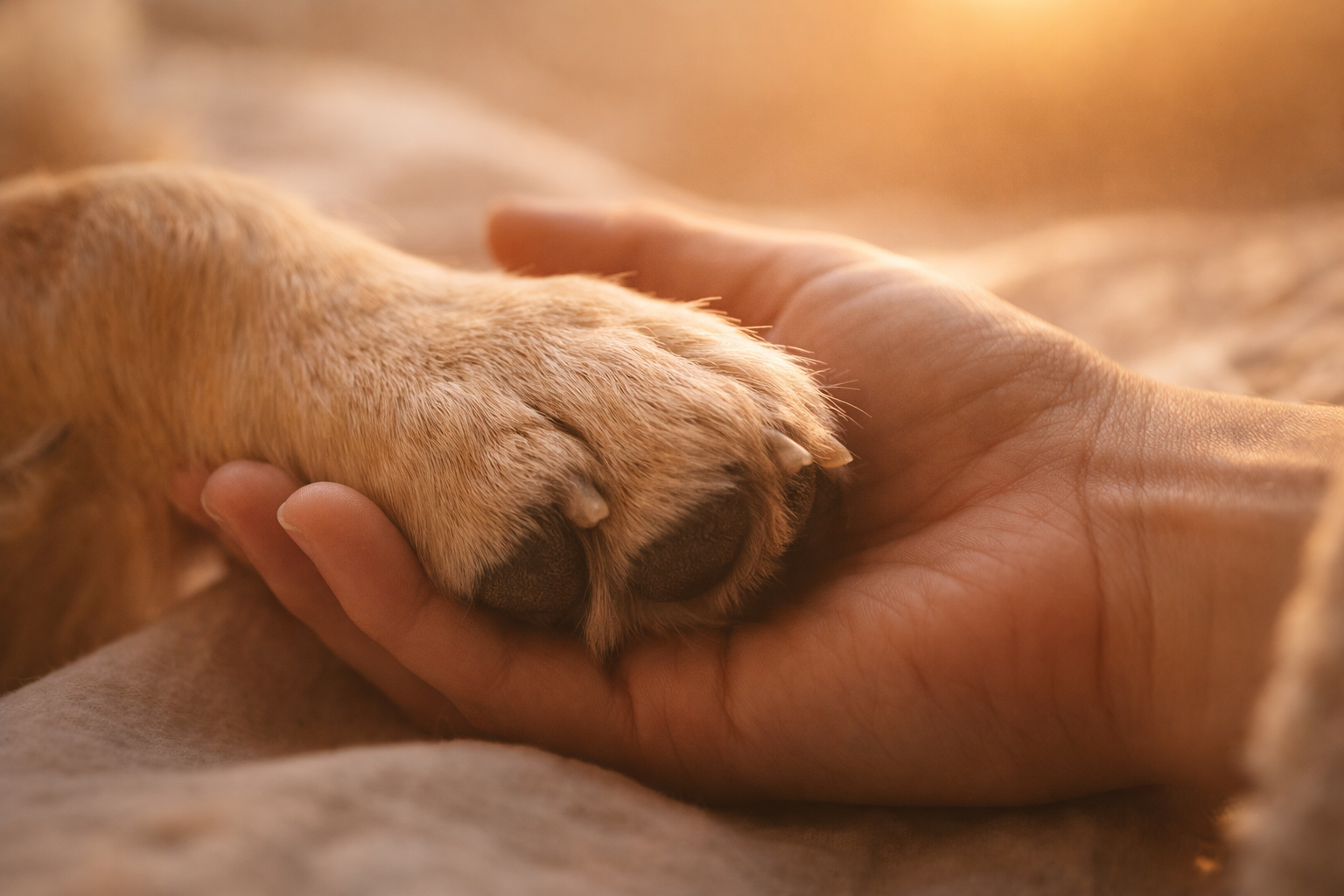
It was not just a dog. And you do not have to grieve alone.
This guide walks through the resources available for coping with pet loss — from evidence-based frameworks to therapeutic tools, support communities, and the kind of gentle, story-driven companionship that K9 Hearts was built to offer.
First: Your Grief Is Real and Recognized by Research
Before we talk about resources, it matters to say this clearly: what you are feeling is not an overreaction.
A peer-reviewed literature review published in PubMed (Lavorgna & Hutton, 2021), which analyzed 48 studies on pet bereavement, found that bereaved pet owners frequently reported feelings of embarrassment and loneliness following the loss of their pet — and that coping mechanisms used included social support, continuing bonds, memorialization, religion, and relationships with other animals. PubMed
A 2025 peer-reviewed systematic narrative synthesis published in SAGE Open (Hughes & Lewis Harkin, 2025) confirmed that when a pet dies, owners can experience similar levels of grief as when a human dies. Sage Journals
Your grief is not disproportionate. It is the natural cost of a love that was real.
The Six Categories of Pet Loss Coping Resources
1. Story and Narrative — Finding Yourself in Someone Else's Words

One of the most powerful early coping resources is simply reading the words of someone who truly understands. Not clinical language. Not a checklist of stages. Just a story that says: I know this grief. I have walked it too.
This is why K9 Hearts founder Paige Cummings wrote Charlie's Last Walk: A Dog Memoir of Healing after Pet Loss — not as a manual, but as a companion. It is the story of Charlie Brown, a three-year-old Labrador whose body began failing him too soon, and of the grief that followed his loss. It is also the story of what happens after — how love finds its way forward even when it feels impossible.
Charlie's Last Walk is available in paperback on Amazon, and in digital format directly through k9hearts.com for instant access.
If you are in the raw early days of loss and need to feel understood right now, begin here
2. Therapeutic Guided Journals — Giving Grief a Place to Go
Make it stand out
A guided journal does something different from a blank notebook. It meets you where you are. It asks the right questions at the right time. It creates a container for grief rather than leaving it shapeless..
Grief that has nowhere to go turns inward. It becomes the 2 AM spiral, the unexplained exhaustion, the inability to talk about your dog without breaking down in ways that feel embarrassing and endless.
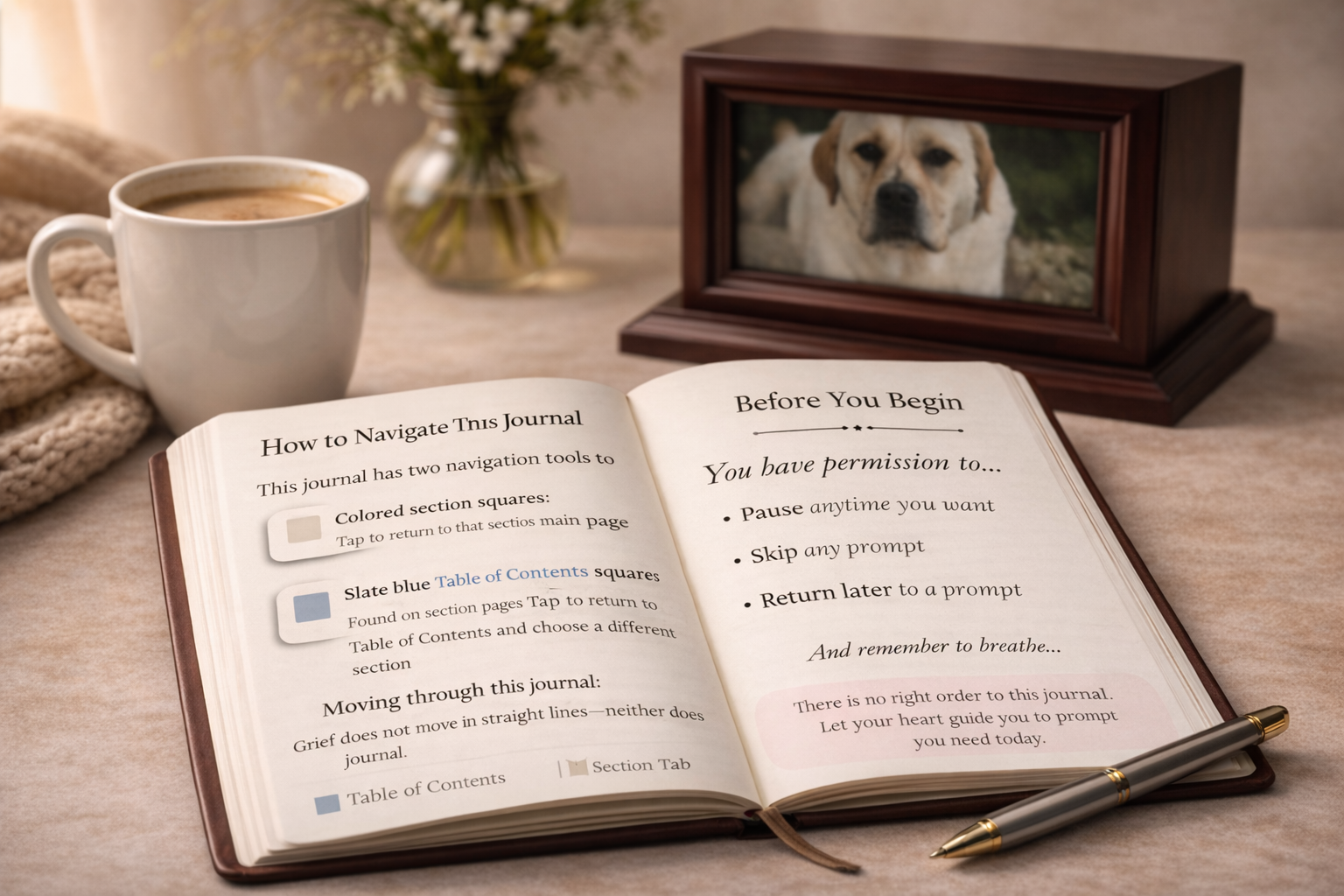
A guided journal does something different from a blank notebook. It meets you where you are. It asks the right questions at the right time. It creates a container for grief rather than leaving it shapeless.
Charlie's Guided Journal for Pet Loss was created specifically for this. Grounded in evidence-based frameworks — including Worden's Four Tasks of Mourning, the Dual Process Model, and Continuing Bonds theory — it guides you gently through the full arc of dog loss grief, from the anticipatory grief of a declining dog to the slow, nonlinear path of remembrance and forward movement.
Available in paperback and hardcover on Amazon, and in digital format through k9hearts.com for immediate download — optimized for GoodNotes, Adobe, and all major PDF readers.
For those who prefer a more personal journaling experience, a quality journal and a reliable pen matter more than you might think. Writing by hand activates different emotional processing pathways than typing.
Leuchtturm1917 Hardcover Journal — a beautifully made journal with numbered pages and a ribbon marker. Many grievers find a dedicated physical journal for their pet loss writing feels more honoring than a random notebook.
Pilot G2 Gel Pens — smooth, consistent writing that makes the physical act of journaling feel intentional rather than effortful.
3. Memorial Art and Continuing Bonds
Continuing bonds are an effort to maintain emotional attachment following death — a continuation of that attachment and an attempt to manage grief. PubMed Central Research consistently shows that meaningful continuing bonds can moderate grief intensity and support post-traumatic growth.
One of the most powerful expressions of continuing bonds is memorial art — creating something that honors your dog's physical presence and legacy in a way that photographs alone cannot always achieve.
The K9Hearts EOP Legacy Portrait was created for this exact purpose. Starting at $97, each portrait is a custom, AI-enhanced memorial image created with grief-informed design principles — not just a filtered photo, but a human-curated tribute that places your dog in a peaceful, healing setting. Tier 3 portrait holders receive a permanent place in the EOP Gallery, where their dog's legacy lives on.

Other continuing bonds expressions that research supports include creating a memory box with your dog's collar, favorite toy, and a few photographs; planting a memorial garden or tree; keeping a meaningful object — a blanket, a leash — in a place of honor in your home.
A shadow box creates a beautiful, tactile memorial that holds your dog's collar, tag, and a favorite photograph together in one meaningful display. The Americanflat 11x14 Shadow Box Frame is a top-rated option — Amazon's Choice with over 15,000 reviews and shatter-resistant glass, it's large enough to hold a portrait alongside your dog's most treasured keepsakes.
The iHeartDogs Forever My Guardian Angel Garden Solar Light creates a dedicated outdoor space for remembrance — a peaceful angel figure with a soft solar glow, rated 4.7 stars by over 2,300 pet families.
4. Social Support — Being Witnessed in Your Grief
Perceived support following animal companion loss affects the grieving process — when grief goes unacknowledged, bereaved owners may perceive their grief as socially unacceptable to express and become withdrawn and socially isolated. PubMed Central
Being witnessed — having someone say I see your grief and it is valid — is not a small thing. It is often the turning point.
If the people around you are struggling to understand, there are communities built specifically for this:
Online pet loss support groups — Facebook hosts several active pet loss grief communities where thousands of bereaved dog owners share their experiences daily. Search "pet loss grief support" on Facebook to find active groups.

Pet loss hotlines — several veterinary schools operate free pet loss support hotlines staffed by trained counselors, including Cornell University's Pet Loss Support Hotline and the University of Illinois CARE Pet Loss Helpline.
K9 Hearts Grief Resources page — our dedicated Pet Loss Support & Grief Resources page compiles evidence-based frameworks, support group information, and guidance for navigating every stage of dog loss grief.
5. Therapeutic Reading and Psychoeducation
Understanding what is happening in your grief can reduce its power over you. When you know that grief does not follow a straight line — that you can feel acceptance on Tuesday and wake up in denial on Wednesday — you stop fighting your own process.
A peer-reviewed 2024 study published in Anthrozoös (Kogan et al.) found that it is essential that those grieving the death of their pet be supported and reassured that there is no right or wrong way to grieve, with all options recognized as legitimate in the experience and expression of one's grief. Sage Journals
Some books that research and clinicians consistently recommend for pet loss grief:
The Loss of a Pet by Wallace Sife, Ph.D. — one of the most widely recommended books on pet bereavement, written by a psychologist who lost his own dog. Peer-reviewed grief literature frequently cites this work.
Goodbye, Friend: Healing Wisdom for Anyone Who Has Ever Lost a Pet by Gary Kowalski — a gentle, spiritually warm exploration of pet loss written by a minister and animal advocate.
6. Professional Support

For some grievers — particularly those experiencing prolonged, complicated, or compounded grief — professional therapeutic support is the most appropriate resource.
A three-tier model for pet loss grief therapy published in the Human-Animal Interaction Bulletin (Packman et al., 2014) recommends that individuals who specifically seek out grief therapy for their loss, or for those who are currently in therapy and express difficulty, receive indicated therapeutic intervention — which proves more effective than when grievers are recruited. Cabi Digital Library In other words, if you feel you need professional support, that instinct is meaningful and worth following.
When seeking a therapist for pet loss grief, look for someone with experience in bereavement counseling, and do not hesitate to ask specifically whether they are comfortable supporting grief for companion animal loss. Not all therapists are — and finding one who is makes a significant difference.
The Association for Pet Loss and Bereavement (APLB) maintains a directory of counselors with specific training in pet loss grief.
A Note on Timelines
The intense grief experienced by pet owners varies in length — with 25% taking between 3 months to a year, 50% between one year and 19 months, and 25% between two and six years. Mijrd
If you are still grieving your dog months or years after their passing, you are not broken. You are not stuck. You loved someone deeply. That does not resolve on a schedule.
K9 Hearts exists for the long arc of that grief — not just the first raw weeks, but the anniversary dates, the dreams, the moments years later when a golden retriever walks by on a trail and your whole body remembers.
Charlie's story became my purpose — and K9 Hearts exists to help you honor yours.
Whenever you are ready, we are here: k9hearts.com
Charlie's Last Walk is available in print on Amazon and in digital format on k9hearts.com.
Charlie's Guided Journal for Pet Loss is available in paperback, hardcover, and digital.
The EOP Legacy Portrait — a grief-informed memorial portrait for your beloved dog — begins at $97. Learn more →

FAQ
What resources are available for coping with the death of a pet?
Resources for pet loss grief include therapeutic guided journals, memorial art, peer support communities, pet loss hotlines, psychoeducational books, and professional bereavement counseling. K9 Hearts offers a complete ecosystem of grief support — including the memoir Charlie's Last Walk, the Charlie's Guided Journal for Pet Loss, EOP Legacy Portraits, and a dedicated Pet Loss Support & Grief Resources page.
Is grief after losing a dog normal?
Yes. Peer-reviewed research confirms that the grief experienced after losing a dog can be as intense as grief following the loss of a human loved one. Feelings of loneliness, guilt, and prolonged sadness are well-documented responses to pet loss.
How long does grief last after losing a dog?
Research shows that pet loss grief varies significantly in duration — with some owners grieving for months and others for several years. There is no correct timeline. What matters is finding support that meets you where you are.
What is a pet loss grief journal?
A pet loss grief journal is a guided therapeutic tool that helps bereaved pet owners process their loss through structured prompts and reflective writing. Charlie's Guided Journal for Pet Loss by Paige Cummings is grounded in evidence-based grief frameworks including Worden's Four Tasks of Mourning and the Dual Process Model.
Are there hotlines for pet loss grief?
Yes. Cornell University's Pet Loss Support Hotline and the University of Illinois CARE Pet Loss Helpline both offer free support from trained counselors. The Association for Pet Loss and Bereavement (APLB) also maintains a directory of professional counselors with specific training in companion animal loss.
What is the EOP Legacy Portrait?
The EOP Legacy Portrait is a custom, AI-enhanced memorial portrait created by K9Hearts founder Paige Cummings. EOP stands for End of Paw Prints — a tribute initiative that honors the day a beloved dog completes their journey. Portraits start at $97 and Tier 3 holders receive a permanent place in the EOP Gallery.
What is disenfranchised grief in pet loss?
Disenfranchised grief refers to grief that is not openly acknowledged or validated by society. Pet loss grief is widely recognized in research as a form of disenfranchised grief — meaning bereaved dog owners often feel their loss is minimized or dismissed. K9 Hearts exists specifically to counter this, offering a space where dog loss is understood and honored without qualification.
References
Lavorgna, B. F., & Hutton, V. E. (2021). A literature review: Pet bereavement and coping mechanisms. Journal of Psychiatric and Mental Health Nursing. https://doi.org/10.1111/jpm.12734 (Peer-reviewed, PubMed indexed)
Hughes, B., & Lewis Harkin, B. (2025). The impact of continuing bonds between pet owners and their pets following the death of their pet: A systematic narrative synthesis. SAGE Open. https://doi.org/10.1177/00302228221125955 (Peer-reviewed, SAGE)
Cleary, M., West, S., Thapa, D. K., Westman, M., Vesk, K., & Kornhaber, R. (2022). Grieving the loss of a pet: A qualitative systematic review. Death Studies, 46(9), 2167–2178. (Peer-reviewed, PubMed)
Kogan, L. R., Packman, W., Bussolari, C., Currin-McCulloch, J., & Erdman, P. (2024). Pet death and owners' memorialization choices. Anthrozoös. https://doi.org/10.1177/10541373221143046 (Peer-reviewed, SAGE)
Packman, W., Carmack, B. J., & Ronen, R. (2014). A therapist's guide to treating grief after the loss of a pet: A three-tier model. Human-Animal Interaction Bulletin. (Peer-reviewed)
Chin, C. T. (2025). The role of pets in well-being and the therapeutic potential of logotherapy in pet loss grief. MIJRD, 4(5). (Peer-reviewed, open access)