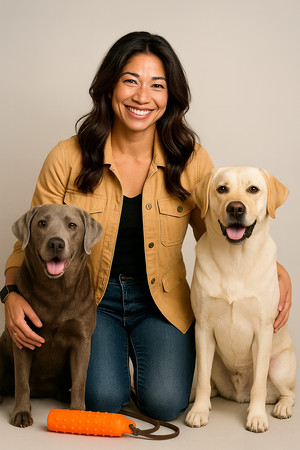

Why Do I Feel So Guilty After Losing My Dog?
Guilt after pet loss is one of the most common — and most painful — dimensions of grief, and it is not a sign that you did anything wrong. Whether you are replaying the decision to pursue euthanasia, wishing you had noticed something sooner, or feeling ashamed that you are starting to laugh again, that guilt is evidence of how deeply you loved. At K9 Hearts, we believe your grief deserves to be witnessed honestly — including the parts that are hardest to say out loud.

As an Amazon Associate, I earn from qualifying purchases. This helps support K9 Hearts' mission to provide grief support resources for those who have lost their beloved dogs.
Losing a dog is one of the most disorienting experiences a person can go through. And for many of us, the grief does not arrive alone. It brings guilt with it — a companion that sits in the corner of every quiet room and speaks in a language full of "what ifs" and "should haves."
You are not alone in this. Research consistently shows that guilt is among the most frequently reported dimensions of pet loss grief, particularly following euthanasia. A qualitative systematic review by Cleary et al. (2022) identified guilt as one of the central themes across 17 studies on pet loss — described by grieving owners as persistent, layered, and often tied to the specific circumstances of the death. This is not a personal failing. It is a known, documented part of how humans process love and loss.
Understanding where your guilt is coming from is the first step toward moving through it rather than around it.
The three most common types of guilt after pet loss
Grief researchers and clinicians have identified several distinct patterns of guilt that tend to emerge after losing a dog. Most people experience more than one.
The first is euthanasia guilt — the weight of having made the decision. Even when euthanasia was clearly the compassionate choice, many owners find themselves replaying it endlessly. Did I act too soon? Did I wait too long? Was there something else I could have tried? Grief theorist J. William Worden describes this as bargaining — the mind's attempt to find control in a situation where there was none. The decision to end suffering is one of the most profound acts of love a person can offer. And it is one of the heaviest to carry.
The second is absence guilt — the grief that comes from not being there at the moment of death. Maybe you were in another room. Maybe you were at work. Maybe circumstances made it impossible for you to be present. That absence can feel like a failure even when it was not within your control. What matters is the entire relationship you built — not the last few minutes of it.
The third is moving-forward guilt — the shame that creeps in when you smile again, or when you start thinking about getting another dog, or when a whole afternoon passes and you didn't think about your dog once. This is sometimes the most surprising form of guilt, because it arrives when things are starting to ease. Worden's Task Four of Mourning addresses this directly: finding a way to carry the love forward does not mean leaving your dog behind. It means making room for both the grief and the rest of your life.
Why guilt after pet loss can feel so consuming
Part of what makes this guilt so difficult is that it rarely gets the social support it deserves. Pet loss is what researchers call a disenfranchised grief — a grief that is not always acknowledged or validated by the people around you. When the world minimizes what you lost, the guilt does not shrink. It just becomes lonelier.
You may find that people who have never experienced this kind of bond offer well-meaning but unhelpful responses. "It was just a dog." "At least you gave them a good life." "You did the right thing." None of those words touch the guilt because they skip over it rather than sitting with it.
What actually helps is acknowledgment. Having your grief witnessed — fully, without comparison or judgment — is one of the most evidence-supported components of healthy bereavement. That is something Paige Cummings knew when she wrote Charlie's Last Walk. After losing her Labrador Charlie Brown to a devastating cascade of diagnoses — OCD (osteochondritis dissecans), DJD (degenerative joint disease), HD (bilateral hip dysplasia), and ED (elbow dysplasia) — she lived this guilt firsthand. The book does not offer easy reassurances. It offers honest company.
If you are working through euthanasia guilt specifically, the book Pet Loss & Behavioral Euthanasia — Guided Toolkit for Grieving & Healing addresses exactly that experience — the shame, the "what ifs," and the silence that surrounds the hardest kind of goodbye.
What the research says about healing from pet loss guilt
There is no single moment when guilt ends. But there are things that genuinely help.
Meaning reconstruction — the process of making sense of what happened and rebuilding your understanding of it — is one of the most well-supported tools in grief research. Psychologist Robert Neimeyer's work on meaning reconstruction suggests that guilt often persists when we have not yet been able to find a coherent narrative for what we did and why. Journaling, supported reflection, and honest storytelling are all evidence-linked ways to move through that process.
Charlie's Guided Journal for Pet Loss was built with this in mind. Structured around the same grief frameworks as Charlie's Last Walk, the journal offers prompts that help you name the guilt, examine it, and slowly integrate it into a broader story about how much you loved your dog — and how that love shaped every decision you made.
Continuing bonds theory — the understanding that healthy grief does not require "letting go" but rather finding a way to carry the relationship forward — is another framework that can ease guilt around moving on. Your dog does not disappear from your life when you start living fully again. They become part of it in a different way.

Gentle ways to begin moving through the guilt
You do not have to resolve the guilt completely before you are allowed to heal. But there are some things that can help you begin.
Name it specifically. Guilt is not one thing — it is many. Sit with the specific thought that keeps returning. Was it the timing? The decision itself? The moment you weren't there? The more precisely you can name it, the less it controls you.
Write it down. A grief journal is not about finding the right words — it is about externalizing the weight. Grief research consistently supports expressive writing as a tool for processing difficult emotions, particularly guilt and regret. If you are not sure where to start, Charlie's Guided Journal for Pet Loss offers structured prompts for exactly this.
Allow yourself comfort. Giving yourself permission to grieve with gentleness rather than judgment is not weakness. Some people find that creating a small ritual — lighting a candle, holding something that belonged to their dog, or simply sitting quietly in a space that holds memories — gives the guilt somewhere to go. The Pet Loss Bereavement Gift Box from Gill + Jill includes a memory candle, photo frame, and remembrance ornament designed to support exactly this kind of quiet honoring.
Consider a memorial that holds their story. For many people, guilt around moving forward eases when there is a permanent, intentional tribute to their dog — something that says, clearly, "You are not forgotten. You are carried." The End of Paw Prints Legacy Portrait, a K9 Hearts initiative, creates an AI-enhanced memorial portrait that becomes part of the EOP Legacy Gallery and Virtual Resting Place — a permanent space where your dog's story lives on.
The paw prints stop. The love never does.
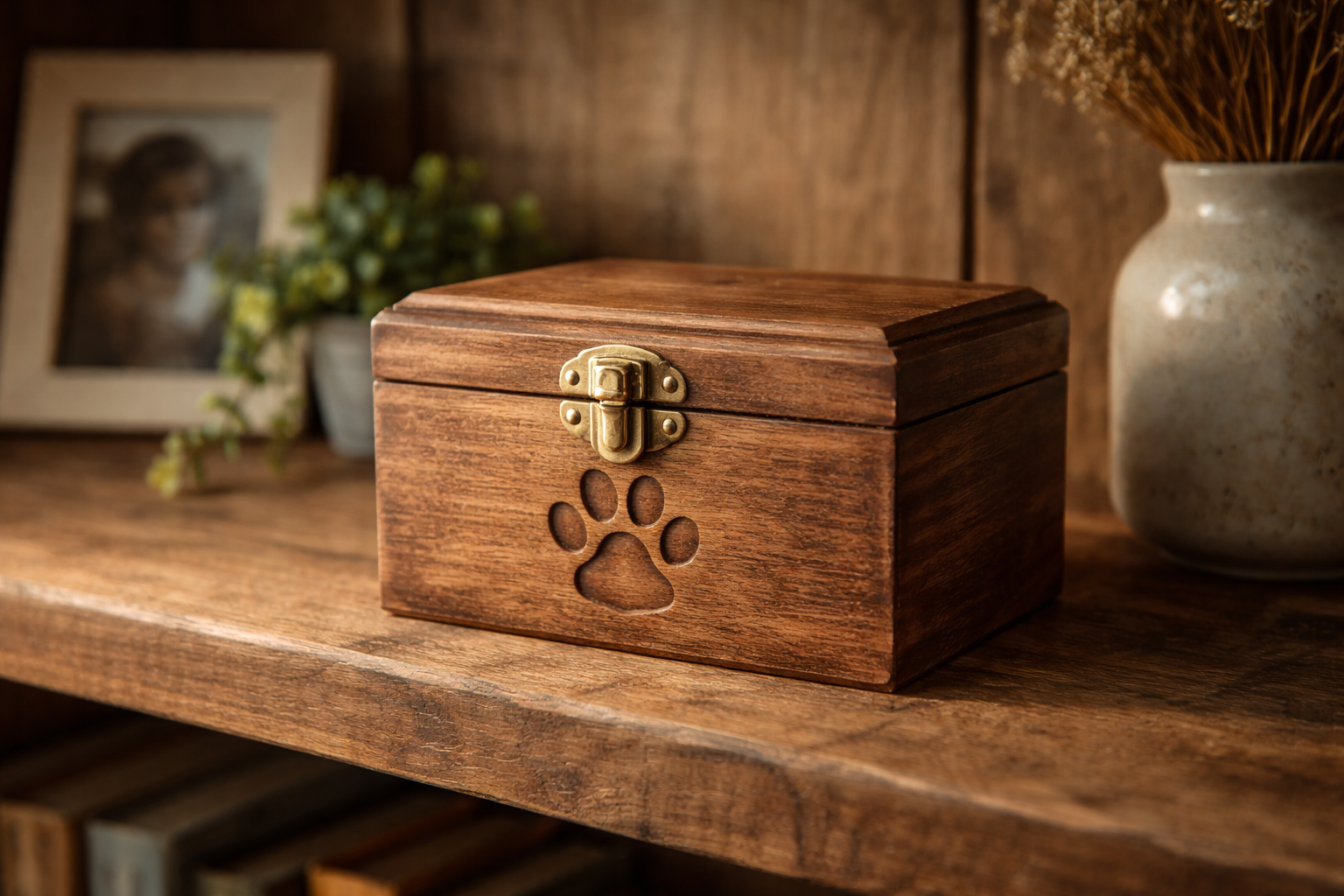
Some people find that having a physical place to keep their dog's belongings — not displayed everywhere, but held safely — makes it easier to move forward without shame. A personalized memory keepsake box, like this customized wooden memorial box, can become exactly that: a sacred, private place for what mattered most, kept alongside the things you return to every year.
A note from Paige
With a B.S. in Psychology and an M.A. in Forensic Psychology, plus nearly 30 years of working with children and families through the hardest parts of their lives, I have seen guilt in many forms. And I have lived this particular kind myself.
After Charlie died, I found myself replaying decisions. Second-guessing timelines. Lying awake wondering if I had missed something, waited too long, noticed too late. None of it changed the outcome. But it took a long time to understand that guilt was not the truth — it was love with nowhere left to go.
That is what I wrote Charlie's Last Walk to say. And it is what K9 Hearts exists to hold space for.
You loved your dog. You made the best decisions you could with the information you had, in one of the hardest moments of your life. That is not something to feel guilty about. That is something to be witnessed.
Where losing your best friend is understood.
If this post spoke to something you are carrying, Charlie's Last Walk was written for exactly this moment. It is not a self-help book. It is an honest account of grief — including the guilt — from someone who has lived it.
Frequently Asked Questions:
Is guilt after losing a dog normal?
Yes — profoundly, and almost universally. Guilt is one of the most consistently reported dimensions of pet loss grief in the research literature. It is particularly common after euthanasia but also appears in owners who were not present at the time of death or who feel conflicted about beginning to heal. Guilt is not evidence that you did something wrong. It is evidence of how much you loved.
Why do I feel so guilty for choosing euthanasia?
Because you were the one who had to make an impossible decision on behalf of someone who could not tell you what they wanted. That responsibility is enormous, and the mind struggles with it long after the fact. Grief researchers describe this as a form of bargaining — the search for control in a situation where there was none. The decision to end suffering, made from love, is one of the most selfless acts a person can offer their dog.
How long does guilt after pet loss last?
There is no fixed timeline. For some people, the acute guilt eases within weeks. For others, it resurfaces at unexpected moments for months or years — especially around anniversaries, or when they think about getting another dog. What changes over time is usually not the absence of guilt but its intensity, and your ability to hold it alongside everything else that was true about your relationship with your dog.
Is it okay to feel guilty about moving on after losing my dog?
Yes. This is one of the most common — and least talked about — forms of pet loss guilt. Feeling like you are betraying your dog by laughing again, or by considering a new dog, or by simply having a good day is a sign that you loved deeply. Grief researcher J. William Worden's framework describes the final task of mourning as finding a way to carry the love forward while also returning to a full life. Moving forward is not moving on. It is carrying your dog with you into what comes next.
I wasn't there when my dog died. Will I ever stop feeling guilty about that?
Most people who carry this guilt eventually find that what mattered most was not the last few minutes, but the entire relationship they built — the walks, the mornings, the years of being chosen by each other. If circumstances kept you from being present, that was not a failure. Your dog knew they were loved. That is what they carried with them.
What is the difference between grief and guilt after losing a pet?
Grief is the broad experience of loss — the waves of sadness, longing, disorientation, and eventual adjustment. Guilt is one specific dimension of grief — the self-directed belief that you did something wrong, didn't do enough, or should have acted differently. They often arrive together and feed each other, but they are not the same thing. Addressing the guilt specifically — by naming it, writing about it, and finding a narrative that holds the full truth of your love and your decisions — can help the broader grief process move more gently.
Can journaling help with pet loss guilt?
Research on expressive writing in bereavement consistently shows that naming and externalizing difficult emotions — especially guilt and regret — can reduce their intensity over time. Journaling is not about finding the right answer. It is about giving the guilt somewhere to go outside of your own head. Charlie's Guided Journal for Pet Loss offers structured prompts that walk you through exactly this process, alongside real excerpts from Charlie's Last Walkthat show you what honest grief processing actually looks like.
References:
Cleary, M., West, S., Arthur, D., & Kornhaber, R. (2022). Grieving the loss of a pet: A qualitative systematic review. Death Studies, 46(9), 2167–2178. https://doi.org/10.1080/07481187.2021.1927674 [Peer-reviewed | Published in: Death Studies] Plain-language summary: This systematic review synthesized 17 qualitative studies on pet loss grief. It identified guilt as one of the central recurring themes, alongside relationship centrality, grief intensity, social support, and future adjustment. Used in this blog to support the claim that guilt is a documented, widely-reported dimension of pet loss grief.
Worden, J. W. (2018). Grief counseling and grief therapy: A handbook for the mental health practitioner (5th ed.). Springer Publishing Company. [Peer-reviewed clinical text | Standard reference in bereavement research and practice] Plain-language summary: Worden's Four Tasks of Mourning framework describes grief as an active process rather than passive stages. Task Two, Task Three, and Task Four are directly relevant to guilt processing and the concept of moving forward without leaving the dog behind. Used in this blog to explain bargaining, the grief process, and carrying love forward.
Neimeyer, R. A. (2001). Meaning reconstruction and the experience of loss. American Psychological Association. https://doi.org/10.1037/10397-000 [Peer-reviewed | Published by the American Psychological Association] Plain-language summary: Neimeyer's work on meaning reconstruction describes grief as a process of rebuilding a coherent personal narrative after loss. Guilt often persists when that narrative remains unresolved. Used in this blog to support journaling and reflective writing as evidence-linked tools for processing guilt.
Doka, K. J. (1989). Disenfranchised grief: Recognizing hidden sorrow. Lexington Books. [Peer-reviewed foundational text | Widely cited in bereavement literature] Plain-language summary: Doka introduced the concept of disenfranchised grief — loss that is not socially recognized or validated. Pet loss is consistently identified in the literature as a form of disenfranchised grief. Used in this blog to explain why guilt after pet loss often goes unsupported and why acknowledgment is a meaningful part of healing.
K9 Hearts does not provide clinical mental health services. If you are experiencing grief that significantly impacts your daily functioning, please reach out to a licensed mental health professional. If you are in crisis, call or text 988. K9 Hearts updates their Resources page for additional resources at https://www.k9hearts.com/pet-loss-and-grief-support.