
How Long Does Pet Grief Last?
As an Amazon Associate, I earn from qualifying purchases. This helps support K9 Hearts' mission to provide grief support resources for those who have lost their beloved dogs.
There is no set timeline for pet grief, and there is nothing wrong with you if you are still hurting weeks, months, or even years after losing your dog. Research consistently shows that grief after dog loss follows the same emotional patterns as grief after human loss — and at K9 Hearts, that reality is never minimized or rushed.

The Question Nobody Warned You About
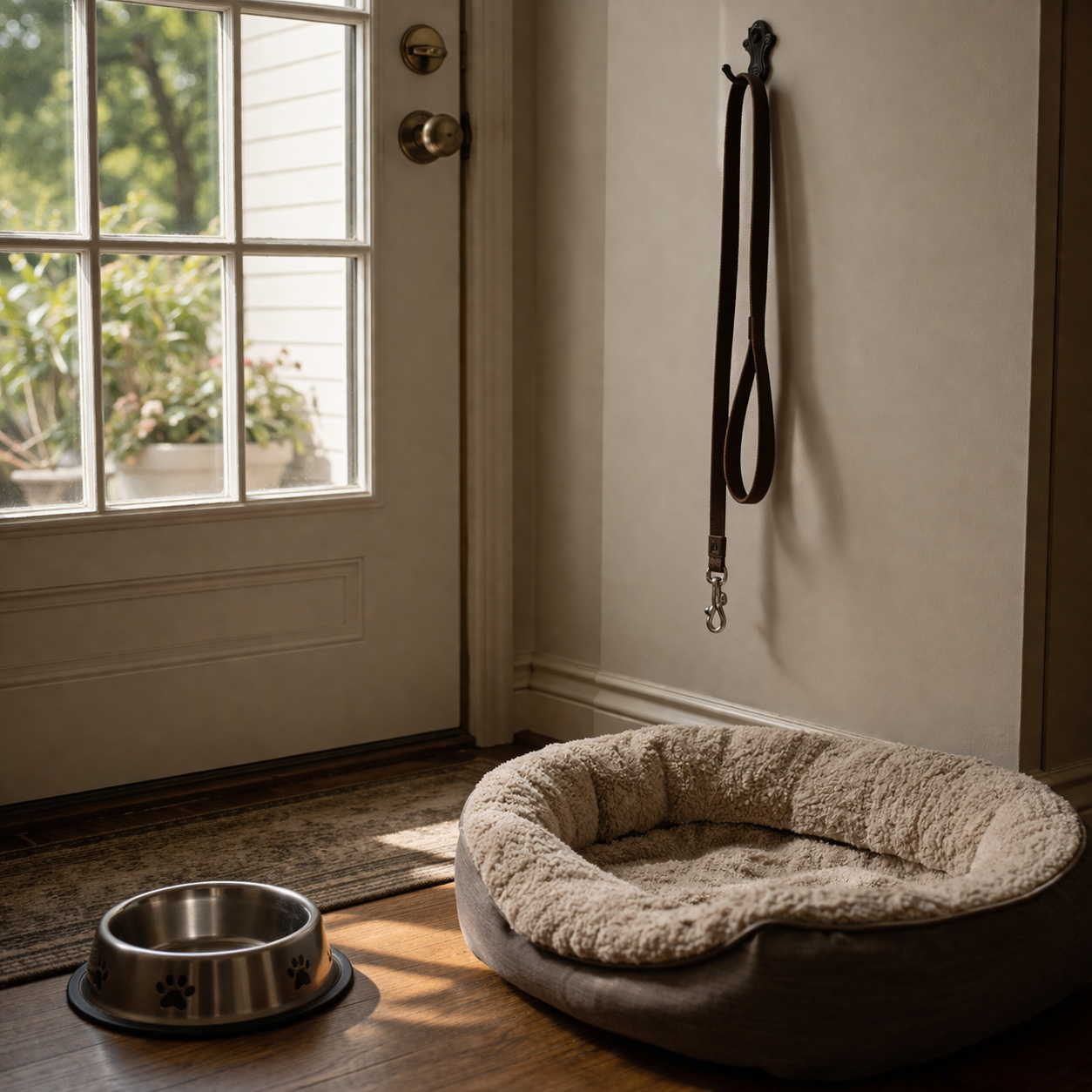
You expected to be sad. What you may not have expected is how the grief keeps finding you — in the quiet of the morning when you reach for the leash out of habit, in the moment you come home and the house feels too still, in the middle of an otherwise ordinary afternoon when something small and ordinary breaks you open all over again. And then someone asks, "Are you still upset about the dog?" and you wonder if there is something wrong with you.
There isn't.
With a B.S. in Psychology and an M.A. in Forensic Psychology, plus nearly 30 years of working with children and families through the hardest parts of their lives, I have sat with people in grief more times than I can count. And one of the most consistent things I have seen — in both research and in real life — is that grief does not follow a schedule. It follows the depth of the bond. And the bond you had with your dog was real.
What Research Actually Says About the Timeline
The honest answer to "how long does pet grief last" is: it depends, and that is not a dodge. It is the most accurate thing research has to say.
Studies on pet bereavement consistently show that grief after the loss of a companion animal can parallel grief after human loss in both intensity and duration. A foundational study published in the British Journal of Psychology examined grief responses in 88 bereaved pet owners using a 40-item questionnaire adapted from human bereavement research. The researchers found that responses including numbness, disbelief, preoccupation with the loss, and a sense of losing part of oneself were reported by half to four-fifths of participants. Critically, the intensity of grief was most strongly correlated with the strength of attachment to the pet and whether the death was sudden — not with how long the person had owned their dog (Archer & Winchester, 1994).
That finding matters. It means the depth of your grief is not about years of ownership. It is about the depth of your bond. And for many people who have lost their dog, that bond was one of the most significant relationships of their lives.
A 2021 systematic review published in OMEGA — Journal of Death and Dying synthesized 19 qualitative studies on the psychosocial impact of pet loss. The authors concluded that health professionals should respond to bereaved pet owners with the same care and consideration they bring to any form of human bereavement. The review identified five consistent themes across the research: the relationship with the pet, the nature of the grief, guilt, support systems, and the bereaved owner's sense of their own future (Roberts & Williams, 2021).
In general terms, the research points to a pattern many grieving people recognize: the most acute period of grief — the raw, disorienting weight of early loss — tends to fall within the first several months. But grief does not end there. It changes shape. It softens and surges. It shows up on anniversaries, on ordinary Tuesday mornings, in the middle of a song. That is not grief going wrong. That is grief doing what grief does.
Why Pet Grief Feels Like It Has No Permission
One of the most painful parts of losing a dog is not the grief itself — it is grieving without permission.
When a person loses a human loved one, there are structures around it. Funerals. Cards. Time off work. Casseroles. People check in. The world pauses, at least briefly, and says: this matters.
When you lose your dog, most of that disappears. You are expected to be fine within a few days. Someone may say "it was just a dog." And so you carry your grief quietly, wondering if the depth of your feeling is appropriate, wondering if you are too much.
Part of what is happening here is deeply rooted in unspoken social rules — the kind that no one announces but everyone seems to know. As a society, we have collectively decided, without ever saying it out loud, that dog grief is not something you talk about past a certain point. A couple of days, maybe a week. After that, the expectation is that you pull yourself together and move on. But here is what that unspoken rule ignores entirely: the intensity of what is happening in your brain and your body does not stop because the social window for grief has closed. You are still in it. You are just now in it alone.
One of the core missions of K9 Hearts is to change that. Your grief deserves a voice — not just in the first raw days, but in the weeks and months that follow. Talking about it, naming it, putting words around the loss — these are not signs of weakness or an inability to cope. They are among the most therapeutically powerful things you can do.
Research on trauma and emotional processing has long recognized that talking through intense emotional experiences — being able to give language to what you are feeling — is one of the most effective ways to move through grief rather than around it. When we suppress grief because we believe no one wants to hear it anymore, we do not make it smaller. We make it harder to reach. We need an outlet. We need to be able to say this mattered and have someone say yes, it did — and that exchange, that witnessing, is part of how healing happens.
That outlet is what K9 Hearts is here to provide. And it starts with saying clearly: it is okay to still be talking about this. It is okay to still be feeling this. You are not too much. You are a person who loved deeply, and you are allowed to grieve like it.
The research has a name for what happens when that permission is taken away.
It is called disenfranchised grief — grief that is not fully recognized or supported by the people around you. A 2023 study on older adults and companion animal loss published in Human-Animal Interactions found that this lack of social validation actively complicates and can prolong the grieving process (Brown et al., 2023). The grief is real. What is absent is the social permission to feel it openly.
K9 Hearts exists because that permission matters. Your grief is not too much. It is evidence of how much your dog was loved.
What Shapes How Long Grief Lasts
No two people grieve the same way, and no two losses are identical. But research and clinical experience both point to factors that influence the arc of grief:
The depth of the bond. A dog who was your constant companion, your emotional anchor, the one who showed up every single day — that loss leaves a different mark than the loss of a pet you were more casually attached to. There is no shame in either. But a deeper bond typically means a longer and more intense grief process. How the death happened.
Sudden and unexpected loss — an accident, an acute illness, a death that gave you no time to prepare — tends to produce a more intense initial grief response. The loss arrives before you are ready, and the shock itself becomes part of what you carry. Grief following anticipated loss, such as after a terminal diagnosis, follows its own path — one where the mourning often begins before the death itself.
Whether you carry guilt. Decisions around euthanasia are among the most agonizing things a dog owner can face. Grief that is layered with self-blame — the feeling that you made the wrong call, that you waited too long or acted too soon — adds weight to an already heavy process. Research identifies guilt as one of the most significant and consistent themes in pet bereavement (Roberts & Williams, 2021).
Your support system. Social support is one of the most reliable predictors of grief recovery across all types of loss. When the people around you minimize your grief or fail to understand it, that isolation makes healing harder and longer. When you are seen and supported — when someone simply acknowledges that your loss is real — the process can move more naturally.
Previous losses. Grief accumulates. Losing your dog can open up older grief — losses you thought you had moved through, human relationships you are still carrying. This is sometimes called compound grief, and it is more common than most people realize.
What "Getting Better" Actually Looks Like
Grief does not disappear. What happens, when healing is happening, is that grief changes its relationship with you.
In the early weeks and months, grief tends to be in the foreground. It is the loudest thing in the room. Over time — and this timeline varies enormously from person to person — it begins to settle into the background. It does not leave. But it stops being the thing that defines every moment.
You may find that memories of your dog begin to bring something alongside the pain. A warmth. A gratitude. A feeling that you would not trade a single day with them, even knowing how it would end. That is not forgetting. That is healing.
This is consistent with what researchers call continuing bonds theory, first articulated by Klass, Silverman, and Nickman in 1996. The core idea is that grief does not require you to sever your connection to the one you lost. In fact, maintaining an ongoing inner relationship with your dog — through memory, ritual, story, or meaningful objects — is not pathological. It is human. And when those bonds are expressed and validated rather than suppressed, research suggests they help minimize the intensity and duration of grief over time (Packman et al., 2011).
This is why Charlie's Guided Journal for Pet Loss was built the way it was — not to help you "get over" losing your dog, but to give you a structured, gentle space to stay in relationship with the love and move through the grief at your own pace, with your own words.
Charlie's Last Walk — Paperback | Hardcover | Digital
Charlie's Guided Journal for Pet Loss — Paperback | Hardcover | Digital

When Grief Becomes Something More
Most grief, even when it is intense and long-lasting, is a natural human response to a profound loss. But for some people, grief does not ease over time — it intensifies, or it stays stuck at the same level of pain without movement.
Researchers have documented a subset of bereaved pet owners who experience what is called complicated grief — grief that significantly disrupts daily functioning and does not follow the gradual arc of adaptation. A study published in Anthrozoös found that complicated grief and PTSD symptoms were documented in some bereaved pet owners, particularly following sudden or traumatic loss (Adrian & Stitt, 2017).
Signs that your grief may need additional support include difficulty functioning in daily life after several months have passed, an inability to experience any positive emotion, a complete withdrawal from relationships, or a feeling that life cannot continue without your dog.
If any of this resonates with you, please reach out to a grief counselor or mental health professional who understands pet loss. You do not have to carry this alone, and reaching out is not weakness. It is wisdom.
You Do Not Have to Grieve on Anyone Else's Schedule
The question "how long does pet grief last" does not have a single answer, because love does not operate on a timeline.
What the research tells us is that your grief is real, that it is proportional to the bond you had, and that healing happens when it is allowed to happen — not when it is rushed or hidden or minimized. The people who heal most completely tend to be the people who were allowed to grieve openly, who had support, and who found ways to stay connected to the love rather than trying to cut it off.
At K9 Hearts, you are in the right place. This is a space where losing your best friend is understood — not managed, not solved, not hurried. Understood.
If you are looking for a place to begin, Charlie's Last Walk was written for exactly this moment — the story of one dog, one family, and a love that refused to be ordinary. It is an invitation to honor yours.
Charlie's Guided Journal for Pet Loss was built for exactly this — not to help you "get over" losing your dog, but to give you a structured, gentle space to stay in relationship with the love and move through the grief at your own pace, with your own words. It is available in paperback and hardcover on Amazon, or as a digital version through the K9 Hearts store.
Frequently Asked Questions About Pet Grief Duration
Is it normal to still cry about my dog months after they died?
Yes. Grief has no expiration date, and crying months after your dog's death is a completely normal part of the process. Grief tends to move in waves rather than in a straight line. Certain moments — quiet mornings, the sound of another dog barking, a familiar smell — can bring the loss forward again even after significant time has passed. This is not a sign that something is wrong. It is a sign of how deeply you loved them.
How long does the intense grief after losing a dog usually last?
Research suggests that the most acute phase of grief — the period of most intense pain — typically falls within the first several months after loss. But this varies widely from person to person depending on the depth of the bond, the circumstances of the death, and the level of support available. A longer grief process does not mean you are grieving incorrectly. It means your bond was significant.
Why do I feel guilty after my dog died — is that normal?
Guilt is one of the most consistently reported experiences in pet bereavement research. Whether you made a decision about euthanasia, feel you missed signs of illness, or simply wish you had more time — this kind of grief-guilt is extremely common. It does not mean you did anything wrong. It is often the mind's way of trying to find control in a situation where there was none. To learn more ready my article on Why do I feel so guilty about losing a dog?
What is disenfranchised grief, and does it apply to pet loss?
Disenfranchised grief is grief that is not recognized or supported by the people around you. Pet loss is one of the most common forms of disenfranchised grief because society often minimizes the significance of a dog's death. This lack of validation does not make your grief less real — research confirms it can actually make the grieving process harder and longer. You deserve to be seen in your grief.
Will I ever feel better after losing my dog?
Most people do find that grief softens over time, even when it never fully disappears. The goal is not to stop missing your dog — it is to reach a place where the love and the memories can coexist with daily life, and where thinking of them brings warmth alongside the sadness. That shift is possible, and it is what most bereaved dog owners describe over time.
Is it okay to still be grieving my dog after a year?
Yes. There is no timeline that marks you as "done" with grief. Grief after the loss of a deeply bonded companion animal can last months, a full year, or longer — and experiencing waves of sadness after a year is entirely consistent with what research documents. What matters is not the length of your grief but whether it is slowly shifting over time. If your grief feels completely stuck and is significantly affecting your daily life, that is when reaching out to a professional can help.
What helps pet grief heal?
Research and clinical experience both point to social support as the most consistent factor in grief recovery. Being seen and acknowledged by people who understand the depth of your loss matters. Expressing your grief — through journaling, conversation, ritual, or creative activity — also supports healing. Maintaining a continuing bond with your dog through memory, story, and meaningful objects is not prolonging grief; it is a healthy and human way to integrate the loss into your life.
How is grief after losing a dog different from grief after losing a person?
The emotional experience of grief — sadness, guilt, disorientation, waves of pain — is remarkably similar. What differs is the social context. When a person dies, there are structures in place to support the bereaved. When a dog dies, those structures are often absent, and the grieving person is expected to recover quickly. This absence of social support, not the grief itself, is often what makes pet loss feel different and more isolating.
References
Adrian, J. A. L., & Stitt, A. (2017). Pet loss, complicated grief, and post-traumatic stress disorder in Hawaii. Anthrozoös, 30(1), 123–133. https://doi.org/10.1080/08927936.2017.1270598 [Peer-reviewed | Published in: Anthrozoös]
Archer, J., & Winchester, G. (1994). Bereavement following death of a pet. British Journal of Psychology, 85(2), 259–271. https://doi.org/10.1111/j.2044-8295.1994.tb02522.x [Peer-reviewed | Published in: British Journal of Psychology]
Brown, C. A., Wilson, D. M., Carr, E., Gross, D. P., Miciak, M., & Wallace, J. E. (2023). Older adults and companion animal death: A survey of bereavement and disenfranchised grief. Human-Animal Interactions. https://doi.org/10.1079/hai.2023.0017 [Peer-reviewed | Published in: Human-Animal Interactions]
Packman, W., Carmack, B. J., & Ronen, R. (2011). Therapeutic implications of continuing bonds expressions following the death of a pet. OMEGA — Journal of Death and Dying, 64(4), 335–356. https://doi.org/10.2190/OM.64.4.d [Peer-reviewed | Published in: OMEGA — Journal of Death and Dying]
Roberts, C. A., & Williams, J. (2021). Grieving the loss of a pet: A qualitative systematic review. OMEGA — Journal of Death and Dying. https://doi.org/10.1177/00302228211010609 [Peer-reviewed | Published in: OMEGA — Journal of Death and Dying | PubMed PMID: 33881389]
K9 Hearts does not provide clinical mental health services. If you are experiencing grief that significantly impacts your daily functioning, please reach out to a licensed mental health professional. If you are in crisis, call or text 988. K9 Hearts updates their Resources page for additional resources at https://www.k9hearts.com/pet-loss-and-grief-support.