
What Do You Do When the Grief of Losing Your Dog Feels Too Heavy to Carry?
As an Amazon Associate, I earn from qualifying purchases. This helps support K9 Hearts' mission to provide grief support resources for those who have lost their beloved dogs.
When the grief of losing your dog feels too heavy to carry alone, the answer is not to carry it alone. There are free support groups, trained counselors, online communities, and crisis resources available right now — many of them built specifically for the weight of pet loss grief. This post is a complete guide to finding the right support for where you are today.
If you are here, something has shifted. The grief is not moving the way you thought it would. It is not getting lighter with time — or it is getting lighter and then crashing back without warning. Or it has been three weeks and you have not been able to eat a full meal. Or it has been three months and you still cannot walk past their leash without having to sit down. Or you are somewhere in the anticipatory grief stage, your dog still here but the diagnosis already spoken, and the weight of what is coming has begun to feel like something you cannot hold alone anymore.
You are not broken. You are not overreacting. And you are not the first person to find themselves here, in this specific dark, wondering what to do next.
This post is for you.

First — Let's Name What "Too Heavy" Actually Means
Too heavy does not mean dramatic. It does not mean you are in crisis, although sometimes it does mean that and we will get to that. Too heavy means the grief has stopped being something you are moving through and started being something you are stuck inside.
It can look like any of these things. Not sleeping, or sleeping too much and still waking up exhausted. Not being able to concentrate on work. Canceling plans because the energy required to explain why you are still this sad feels like more than you have. Avoiding the parts of your house where they used to be. Finding yourself crying in the car, in the grocery store, in the middle of a meeting, without warning. Feeling like the world has continued moving while you have been left standing still in the place where they used to be.
It can also look quieter than that. A flatness. A going-through-the-motions. A sense that nothing feels like it matters quite the way it used to.
All of these are real. All of these are documented responses to the loss of a primary attachment figure — which is what a heart dog is, in the most clinical sense of the words. Research confirms that pet owners who have lost a strongly bonded companion animal experience grief responses comparable in intensity to losing a human loved one, and that the absence of social recognition for that grief — the disenfranchised nature of pet loss — frequently makes the grief harder to move through, not easier (Hughes & Lewis Harkin, 2022; Sharkin & Knox, 2003).
You are not making this harder than it needs to be.
The world is making it harder than it needs to be by not making space for what you are carrying.
Why the People Around You May Not Be Helping — Even When They Want To
This is one of the most painful parts of pet loss grief, and it deserves to be named directly.
The people who love you probably do not know what to say. They may have said things that landed wrong — at least they're not suffering anymore, you gave them such a good life, when do you think you'll get another dog? They mean it kindly. It still closes a door in your face.
A PMC-published study on grief support found that just over one third of bereaved people rated the support they received as good or excellent — while 38% rated it as poor or very poor. The support rated most satisfying was not advice, not practical help, not being told things would get better. It was emotional presence — someone listening without an agenda, holding space without trying to fix anything (PMC8158955).
Most people in a griever's life do not know how to do that. Not because they do not care. Because they are uncomfortable with grief they cannot resolve, and so they try to resolve it with words that land as dismissal.
Research also shows that shame plays a direct role in worsening pet loss grief. When people feel that their grief is not socially acceptable to express, they begin to hide it — sometimes to the point of not telling anyone about the loss at all. And the isolation that follows makes the grief harder, not easier (Sharkin & Knox, 2003).
If you have been hiding how bad it actually is — if the honest answer to how are you doing has been locked somewhere no one has been given access to — this is the post that says: you can put that down now. You do not have to carry it in secret.

What Actually Helps: The Case for Finding Your People
The most important thing research tells us about navigating pet loss grief is also the most human: you need to be around people who understand. Not people who want to help but don't know how. Not people who love you but are waiting for you to be done. People who have been where you are and do not need you to explain why a dog's loss could feel this enormous.
A peer-reviewed literature review across 48 studies on pet bereavement found that bereaved pet owners consistently reported feeling embarrassed and lonely following the loss of their pet — and that social support was one of the primary coping mechanisms that helped (PubMed 34096419). Not just any social support. The kind that does not minimize the loss.
That is a specific kind of community. And it exists. It is more accessible than most grieving people know.
What follows is every type of support available to you — from something you can access in the next ten minutes to professional one-on-one care — organized by what you might need right now.
If You Need Someone Right Now
Some grief does not wait for business hours. If you are in the middle of the night, in the middle of a wave, and you need to say something out loud to someone who will not look at you with discomfort — these are open right now.
988 Suicide and Crisis Lifeline — Call or text 988 (US) | Call or text 9-8-8 (Canada) If the grief has moved into thoughts of not wanting to be here — if it has become something more than pain and started to feel like a reason — please reach out. You do not have to explain why a dog's death could feel this big. You just have to make the call. Crisis Text Line is also available any time: text HOME to 741741.
Rainbow Bridge Pet Loss Chat Room — rainbowsbridge.com Open 24 hours a day. Volunteers are present every evening from 8pm to midnight EST. There is also a Monday night candle ceremony at 10pm EST where people gather to remember their dogs together. If you have never been somewhere online where a room full of people light a candle for a dog they have never met and treat it as the serious, sacred thing it is — this is that place.
r/Petloss on Reddit — reddit.com/r/petloss More than 83,000 members. Active at all hours. Moderated — posts from new accounts require approval before they appear, which keeps the space safer than most open forums. You can share your dog's name, their photo, the story of their last day, or just the fact that you cannot stop crying — and people will respond with the specific, recognizing warmth of someone who has been exactly there. You do not have to create an account to read. You do not have to post if you are not ready. Sometimes just reading other people's stories and knowing you are not alone is enough.
Free Scheduled Support Groups — Real People, Real Time
There is something different about a scheduled group — about knowing that at a specific time, on a specific night, a group of people who understand will be there. It creates a rhythm inside grief that has no natural rhythm of its own. It gives the week a shape.
Association for Pet Loss and Bereavement (APLB) — aplb.org
The APLB is one of the most established pet loss organizations in the world. Their support offerings include chat rooms open Tuesday and Thursday evenings from 9 to 11pm EST, staffed by trained Pet Loss Grief Specialists. Video support groups run multiple times per week — Sunday afternoons, Sunday evenings, and Saturday evenings — all facilitated by certified specialists. There is also a dedicated anticipatory grief group for people whose dog is still alive but facing a serious diagnosis, held on the first Thursday of each month from 8 to 10pm EST. A Facebook group provides peer support outside of chat room hours. Free membership is available and gives access to the chat rooms and one video support group session.
Lap of Love — lapoflove.com/our-services/pet-loss-support
Lap of Love is primarily known as a veterinary hospice and in-home euthanasia service, but their grief support program is one of the most thoughtfully built available. Free weekly virtual support groups are led by professionally certified pet loss coaches. Paid options include individual one-on-one sessions and extended courses. This is particularly worth knowing about if your grief is connected to the end-of-life decision — the euthanasia choice, the question of whether it was the right time, the guilt that can follow. Their coaches are specifically trained for this.
PetCloud — petcloud.pet
Free virtual support groups every Sunday, with additional groups throughout the week. Founded and run by Kevin Ringstaff, a grief specialist who has built his practice entirely around pet loss. The framing here is direct and honest: the intimacy you had with your dog — the creature who was with you more hours of the day than most humans ever are — is the reason the loss hits the way it hits. That is named here, not explained away.
UC Davis School of Veterinary Medicine — vetmed.ucdavis.edu
A free monthly Zoom support group hosted by one of the country's leading veterinary schools. Third Thursday of each month, 3:30 to 5pm Pacific Time. There is something specifically meaningful about a group hosted by a veterinary institution — these are people who took the bond between humans and their animals seriously enough to build their careers around it.
BirchBark Foundation — birchbarkfoundation.org
Group and individual sessions via Zoom on Wednesdays from 6 to 7:30pm. Individual sessions are available for those who want one-on-one support in a smaller, more private setting than a group.

Hotlines — When You Need a Voice, Not a Screen
Cornell University Pet Loss Support Hotline — 607-218-7457 Monday through Friday 6 to 9pm ET, Saturday and Sunday 12 to 9pm ET. Staffed by veterinary students trained in pet loss support. This is not a crisis line — it is a dedicated line for pet loss grief specifically.
Tufts University Pet Loss Support Helpline — 508-839-7966 Monday through Thursday 6 to 9pm ET. 24-hour voicemail with callback during the next scheduled shift. A second university-backed option for when Cornell is unavailable.
University of Illinois C.A.R.E. Hotline — 877-394-2273 (toll-free) Sunday, Tuesday, and Thursday from 7 to 9pm CT. Toll-free number makes this accessible regardless of phone plan.
Washington State University Pet Loss Hotline — 866-266-8635 Email: plhl@vetmed.wsu.edu. Staffing can vary by semester — leave a message if no one answers.
ASPCA Pet Loss Helpline — 877-474-3310 Confirm current availability through the APLB's updated hotline directory at aplb.org.
Forums and Ongoing Communities — For When You Need to Be Witnessed at Your Own Pace
Some grief does not want to be in a scheduled group. Some grief wants to write something at 4am and have it read by people who understand, without a meeting to attend or a video camera to turn on.
Petloss.com — petloss.com One of the oldest pet loss sites on the internet. A moderated message board running since 1995. A chat room. A Monday candle ceremony at 10pm EST. This site was built before social media, with no algorithm and no engagement metrics, purely to hold the grief of people who had lost their animals.
Rainbow Bridge Forum — forums.rainbowsbridge.com Active forum, any time, any day. A place to share your dog's story, post a photo, and have someone respond with recognition.
Grieving.com — Pet Loss section — forums.grieving.com/forum/17-loss-of-a-pet/ A broader grief community with a dedicated pet loss section. Useful if your pet loss grief is layered with other losses — if this loss has activated grief that was already there from something else.
Facebook Groups — Finding Your Community and Staying Safe In It
Facebook has become one of the largest gathering places for pet loss grief. The ability to share a photo, write a tribute, and receive a response within minutes from someone who understands is something no forum or scheduled group can replicate.
The following groups are verified, actively moderated, and worth knowing about.
PVC: Coping With The Loss Of A Pet Support Group — facebook.com/groups/pvccopingoriginal A private group with more than 142,000 members, run by the Vet Corner Groups network. One of the largest and most active pet loss support communities on Facebook. Active daily.
PVC — One Day At A Time Pet Support For Terminally Ill and Elderly Pets — facebook.com/groups/pvconedayatatimepetsupportoriginal Also run by the Vet Corner Groups network. Nearly 9,500 members. Specifically for people whose pet is still alive but facing a terminal or serious diagnosis — the anticipatory grief space. If your dog is still here and you are already grieving, this group was built for exactly that season.
Pet Vet Corner℠ — facebook.com/groups/petvetcorner More than 1.6 million members. Only approved veterinarians provide answers or comments. This is not a grief support group in the traditional sense, but it is an extraordinary resource for anyone navigating medical questions about a sick or aging dog.
How to find additional groups and stay safe in them
New pet loss groups are being created on Facebook every day. Search terms like pet loss support, dog loss grief, anticipatory grief pets, or heart dog grief — then click Groups in the filter options.
Once you find a group, look for these signs before you join and before you post. Active moderation is the most important signal — rules posted, enforced consistently, admins visible. Scroll the feed before joining to check the tone of recent posts. Are people responding with warmth? Is grief being held, not redirected? Be cautious of groups where members are told how long to grieve, where getting another pet is suggested quickly in the comments, or where anyone recommending professional help is discouraged.
A group with fewer members but strong moderation and consistent warmth is often safer and more supportive than a very large group with minimal oversight. Trust your instincts — if a space does not feel right, leave it. You are looking for people who will say your dog's name like it matters. Because it does.
When You Need More Than a Group: Professional Support
There is a difference between needing community and needing professional support. Both are legitimate. Neither is more serious than the other — they are different tools for different needs.
You may need professional support if the grief has been significantly impacting your daily functioning for an extended period. If you are not sleeping, not eating, not able to work or care for yourself or the people who depend on you. If the grief has activated something older — a previous loss, a trauma, a depression that was already there and has now found a way back in.
APLB Counselor Directory — aplb.org A searchable directory of Pet Loss Grief Specialists — people who have completed specific training in pet bereavement. Searchable by location and whether they offer virtual sessions.
Pet Loss Community — petlosscommunity.com Founded by two veterinarians and a psychologist. Offers a free 15-minute consultation to help you figure out what kind of support is the right fit — individual therapy, group sessions, or self-paced resources.
Psychology Today Therapist Finder — psychologytoday.com/us/therapists Filter by grief as a specialty. Look for anyone who specifically mentions pet loss, animal loss, or disenfranchised grief in their profile. A therapist who understands that pet grief is clinically real is the difference between feeling seen and feeling minimized in what is supposed to be the one room where you are allowed to be honest.
BetterHelp — betterhelp.com Online therapy, accessible from home. When searching, note in your preferences that you are grieving the loss of a companion animal and want to work with someone who has experience with pet loss or disenfranchised grief.
No email required — direct file download. This PDF contains all hotlines, support groups, Facebook communities, and crisis resources in a printable two-page format.
Something to Read When You Are Ready
Grief has its own timeline. Some people find that reading helps — that having words on a page that name what they are feeling is its own form of being witnessed.
The Grief Recovery Handbook by John W. James and Russell Friedman was written for any significant loss — death, divorce, the losses that the world does not always acknowledge as large enough to warrant the grief they produce. The framework it offers translates directly to the weight of losing a heart dog. It is one of the most widely recommended grief resources available, grounded in a practical program rather than a passive reading experience. It asks you to do something with your grief rather than simply understand it.
The Grief Recovery Handbook — paperback: https://amzn.to/4sJOJ87
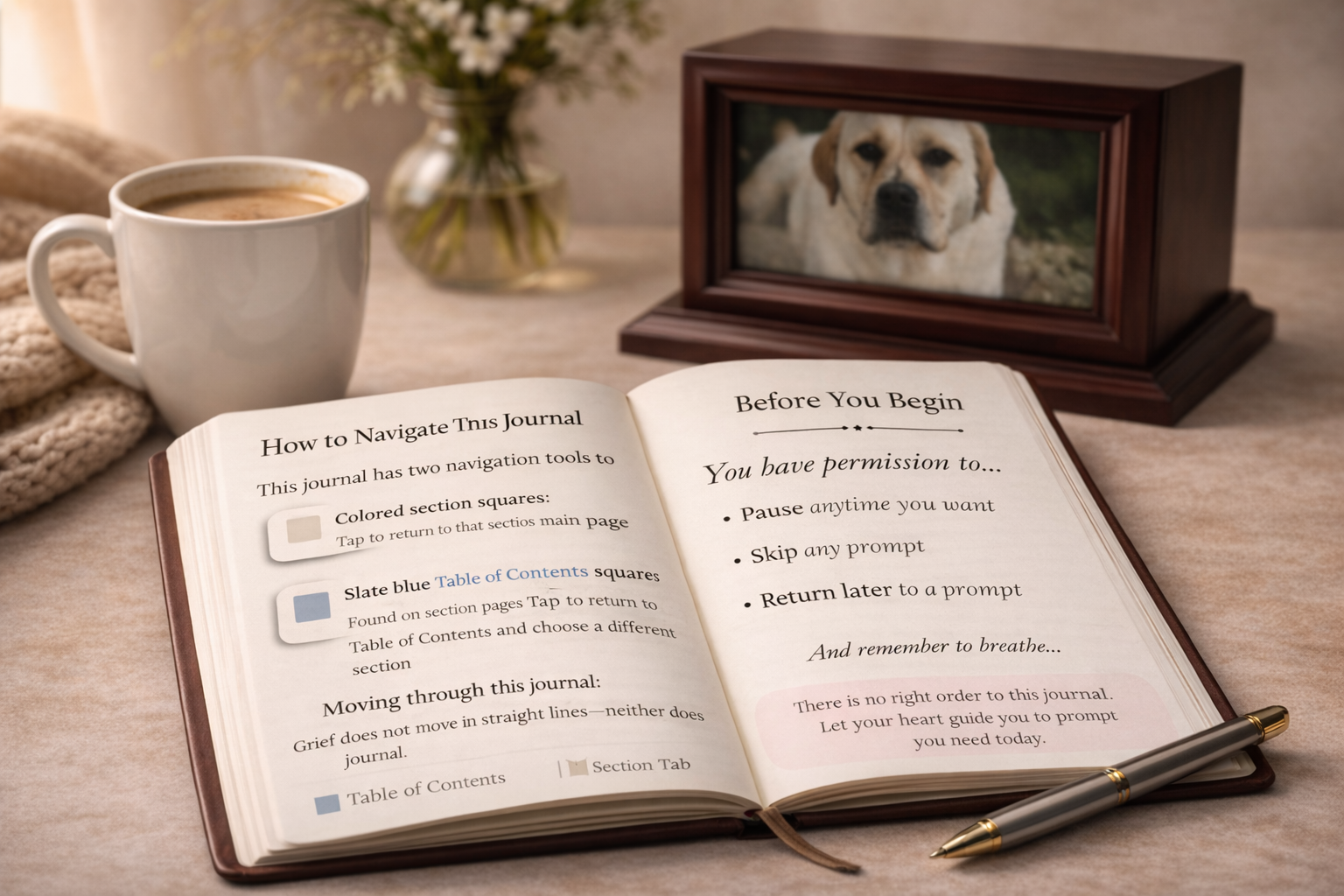
Charlie's Guided Journal for Pet Loss was built for the moment when grief needs somewhere to go — not a blank page, but a companion with questions that lead somewhere real.
Charlie's Guided Journal also comes in paperback: https://amzn.to/4c04eTt | hardcover: https://amzn.to/40P9Euc on amazon. If you prefer a digital version to use on your desktop or table, click here to see our digital versions.
Charlie's Last Walk — the memoir of Charlie Brown, the heart dog who is the reason K9 Hearts exists — is for the moment when you want to know that someone else has been exactly where you are, and found a way to carry it forward.
Charlie's Last Walk is paperback: https://amzn.to/3NyR4Ue | hardcover: https://amzn.to/41o7phE on Amazon. For a digital download for an immediate read, click here.
A Note on Grief That Feels Like More Than Grief
If you read the companion post to this one before arriving here — What Is a Heart Dog? at k9hearts.com/blog/what-is-a-heart-dog — you already know that some people in the anticipatory grief stage, and some people in the immediate aftermath of loss, find themselves thinking thoughts that go beyond pain. Thoughts about not wanting to be here. About there being no reason to continue.
Those thoughts deserve more than a resource list. They deserve to be said out loud to someone. A therapist. A crisis line. A person in your life who you trust enough to be completely honest with.
If the grief has moved into that territory — please reach out. 988 is available any hour, any day. A pet loss counselor from the APLB directory can be contacted this week. Pet Loss Community offers a free 15-minute consultation that does not require you to have already decided what kind of help you need.
You do not have to have it figured out before you reach out. You just have to make contact.
Honoring Them While You Heal
Grief and honoring are not opposites. They can exist at the same time — and sometimes the act of honoring is what gives grief somewhere to go other than just inward.
The End of Paw Prints movement — K9 Hearts' tribute for the day a dog's paw prints stop — was built for this moment. Not to rush the grief. Not to replace what was lost. But to give it a permanent, beautiful, named place in the world. An EOP Legacy Portrait takes a photograph of your dog and transforms it into a timeless piece — their face, their light, preserved in a way that can be held and returned to.
The paw prints stop. The love never does.
Learn more about the EOP Legacy Portrait at k9hearts.com/dog-memorial-portrait-art.
Frequently Asked Questions
Is it normal for pet loss grief to feel this intense?
Yes. Research confirms that the grief following the loss of a strongly bonded companion animal can be clinically comparable in intensity to losing a human loved one. The absence of social recognition for this grief — the fact that the world does not always make space for it — frequently makes it harder to move through, not easier. You are not overreacting. You are grieving in proportion to what was real.
How do I find a therapist who understands pet loss?
Start with the APLB's counselor directory at aplb.org, which lists Pet Loss Grief Specialists who have completed specific training in pet bereavement. You can also search Psychology Today's therapist finder at psychologytoday.com/us/therapists — filter by grief as a specialty and look for anyone who specifically mentions pet loss, animal loss, or disenfranchised grief. Pet Loss Community at petlosscommunity.com offers a free 15-minute consultation to help you figure out what kind of support is the right fit.
What if I am not ready to talk to anyone yet?
That is a completely valid place to be. Start with reading — either in the forums where you can absorb other people's stories without posting, or in a book like The Grief Recovery Handbook which gives you something to do with the grief at your own pace. r/Petloss on Reddit is also a place you can read without posting. You do not have to be ready to speak to benefit from being around people who understand.
What is the difference between a pet loss support group and a pet loss therapist?
A support group offers community — the specific comfort of being around people who have been where you are, who do not need you to explain why this hurts so much. A therapist offers professional clinical support — someone with the training to help you understand what you are carrying, identify if the grief is activating something older or deeper, and work with you on tools for moving through it. Both are legitimate. Many people benefit from both at the same time.
Are there free options for pet loss support?
Yes. The APLB offers free chat rooms and one free video support group session with membership. Lap of Love offers free weekly virtual support groups. PetCloud offers free Sunday groups. PetLoss Partners offers free Tuesday and Thursday chats. Cornell, Tufts, University of Illinois, and Washington State all offer free phone support. r/Petloss on Reddit is free and available any time. Rainbow Bridge chat is free and open 24 hours. All of the Facebook groups listed in this post are free to join.
What do I do if the grief has moved into thoughts of not wanting to be here?
Please reach out. 988 is available any hour, any day, by call or text. In Canada, call or text 9-8-8. Crisis Text Line is available any time — text HOME to 741741. A Pet Loss Grief Specialist from the APLB directory can also be contacted this week. Pet Loss Community offers a free 15-minute consultation for anyone who is not sure what kind of help they need. You do not have to have it figured out before you ask for help.
How long does pet loss grief last?
There is no timeline that is right or wrong. Research shows that grief does not follow a predictable arc — it moves in waves, sometimes seeming to ease and then returning with unexpected intensity. What matters is not how long the grief lasts but whether you have support while you are in it. The companion post to this one — What Is a Heart Dog? at k9hearts.com/blog/what-is-a-heart-dog — explores the research behind why the bond was so intense and why the grief makes sense in proportion to it.
References
Hughes, B., & Lewis Harkin, B. (2022). The impact of continuing bonds between pet owners and their pets following the death of their pet: A systematic narrative synthesis. OMEGA — Journal of Death and Dying, 90(4), 1666–1684. https://doi.org/10.1177/00302228221125955
Packman, W., Carmack, B. J., & Ronen, R. (2012). Therapeutic implications of continuing bonds expressions following the death of a pet. OMEGA — Journal of Death and Dying, 64(4), 335–356. https://doi.org/10.2190/om.64.4.d
Sharkin, B. S., & Knox, D. (2003). Pet loss: Issues and implications for the psychologist. Professional Psychology: Research and Practice, 34(4), 414–421. https://doi.org/10.1037/0735-7028.34.4.414
Walsh, F. (2009). Human-animal bonds II: The role of pets in family systems and family therapy. Family Process, 48(4), 481–499. https://doi.org/10.1111/j.1545-5300.2009.01297.x
Worden, J. W. (2009). Grief counseling and grief therapy: A handbook for the mental health practitioner (4th ed.). Springer.
K9 Hearts does not provide clinical mental health services. If you are experiencing grief that significantly impacts your daily functioning, please reach out to a licensed mental health professional. If you are in crisis, call or text 988. K9 Hearts updates their Resources page for additional support at https://www.k9hearts.com/pet-loss-and-grief-support.