

What Anticipatory Grief Actually Feels Like, Day by Day: A Guide for Those Watching Their Dog Decline
As an Amazon Associate, I earn from qualifying purchases. This helps support K9 Hearts' mission to provide grief support resources for those who have lost their beloved dogs.
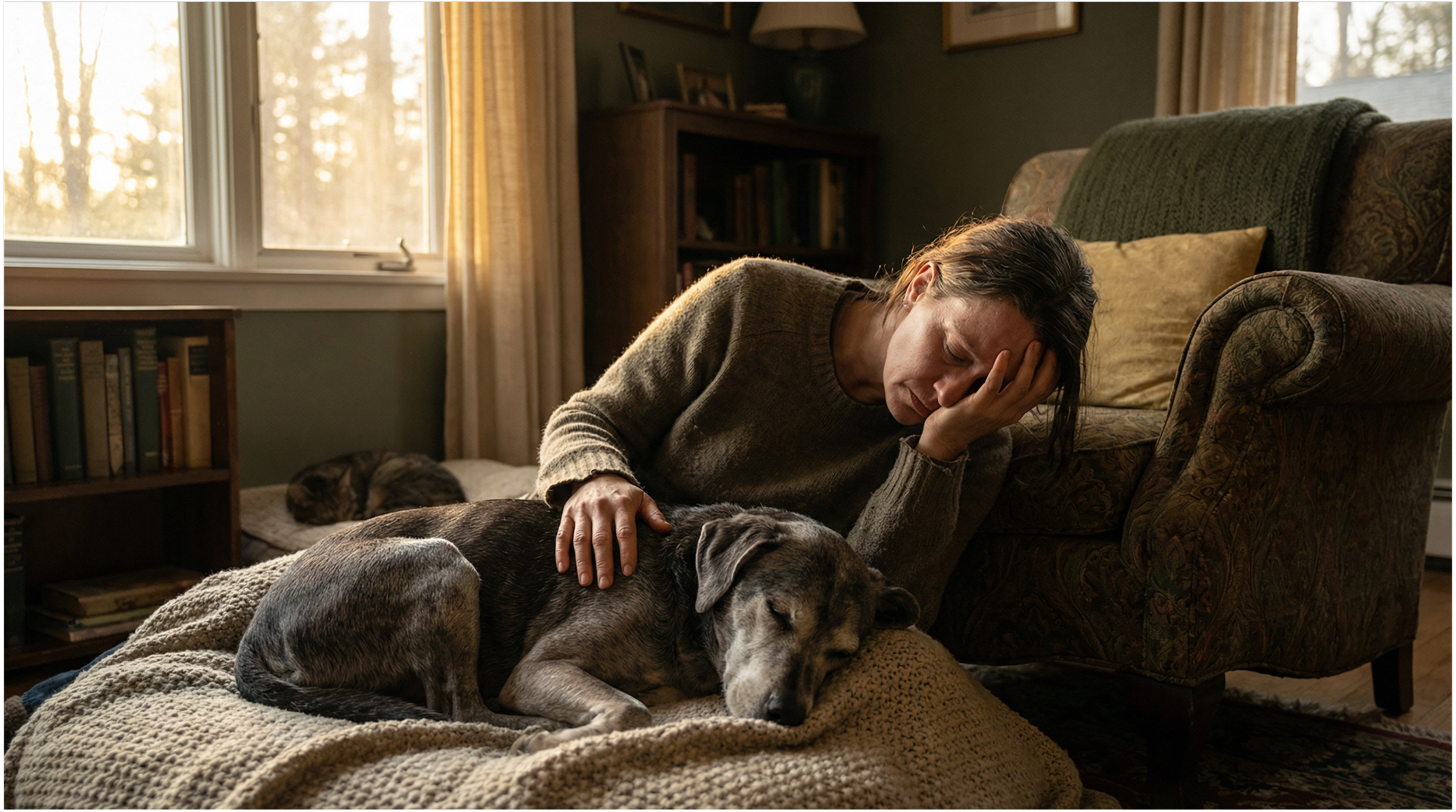
Nobody asked me how I was doing in the months before Charlie died. They asked about him — "How's Charlie?" "What did the vet say?" "Is the new medication helping?"
But nobody asked about me. About what it felt like to wake up every morning wondering if this would be the day. About the exhaustion of constant assessment. About grieving someone who was still lying next to me, still breathing, still here — but already slipping away.
Anticipatory grief — the grief before the loss — is one of the most overlooked and misunderstood aspects of loving a dying dog. People don't talk about it. They don't ask about it. And you often don't realize you're experiencing it until you're drowning in it.
If you're watching your dog decline, if you know the end is coming but you don't know when, if you're making impossible decisions while trying to treasure remaining time — this is for you. Let me tell you what anticipatory grief actually feels like, day by day, hour by hour. Because someone should acknowledge what you're carrying.
What Anticipatory Grief Actually Is
Anticipatory grief isn't "practice grief" or "preparation" for the loss to come. It is its own distinct experience with unique challenges that differ from grief after death.
Research in palliative and bereavement care describes pre-death grief as grief that begins before a death occurs — particularly when there is an uncertain or poor prognosis and when the caregiver is navigating shifting roles and mounting emotional demands (Cleary et al., 2022). In companion-animal caregiving, the same framework applies. Guardians may grieve the impending loss, the pet's decline, the loss of shared routines, and the weight of upcoming decisions — often while their dog is still physically present and still needing their care.
This isn't theoretical. It is relentlessly real.
You're Grieving Multiple Losses Simultaneously
When your dog is declining, you are not just grieving their eventual death. You are grieving all of the following at once:
The loss of their health and vitality
The future you thought you'd have together
Daily routines that are changing or already gone
Your sense of control over what happens next
The dog they used to be before illness
The life you were building together
All of these losses are happening simultaneously, compounding each other — while your dog is still physically present. It is disorienting. It is exhausting. And it is completely valid.
You're Living in Suspended Animation
You cannot fully grieve because they are not gone yet. But you cannot pretend everything is fine because clearly it is not. You are trapped in a liminal space between normal life and loss, and there is no rulebook for how to exist there.
Time feels both too fast — racing toward the inevitable — and too slow, with every hard day stretching endlessly. You are hyperaware of every moment because it might be one of the last. But that hyper-awareness is exhausting in ways that are almost impossible to describe to someone who has not lived it.
You're Making Decisions Under Impossible Pressure
Unlike grief after death, anticipatory grief comes with constant decision-making responsibility. Every day you are assessing: Is today the day? Should we try this treatment? Is the medication still working? Am I keeping them here for me — or for them?
Research confirms that this caregiving burden is real and measurable. Studies using the validated Zarit Burden Interview — adapted for pet owners — have found that caring for a seriously ill companion animal is associated with significantly elevated stress, symptoms of depression and anxiety, and a reduced quality of life for the owner, independent of other factors (Spitznagel et al., 2019). This is not weakness. It is a documented physiological and psychological response to an extraordinarily difficult situation.
The decision fatigue is relentless. Your brain never gets to rest.
What a Day in Anticipatory Grief Actually Looks Like
Let me walk you through what I lived with Charlie, because the specifics matter. The day-to-day reality is what people don't see.

Morning: The Assessment Begins
I'd wake up and immediately look at Charlie. Is he breathing comfortably? Can he stand on his own? Are his eyes clear or clouded with pain?
Before I even got out of bed, I was running mental quality-of-life scales. This wasn't conscious — it became automatic. Every morning started with evaluation instead of greeting.
Some mornings he'd seem okay, and I'd feel guilty relief. Not today. We have more time. Then guilt for feeling relieved that he was still suffering — just not enough to justify euthanasia yet.
Other mornings he'd struggle to stand, and my stomach would drop. Is this it? Do I call the vet? Is he telling me he's ready, or is he just having a bad morning?
There was no rest from this cycle. Every. Single. Morning.
Daytime: Hypervigilance and Watching
Throughout the day, part of my attention was always on Charlie. Not in the sweet way of enjoying his presence — but in constant monitoring.
How's his breathing? Is he drinking enough water? Did he eat his food? Is he moving around or just lying in one spot? Is that a pain sound or just a normal dog noise?
I could not focus fully on work, on conversations, on anything — because a portion of my brain was always running surveillance. This divided attention is exhausting in ways that are hard to explain to people who haven't lived it.
Mealtime: Negotiations and Worry
Charlie's appetite fluctuated as his condition worsened. Some days he'd eat normally. Other days I'd have to coax, bribe, or hand-feed him.
Each meal became a referendum on his quality of life. If he ate, I could breathe a little. If he didn't, the panic would creep in. Is he giving up? Is he in too much pain to care about food? Is this a sign?
I learned to read meaning into every bite or refusal, turning ordinary routines into high-stakes assessments.
Evening: The Guilt Hours
Evenings were when the guilt would crash in. The day was ending — which meant one less day with him. Had I treasured it enough? Had I been present, or had I been too focused on work, on logistics, on the constant assessment?
The guilt of not being present enough while simultaneously being hypervigilant every single moment — that is a special kind of torture.
Bedtime: The Fear Settles In
Lying in bed at night, listening to Charlie breathe, I'd think: Will he be here tomorrow morning? Should I have scheduled euthanasia already? Am I being selfish keeping him here? Am I being cowardly if I let him go?
The nighttime questions were relentless. In the dark, with nothing to distract me, the fear and grief would settle in — heavy and suffocating.
Some nights I'd lie awake for hours, just listening to him breathe, trying to memorize the sound because I knew it wouldn't last forever.

The Emotional Landscape of Anticipatory Grief
Beyond the daily logistics, there is an emotional terrain you are navigating that people rarely talk about.
Grief and Love Are Tangled Together
When you are with your dying dog, you are experiencing intense love and intense grief simultaneously. You cannot simply enjoy their presence because you are painfully aware it is temporary. Every moment of connection is colored by the impending loss.
This makes it hard to be present. You are trying to treasure time while also bracing for the end. Those two impulses fight each other constantly.
Exhaustion Is Multi-Layered
Research on companion animal caregiving confirms what you are probably already feeling in your body. A peer-reviewed study by Nakano et al. (2019), published in BMJ Open, found that among pet owners whose dogs or cats had received a cancer diagnosis in the previous one to three weeks, 39.8% screened positive for clinically significant depression and 39.8% met the threshold for high state anxiety — compared to owners of healthy pets. This was a cross-sectional study, meaning it captured a snapshot in time rather than a long-term follow-up, but the findings are striking in what they confirm: the emotional weight of anticipatory caregiving registers measurably in the body and mind.
You are physically exhausted from the demands of care — helping them move, managing medications, cleaning up accidents, staying alert to their needs. You are emotionally exhausted from constant grief and fear. You are cognitively exhausted from divided attention and non-stop decision-making. And you cannot rest — because your dog still needs you.
Social Isolation Deepens
People don't know how to support someone in anticipatory grief. They might ask about your dog, but they rarely ask about you. And when they do, what are you supposed to say?
"I'm barely functioning"? "I'm grieving someone who's still alive"? "Every day feels like a fresh wave of impossible choices"?
Most people cannot hold that, so you learn to say "hanging in there" and change the subject. Research on pet loss consistently identifies this pattern — pet grief is frequently what researchers call disenfranchised grief, meaning it is socially minimized or not openly acknowledged (Cleary et al., 2022). When people do not recognize your loss as real or significant, the grief often becomes private and isolated — which research suggests makes the overall experience harder to bear.
The isolation of not being able to name what you are experiencing makes it even heavier.
Anger Surfaces Unexpectedly
You might find yourself angry at people whose dogs are healthy. Angry at your dog for being sick. Angry at the universe for the timing. Angry at yourself for being angry.
This anger is part of anticipatory grief, but it often carries shame — because it feels inappropriate to be angry at your dying dog, or at people who are not doing anything wrong except having what you are losing.
Anticipatory Guilt Is Crushing
The guilt in anticipatory grief is multifaceted. Guilt for grieving while they are still alive. Guilt for the moments you were not fully present. Guilt for whatever decision you ultimately make — too soon, too late, too aggressive, not aggressive enough.
There is no escaping the guilt. It is woven into every aspect of this experience. But guilt in this context is not evidence that you are doing something wrong. It is evidence that you love deeply.
The Decisions That Haunt You
One of the hardest parts of anticipatory grief is that you are making constant decisions with insufficient information and no guarantee you are choosing right.
The Quality of Life Assessment
Every day — sometimes multiple times a day — you are running informal quality-of-life assessments. You may even use formal scales recommended by your veterinarian.
The problem is, the line between "still has quality of life" and "suffering too much" is blurry and constantly shifting. What seemed okay yesterday may feel unbearable today. What feels unbearable this morning may look better this afternoon.
You are trying to be objective about the most subjective thing possible: Is my dog still experiencing enough good to outweigh the bad?
And your dog cannot tell you. You are making this call based on your interpretation of their signals, your intimate knowledge of their personality, and your gut feeling — none of which provide certainty.
The Euthanasia Timing Question
This is the question that haunts every moment of anticipatory grief: When?
Too early, and you have stolen time you both could have had. Too late, and they suffered unnecessarily. The window of "right" feels impossibly narrow and completely invisible.
With Charlie, I agonized over this daily. Every morning I'd wake up wondering if today was the day. Some days he seemed okay enough that scheduling felt premature. Other days he struggled, and I'd mentally draft the call to the vet — only to watch him rally by afternoon.
The uncertainty is agonizing. And there is no way to know if you got it right until it is already done.
The Medical Intervention Choices
Should you try one more treatment? Pursue that surgery? Start a new medication? Or is that just prolonging suffering for your own sake?
Every medical decision during a decline is complicated by anticipatory grief. You are trying to balance hope against realism, quality against quantity, your dog's needs against your own fear of losing them.
Self-Care When You're Running on Empty
The standard self-care advice feels hollow when you are in anticipatory grief. "Take a bath" or "practice mindfulness" do not address the relentlessness of what you are experiencing.
But there are some things that genuinely help.
Accept That You're Not Okay
Stop trying to function normally. You are navigating one of the hardest experiences of your life. Your capacity is reduced. That is not a personal failing — it is reality.
Give yourself permission to do the bare minimum in areas outside of your dog's care. The laundry can wait. The emails can wait. You are in survival mode, and that is appropriate.
Create Comfort in Small Ways
You cannot fix the big thing — your dog is dying. But you can make the day-to-day experience slightly more bearable.
Soft blankets for sitting with your dog. Gentle music playing in the background. Comfortable clothing that does not add physical discomfort to emotional pain. Herbal tea that provides a small ritual of comfort.
These are not solutions, but they are small kindnesses to yourself during an unkind time.
One thing that has helped many caregivers during this season is having something soft and warm nearby — not just for your dog, but for you. Grief is physically exhausting. Your body carries what your heart is holding. Wrapping yourself in something gentle when you sit beside your companion — or when you finally collapse on the couch at the end of a long day of watching and waiting — is not a luxury. It is a quiet act of self-care.
The Exclusivo Mezcla Fleece Throw XL Blanket is one of those small comforts worth having nearby. It is made from brushed polyester flannel fleece that is soft on both sides, breathable, skin-friendly, and machine washable — because the last thing you need right now is something that is hard to care for. It is large enough (50x70 inches) to curl up under while you sit with your dog, and gentle enough for sensitive skin. Sometimes the smallest kindnesses — a warm blanket, a quiet corner, a moment to breathe — are what carry you through.
Journal the Impossible Questions
Writing down the questions, fears, and decisions you are facing can help externalize some of what you are carrying. You do not need answers — just the act of putting it on paper creates a small amount of psychological space.
Research supports this. A peer-reviewed randomized controlled trial by Lichtenthal and Cruess (2010), published in Death Studies, found that bereaved individuals who used directed writing — writing specifically structured to guide them toward sense-making and meaning-finding — showed measurable differences in prolonged grief, depression, and trauma symptoms compared to those who wrote without a structured focus. This matters for anticipatory grief: it is not just venting onto a page that helps. It is writing with direction and purpose.
Charlie's Guided Journal for Pet Loss was built on exactly that principle. It includes a dedicated section for anticipatory grief — because grief does not always wait for the final goodbye. The prompts are structured to support you while your dog is still here, not just after. Available in paperback and hardcover on Amazon, and in digital format at K9 Hearts so you can begin today.
Accept Imperfect Presence
You do not have to be perfectly present for every remaining moment. The idea that you should treasure every second creates impossible pressure.
Some moments you will be present. Others you will be distracted, exhausted, or just trying to survive. That is okay. You are doing the best you can.
Create Memory Anchors
Take photos. Write down the small moments. Record their breathing if that brings comfort. These are not about capturing everything — they are about creating touchstones for later.
But do not let memory-making become another source of pressure. The goal is not documentation perfection. It is capturing what feels meaningful in the moment.
What You Need (That People Aren't Offering)
Here is what actually helps during anticipatory grief.
Permission to Grieve Now
You do not have to wait until they are gone to grieve. You are experiencing loss right now — the loss of health, routines, the future you planned. That deserves acknowledgment.
A qualitative systematic review by Cleary et al. (2022), published in Death Studies, synthesized 19 qualitative papers from 17 studies exploring the experience of pet bereavement. One of the consistent themes was that bereaved and anticipatorily grieving pet owners deeply need social validation — someone to acknowledge that what they are experiencing is real and significant, not an overreaction. If you have been told to "stay positive" or "treasure this time," and that advice felt hollow, you were not wrong. What you needed was someone to say: this is hard, and you are allowed to grieve.
Grief during anticipatory grief is not premature or overdramatic. It is appropriate to what you are living through.
Validation That This Is Hard
"This is impossibly hard" is a more helpful statement than "stay positive" or "treasure this time."
You need someone to acknowledge that you are carrying an enormous weight, making impossible decisions, and managing grief while still providing daily care. That is brutal — and it deserves to be named.
Practical Support
When people ask "how can I help?" you are often left having to generate a task list — which requires decision-making capacity you simply do not have.
More helpful: specific offers. "I'm bringing dinner Tuesday." "I'm coming over Saturday morning so you can get out of the house." "I'll pick up your prescriptions." Specificity removes the burden from you.
Space for All the Emotions
You are not going to feel just sad. You will feel angry, guilty, relieved, numb, terrified, grateful, resentful — sometimes all in the same hour.
You need people who can hold that complexity without trying to fix it or redirect it. If you do not have that right now, that is not a reflection of the depth of your love. It is a reflection of how poorly our culture tends to support people in anticipatory grief.
After: When Anticipatory Grief Becomes Grief
When your dog dies, anticipatory grief does not transform cleanly into "regular" grief. Instead, it adds layers:
Relief that the decision-making is finally over — and guilt about that relief
Second-guessing every choice you made
Grief for the time spent in hypervigilance instead of simple presence
Exhaustion finally catching up now that you can rest
The strange, disorienting quiet after months or years of constant monitoring
The anticipatory grief does not prepare you for the loss. It just means you have been grieving longer.
Creating Memorials That Honor the Full Journey
When you have walked through anticipatory grief, your memorial needs may be different than someone whose loss was sudden.
You are honoring not just the loss — but the entire journey. The impossible decisions. The love that sustained you through watching them decline. The days and weeks and months of holding vigil.
At K9 Hearts, our Legacy Art is created to celebrate your dog as they were in their vitality — not as they were at the end. For those who watched a long decline, having art that reflects your dog's spirit before the illness can be deeply healing. It is not about erasing the hard days. It is about reclaiming the whole story of who they were.
For those whose loss has occurred — or whose dog is nearing the end — the End of Paw Prints (EOP) movement offers a way to mark that moment with the reverence it deserves. EOP is a K9 Hearts initiative that provides a ceremonial designation for the day a beloved dog passes — parallel in spirit to the "End of Watch" tradition for working dogs. It acknowledges the profound bond between a person and their dog and honors the moment their paw prints stopped. The paw prints stop. The love never does. If you are approaching that day, or have already passed through it, EOP was created to give that moment the recognition it deserves.
A Final Truth About Anticipatory Grief
Nobody prepares you for how hard it is to love someone who is dying. The hypervigilance. The impossible decisions. The way grief and love tangle together so tightly you cannot separate them.
You are doing one of the hardest things a person can do — staying present with suffering, making choices with life-and-death weight, and continuing to love even when loving hurts this much.
The questions no one asks — "How are you holding up?" "What is it like for you right now?" "What do you need?" — those are the questions that matter.
So I am asking: How are you? What does today feel like? What are you carrying?
Your answer — whatever it is — is valid. The anticipatory grief you are experiencing is real, hard, and deserving of acknowledgment.
You are not doing this wrong. You are doing the hardest thing. And that is enough.
— Paige Cummings, Founder of K9 Hearts With a B.S. in Psychology and an M.A. in Forensic Psychology, plus nearly 30 years of experience working with children and families through crisis, trauma, and loss — K9 Hearts was founded after losing Charlie, my heart dog. This work is personal. It always will be. Where losing your best friend is understood.
Charlie's Last Walk: A Dog Memoir of Healing after Pet Loss is available in paperback and hardcover on Amazon, and in digital format at K9 Hearts.
FAQ
What is anticipatory grief in pet loss? Anticipatory grief in pet loss is the grief that begins before a dog dies — typically when a dog has been diagnosed with a terminal illness, is in serious decline, or when a guardian is approaching an end-of-life decision. It involves mourning multiple losses simultaneously: the dog's health, shared routines, the future you thought you'd have, and the emotional demands of caregiving. Anticipatory grief is a recognized experience documented in peer-reviewed research (Cleary et al., 2022) and is just as real as grief after death.
Is it normal to grieve your dog before they die? Yes. Grieving your dog before they die is completely normal and is recognized in grief research as anticipatory grief. You are not borrowing trouble or being overdramatic. When you love a dog and you know the end is coming, your heart begins to grieve long before the final goodbye. This grief is valid, and it deserves acknowledgment and support.
Why am I so exhausted while caring for my dying dog? The exhaustion you feel is multi-layered and real. You are physically exhausted from the demands of care. You are emotionally exhausted from constant grief and fear. And you are cognitively exhausted from non-stop decision-making and hypervigilance. Research confirms this: a peer-reviewed cross-sectional study found that nearly 40% of pet owners whose animals had recently received a serious illness diagnosis screened positive for clinically significant depression and anxiety (Nakano et al., 2019). Your body is carrying an enormous load. Giving yourself permission to rest in small ways — even while caregiving continues — is not a failure. It is necessary.
What is a quality of life assessment for a dying dog? A quality of life assessment is an informal or formal evaluation used to gauge whether a dog is experiencing more good days than bad. A commonly used tool is the HHHHHMM Scale developed by Dr. Alice Villalobos, which evaluates Hurt, Hunger, Hydration, Hygiene, Happiness, Mobility, and More Good Days Than Bad. Many owners conduct informal versions of this assessment multiple times daily during a dog's decline. Your veterinarian is the most important guide for this process.
How do I know when it's time to euthanize my dog? This is one of the most painful questions in anticipatory grief, and there is no single universal answer. Veterinarians often use quality of life scales to help guide the decision. Key indicators generally include consistent inability to eat or drink, unmanageable pain, loss of the ability to breathe comfortably, inability to perform basic functions with dignity, or more bad days than good. Trust your knowledge of your dog — you know them better than anyone — and allow your veterinarian to walk alongside you in this decision.
What is disenfranchised grief and how does it apply to pet loss? Disenfranchised grief refers to grief that is not fully recognized or validated by society. Pet loss is one of the most common forms of disenfranchised grief — people are often told to "get over it" or that "it was just a dog." Research consistently shows that this lack of validation makes the grief experience more isolating and harder to process (Cleary et al., 2022). Your grief for your dog is legitimate regardless of whether others understand its depth.
Can journaling help with anticipatory pet grief? Yes. Research supports the use of structured, directed journaling as a tool for grief processing. A peer-reviewed randomized controlled trial found that bereaved individuals who used writing guided toward sense-making and meaning-finding showed measurable improvements in grief, depression, and trauma symptoms compared to those using unstructured writing (Lichtenthal & Cruess, 2010). Charlie's Guided Journal for Pet Loss includes a full section dedicated to anticipatory grief, with structured prompts designed to support you while your dog is still here. Available in paperback, hardcover, and digital format.
What is caregiver burden in pet owners? Caregiver burden refers to the measurable strain — physical, emotional, and cognitive — experienced by those providing care for a seriously ill loved one. Research using the validated Zarit Burden Interview adapted for pet owners confirms that clinically significant caregiver burden is real and common in owners of seriously ill companion animals, and is associated with elevated stress, depression, anxiety, and reduced quality of life (Spitznagel et al., 2019). If you are feeling overwhelmed, depleted, or barely functioning, that is a recognized and documented response — not a personal weakness.
What is the End of Paw Prints (EOP) movement? The End of Paw Prints (EOP) is a K9 Hearts initiative that offers a ceremonial designation for the day a beloved dog passes — parallel in spirit to the "End of Watch" tradition for working dogs. EOP acknowledges the profound bond between a person and their dog and marks the moment their paw prints stopped with reverence, dignity, and love. The EOP tagline is: "The paw prints stop. The love never does." Learn more at k9hearts.com/about-eop.
How can K9 Hearts Legacy Art help during or after anticipatory grief? For many people who have watched a long decline, having legacy art that captures their dog's spirit and vitality — before illness took hold — becomes a deeply healing part of the grief journey. K9 Hearts Legacy Art honors who your dog truly was, not just their final chapter. You can begin the process before your dog passes if you choose. Visit k9hearts.com/dog-memorial-portrait-art to learn more.
Where can I find grief support resources for pet loss? K9 Hearts offers grief resources, guided journals, and legacy art specifically for those who have lost — or are losing — a beloved dog. Visit the K9 Hearts Pet Loss Support & Grief Resources page for frameworks, support group information, and additional resources. If your grief is significantly impacting your daily functioning, please reach out to a licensed mental health professional.
References:
Cleary, M., West, S., Thapa, D. K., Westman, M., Vesk, K., & Kornhaber, R. (2022). Grieving the loss of a pet: A qualitative systematic review. Death Studies, 46(9), 2167–2178. https://doi.org/10.1080/07481187.2021.1901799
✅ Peer-reviewed. Published in Death Studies, a peer-reviewed academic journal (Taylor & Francis). This systematic review synthesized 19 qualitative papers from 17 studies on the psychosocial experience of pet bereavement. Five major themes emerged: the relationship with the pet, grief, guilt, support needs, and future adjustment. The review documented that pet loss grief is frequently disenfranchised — minimized by others — and that social validation is a central unmet need for grieving pet owners. Used in this blog to support sections on disenfranchised grief, social isolation, and the need for validation during anticipatory grief.
Lichtenthal, W. G., & Cruess, D. G. (2010). Effects of directed written disclosure on grief and distress symptoms among bereaved individuals. Death Studies, 34(6), 475–499. https://doi.org/10.1080/07481187.2010.483332
✅ Peer-reviewed. Published in Death Studies, a peer-reviewed academic journal. This was a randomized controlled trial (RCT) — the gold standard study design in clinical research. It compared three types of writing in bereaved adults (n=68): writing directed toward sense-making, writing directed toward benefit-finding, and traditional non-directed emotional writing. Directed writing — particularly toward meaning-making — produced measurable differences in prolonged grief, depression, and trauma symptoms. Limitation: The sample was small (n=68) and attrition by follow-up was approximately 40%; results should be interpreted with appropriate caution. Used in this blog to support the recommendation of structured, guided journaling over unstructured venting.
Nakano, Y., Matsushima, M., Nakamori, A., Hiroma, J., Matsuo, E., Wakabayashi, H., Yoshida, S., Ichikawa, H., Kaneko, M., Mutai, R., Sugiyama, Y., Yoshida, E., & Kobayashi, T. (2019). Depression and anxiety in pet owners after a diagnosis of cancer in their pets: A cross-sectional study in Japan. BMJ Open, 9(2), e024512. https://doi.org/10.1136/bmjopen-2018-024512
✅ Peer-reviewed. Published in BMJ Open, an open-access peer-reviewed journal of the BMJ Publishing Group. This cross-sectional study assessed 99 owners whose dog or cat had received a cancer diagnosis within the prior 1–3 weeks, and 94 owners of healthy pets. Among the cancer-diagnosis group, 39.8% screened positive for clinically significant depression (CES-D ≥16) and 39.8% met the threshold for high state anxiety (STAI ≥55). Limitation: Cross-sectional design captures a single point in time; causality cannot be established. The sample was drawn from Japan, which may not fully generalize to all cultural contexts. Used in this blog to support the section on multi-layered exhaustion and the documented emotional weight of pet caregiving during illness.
Spitznagel, M. B., Mueller, M. K., Fraychak, T., Hoffman, A. M., & Carlson, M. D. (2019). Validation of an abbreviated instrument to assess veterinary client caregiver burden. Journal of Veterinary Internal Medicine, 33(3), 1251–1259. https://doi.org/10.1111/jvim.15508
✅ Peer-reviewed. Published in the Journal of Veterinary Internal Medicine, a peer-reviewed journal of the American College of Veterinary Internal Medicine. This study validated the adapted Zarit Burden Interview (ZBI) for use with pet caregivers and confirmed that caregiver burden — characterized by elevated stress, depression and anxiety symptoms, and reduced quality of life — is measurable and clinically significant in owners of seriously ill companion animals. A score of 18 or above on the adapted ZBI is the established threshold for clinically meaningful burden. Used in this blog to support the section on decision fatigue and the documented reality of caregiver burden in pet owners.