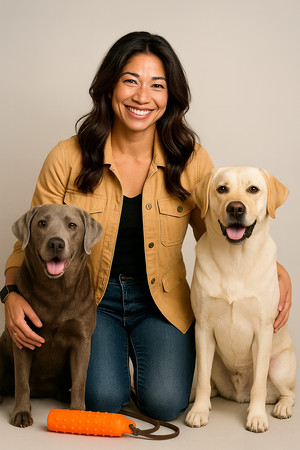

The Collar Still Jingles in My Mind: Understanding Phantom Sounds in Pet Loss Grief

As an Amazon Associate, I earn from qualifying purchases. This helps support K9 Hearts' mission to provide grief support resources for those who have lost their beloved dogs.
You're standing in the kitchen making coffee and you hear it — the soft click of nails on the hardwood floor behind you. You turn around, half-expecting to see them there.
The floor is empty.
Your dog has been gone for three weeks. You know that. And yet your brain just played that sound for you as clearly as if it had actually happened.
If this has happened to you, I want you to hear this first: you are not losing your mind. You are grieving. And what you are experiencing has a name, a scientific explanation, and more company than you might ever imagine.
What Are Phantom Sounds — And Why Do They Happen?
Phantom sounds — hearing your dog's collar jingle, their nails on the floor, their breathing in the night — are a well-documented part of what grief researchers call sensory and quasi-sensory experiences of the deceased, or SEDs.
Research now recognizes these sensory experiences as a normal response occurring in 42% to 82% of bereaved individuals (Kamp et al., 2025). The studies documenting this phenomenon have been conducted across disciplines — psychiatry, psychology, and anthropology — and the findings are consistent: the vast majority of these experiences are benign and should be considered in light of their biographical, relational, and sociocultural contexts (Kamp et al., 2020).
While most of this research has been conducted in the context of human-to-human loss, the mechanism is the same when you have lost a beloved dog. Your brain learned the sounds of your dog the way it learns a language — through thousands of repetitions, over months and years, woven into the rhythm of your daily life.
When they are suddenly gone, the brain doesn't immediately stop expecting those sounds. Research tells us that we are so attuned to the presence of our loved ones that, when they are no longer there, we still expect to see and hear them — and our minds unconsciously fill in the gaps (Castelnovo et al., 2015).
This is not a malfunction. This is attachment.
The Sounds You Might Be Hearing
Every dog has their own sound signature — a collection of auditory details so specific to them that only someone who loved them would recognize every one.
The click of nails on the floor. The particular rhythm of how they moved from room to room. Whether they were a slow amble or a determined trot, that sound is stored in your muscle memory. You heard it so many thousands of times that your brain began to anticipate it. Now it sometimes creates it — especially in the moments when you would have ordinarily heard it: in the morning, when you first come home, when you head toward the kitchen.
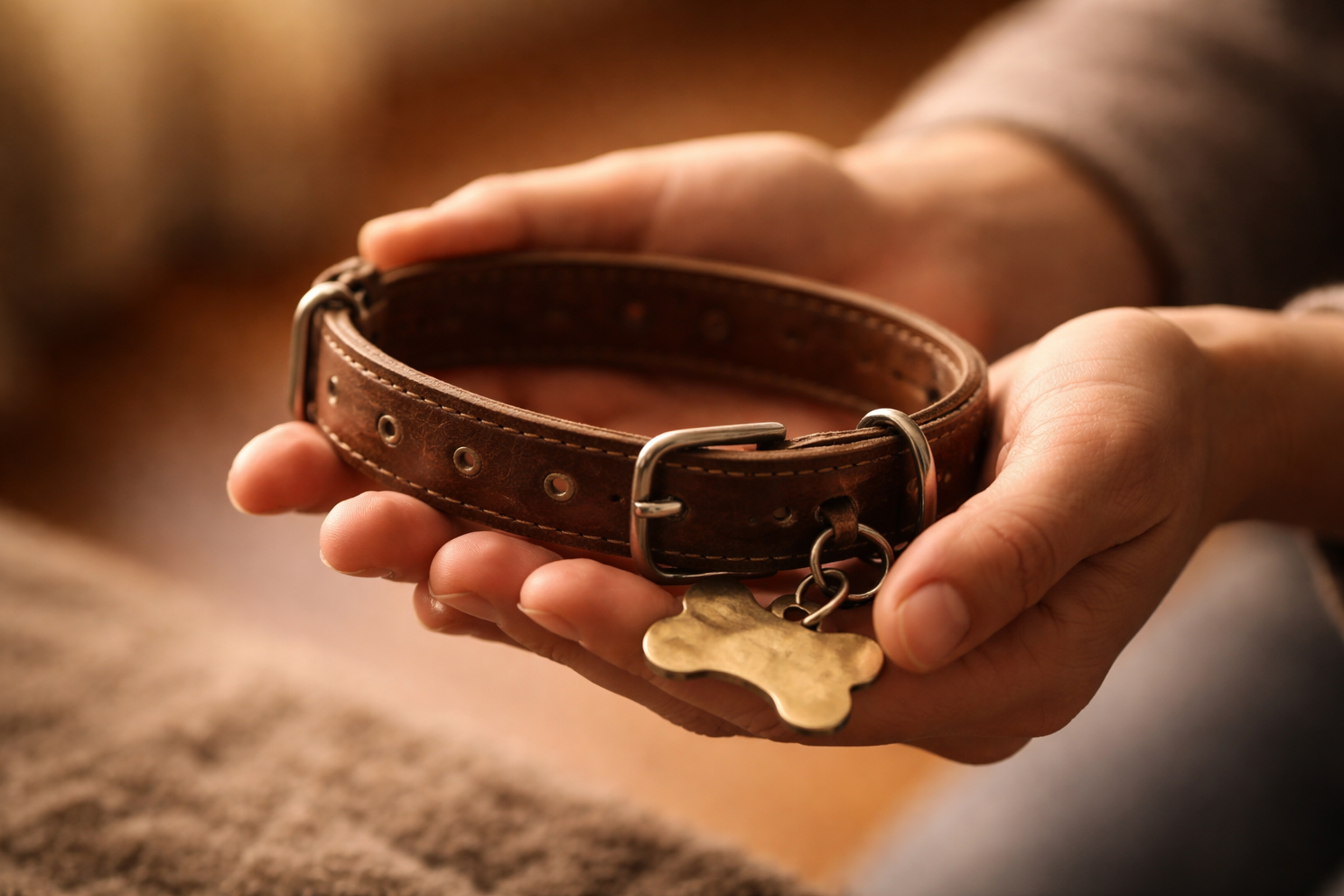
The jingle of their collar. The shake that starts from the head and ripples through the whole body. The tags hitting each other in that specific pitch that belonged only to your dog. This sound is tightly paired in your brain with comforting associations — feeding time, walk time, them coming to find you. It can surface when you least expect it.
Their breathing in the night. If your dog slept near you, their nighttime sounds became part of the ambient backdrop of your rest — the shift of weight, the deep sigh, the small sounds of their dreams. Auditory bereavement experiences are among the most frequently reported, occurring in 13% to 30% of bereaved individuals (Rees, 1971; Grimby, 1993) — and for those who shared sleeping spaces with their dogs, this number is likely higher.
Their bark at the door. If your dog had a job — alerting you when someone arrived — that bark became part of your home's soundscape. Even now, months later, some people report hearing their dog's distinctive bark when the doorbell rings: a phantom guardian still at their post.
Why It Hits So Hard
Phantom sounds aren't just intellectually confusing — they can be emotionally destabilizing. Here is what the research and experience tell us about why.
Every phantom sound can trigger a split second of hope — and then the crash. The jingle of their collar. The sound of their nails. For one brief, involuntary moment, your nervous system responds as though they are still there. Then reality arrives. That cycle of hope and disappointment is exhausting, and it is one of the reasons grief doesn't move in a straight line.
Phantom sounds can make you question yourself. When you hear something that isn't there, it's natural to wonder if something is wrong with you. Research tells us that people are often reluctant to share these experiences because they feel embarrassed and fear that no one will believe them — they may even wonder if they're showing signs of mental illness. They are not. Experiencing a grief-related sensory experience is not a sign of psychiatric illness (Castelnovo et al., 2015). It is a sign of how deeply your dog was woven into your world.
Phantom sounds and the slow reshaping of silence.
For weeks, maybe months, the sounds of your dog were woven into the specific shape of your day. Not just the big moments — but the quiet, unremarkable ones. The sound of them settling at your feet while you drank your morning coffee. The jingle of their collar when you reached for your keys. The particular quality of silence that wasn't really silence at all, because they were breathing somewhere nearby.
When those sounds stop, it isn't just quiet. It's a shape that has been emptied. And for a long time, the brain keeps reaching back into that shape — filling it in with phantom sounds, phantom movement, phantom presence — because that shape was built over years of loving them.
Here is what the science tells us, and here is what many of us also quietly believe — and both of these things can be true at once.
The research tells us that phantom sounds are the brain's neurological response to deep sensory learning. Your dog's sounds were encoded into your daily rhythms so completely that the brain continues to generate them even after the source is gone. This is not a malfunction. It is attachment, doing what attachment does.
And yet — for many people who are grieving, the science is only part of the story. There is also a quiet, persistent hope that our dogs did not simply disappear. That they are still somewhere. Still walking. Still present in some form that we cannot fully see or measure. If that is where you find yourself — holding both the science and something more — you are not alone, and you are not wrong to hold both. The science helps ground us when the phantom sounds feel disorienting. The belief that our dogs are still with us in some way helps carry us when the science isn't enough. Neither truth cancels the other.
Over time, the phantom sounds begin to fade. New routines slowly fill the shape that used to belong to them. And here is where grief can get complicated — because our culture has a deep, complicated fear of forgetting.
We are taught that remembering is how we honor the ones we love. That forgetting is a kind of betrayal. But what looks like forgetting — the morning you realize you didn't reach for the leash out of habit, the evening the silence felt a little less sharp — is not forgetting. It is healing. It is your nervous system slowly, gently learning to carry the love differently.
Your dog is not less loved because the phantom sounds have quieted. They are not less honored because a new routine has taken shape around their absence. The love doesn't disappear. It changes form.
If the fear of forgetting is what is keeping you from moving forward, consider giving yourself something intentional to return to — something that says I will not forget, and I don't have to carry this alone every single day. An anniversary you mark each year. A living memorial — a plant, a garden stone, something that grows and continues. Or journaling, which research consistently shows helps cement memories in the brain and process grief in ways that speaking alone cannot (Baikie & Wilhelm, 2005). Write down the sounds. Write down the routines. Write down exactly what their presence felt like in the specific shape of your days. That writing becomes a record that lives outside of you — so the fear of forgetting has somewhere real to rest.
The phantom sounds will fade. That is not loss. That is love learning to walk beside you instead of ahead of you.
You Are Not Alone — The Research Says So
One of the earliest and most widely cited studies in bereavement research was conducted by Rees (1971) and involved 227 widows and 66 widowers. Nearly half of those interviewed reported experiencing the deceased in some sensory form — and Rees regarded the majority of these occurrences as normal and helpful accompaniments of the bereavement process. More recent research confirms and expands this, consistently finding that the vast majority of sensory grief experiences are benign (Kamp et al., 2020).
The important word there is benign. Experiencing phantom sounds does not mean you are stuck in your grief. It does not mean you are unwell. It means you loved your dog deeply enough that your brain built an entire internal world around their presence — and that world doesn't dismantle overnight.
How to Move Through Phantom Sounds With Compassion
Acknowledge without judgment. When you hear your dog's collar or their breathing, try naming it gently: "My brain just played that sound. That makes sense. I miss that sound so much." This small act of acknowledgment does two things: it validates your experience, and it gently keeps you tethered to reality without fighting what your brain is doing.
Don't try to force it to stop. Your brain is not doing this deliberately, and you cannot think your way out of it. Let the experience happen. Notice it. Feel whatever emotion rises with it. Then gently redirect your attention to your actual surroundings.
Create an intentional sensory connection. Rather than being ambushed by phantom sounds, some people find comfort in creating deliberate, real sensory experiences with their dog's belongings. Keep your dog's collar somewhere accessible. When the phantom sounds come — or when you simply miss that jingle — hold the collar in your hands. Feel the weight of it. Run your fingers over the tags. If it helps, shake it gently and listen to what it actually sounds like, in real time. Giving your brain a real sensory experience can be grounding in a way that simply waiting out the phantom cannot.
You might also consider placing a few of their belongings — collar, a favorite toy, a photo — in a small shadow box where you can see and touch them intentionally. This gives grief a dedicated, honored space rather than letting it ambush you from unexpected corners of the house.
Write it down. Putting sensory memories on paper — the exact rhythm of their nails, the specific pitch of their bark, the weight of them against your leg — does something important. It takes memories that are floating and ambushing you and gives them a place to land. Journaling about the specific sounds you miss can help your brain organize and process these experiences rather than being startled by them.
Charlie's Guided Journal for Pet Loss was built around exactly this kind of work. It includes prompts specifically designed for sensory grief — the sounds you are missing, the physical presence you are longing for, and the way grief lives in the body, not just the mind. If you are finding that the loss lives more in your senses than in your thoughts, the journal can give that grief a structured, gentle place to go.
Available in paperback | Hardcover: | Digital version
The Other Senses of Grief
Phantom sounds are one part of a larger picture that grief researchers call sensory grief. Research documents that sensory experiences of the deceased can include visual, auditory, olfactory, and physical perceptions — as well as a generalized felt sense of the deceased's presence (Kamp et al., 2025).
Visual experiences. Seeing a shape out of the corner of your eye that looks like your dog. Catching movement that isn't there. Looking at their empty bed and, for a split second, seeing them lying there. These follow the same neurological pattern as auditory experiences — your brain filling in what it expects to see.
Phantom touch. Feeling the weight of them against your leg on the couch. Sensing their head resting on your lap. Reaching down to pet them and meeting empty air. Touch memory is among the most persistent forms of sensory memory, and it can surface long after loss.
Smell memory. The connection between scent and memory is one of the most well-established findings in neuroscience — the olfactory system has direct pathways to the brain's memory and emotion centers in a way that other senses do not (Herz & Engen, 1996). Many people report catching the scent of their dog even when logically they know it is impossible. Some preserve an unwashed blanket or piece of bedding specifically for this reason. While the scent will eventually fade, having access to it in the early months can be genuinely comforting.
The phantom routine. Your body continues the motions of caring for your dog even after they are gone. Reaching for the leash at walk time. Glancing at where their bowl used to be. Stepping around a dog bed that is no longer there. These are muscle memory in its most tender form — your body honoring the patterns that shaped your days.
When to Seek Additional Support
For most people, phantom sounds and sensory experiences gradually become less frequent as the weeks and months pass. Research shows that these experiences foster continuing bonds and are meaningful — they are part of how grief unfolds, not evidence that it is failing to progress (Kamp et al., 2025).
However, it may be worth reaching out to a grief professional if:
Phantom experiences are increasing rather than decreasing over time
You find yourself unable to distinguish between phantom sounds and real sounds
Distress from these experiences is causing you to avoid your home or daily activities
These experiences are accompanied by an inability to function, thoughts of self-harm, or other signs of prolonged grief
Professional grief support — especially from someone who understands pet loss — can be deeply helpful. You can find resources and referrals on the K9 Hearts Pet Loss Support & Grief Resources page at https://www.k9hearts.com/pet-loss-and-grief-support.
Honoring the Sounds You Miss
Rather than trying to outrun the sounds that move through you, consider honoring them.
A sound memorial for your space. Some people find comfort in placing a set of memorial wind chimes somewhere meaningful — a garden, a porch, a window where their dog used to sit. The sound doesn't replicate what you've lost, but it fills the quiet with something intentional and gentle. It is a way of saying: this silence is not empty. It is held.
The FourAngels Dog Memorial Wind Chime is a 32-inch hand-crafted aluminum chime with an angel holding a dog engraved on the pendant, packaged in a gift box with a heartfelt poem card. It is designed specifically for those grieving a dog, and the gentle tones are tuned to offer a calm, soothing sound rather than something sharp or jarring. It's the kind of thing you can hang in a spot that was meaningful to your dog — and hear something soft every time the wind moves.
Preserve recordings while they are vivid. If you have any video or audio recordings of your dog — their bark, their breathing, even just the sound of their collar in the background — back these up somewhere safe now, while you are thinking of it. Someday you may want to hear those sounds again, not as phantom experiences but as an intentional act of remembrance.
Write about what you are listening for. Describe the exact pitch of their bark. The rhythm of their breathing. The way their nails sounded on tile versus carpet. This descriptive writing doesn't just honor your sensory memory — it gives those memories a form that will outlast the phantom echoes.
The EOP™ Movement: Giving Your Dog a Formal Honor
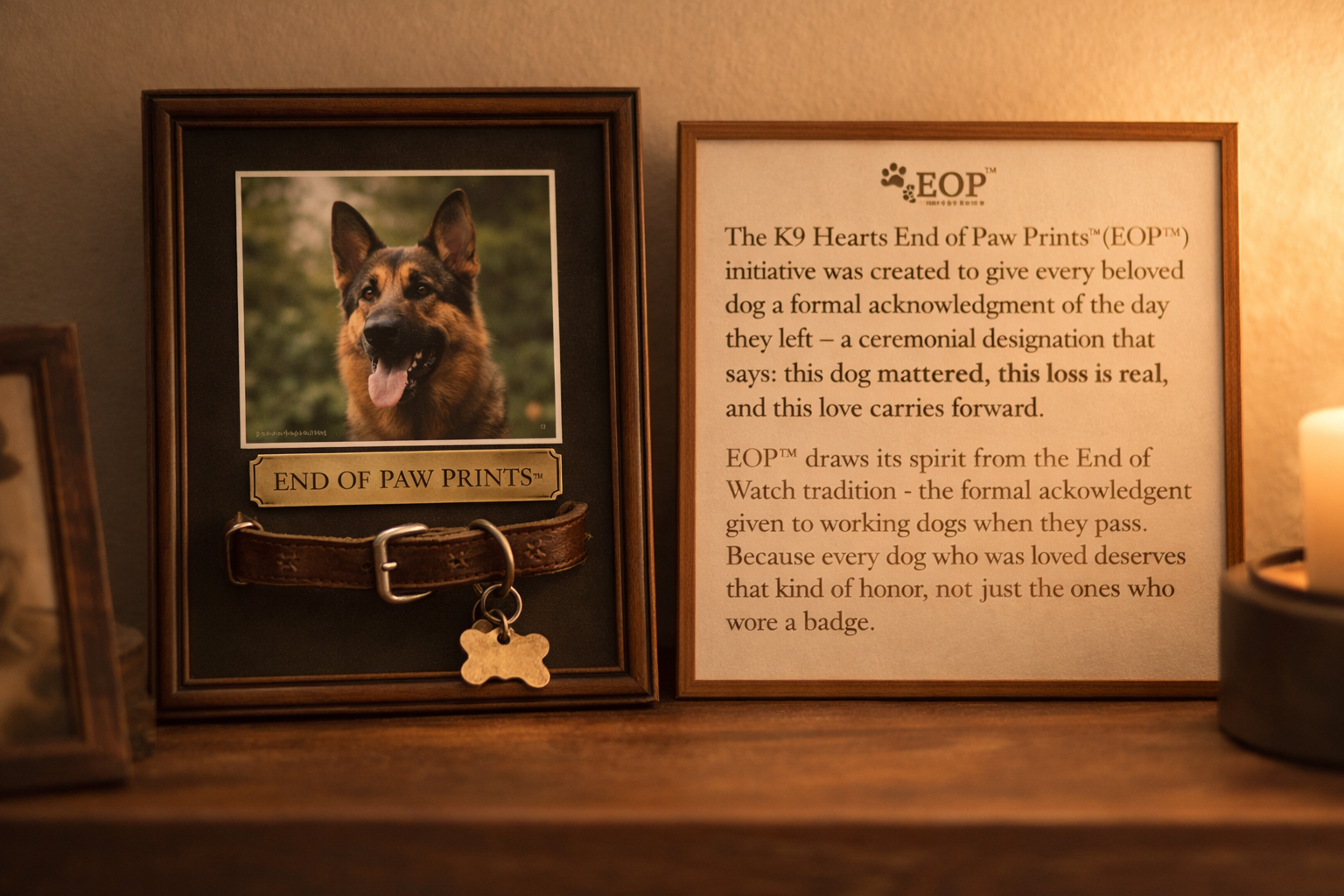
The K9 Hearts End of Paw Prints™ (EOP™) initiative was created to give every beloved dog a formal acknowledgment of the day they left — a ceremonial designation that says: this dog mattered, this loss is real, and this love carries forward.
EOP™ draws its spirit from the End of Watch tradition — the formal acknowledgment given to working dogs when they pass. Because every dog who was loved deserves that kind of honor, not just the ones who wore a badge.
If the phantom sounds you are experiencing are evidence of anything, it is this: your dog was not "just a dog." They were woven into the fabric of your daily life in a way that left a real imprint — sensory, emotional, neurological. EOP™ is one way to honor that imprint with the formality it deserves.
The paw prints stop. The love never does.
Learn more about the EOP™ movement and the EOP Legacy Portrait at https://www.k9hearts.com/about-eop.
Legacy Art: A Visual Anchor for Sensory Grief
When phantom sounds come and go and you are searching for something stable to return to — something you can see and hold your gaze on — a K9 Hearts Legacy Portrait can offer that.
Sensory grief moves through the body in waves. Vision is often the most grounding sense — the place we return to naturally when other senses feel destabilizing. A Legacy Portrait of your dog, created from a favorite photo, gives your grief a visual anchor: a place where they are still vividly, beautifully present in your space.
It is not a replacement. It is a holding place — a way for the love to stay visible while the rest of grief slowly finds its footing.
Visit K9 Hearts Legacy Healing Art →
Question for You
Do you believe your dog is still with you in some way after they passed? I want to hear from you. A poll is coming — watch for it on K9 Hearts social media at launch, and share your answer there. Your experience matters, and your voice helps build this community.
FAQ
Q: Is it normal to hear your dog after they die? Yes. Hearing sounds associated with your dog after their death is a well-documented phenomenon in grief research called a sensory or quasi-sensory experience of the deceased. Studies show these experiences occur in 42–82% of bereaved individuals and are considered a normal, benign part of grieving.
Q: Why do I keep hearing my dog's collar? Your brain formed deep sensory associations with your dog's sounds through thousands of repetitions over months or years. After loss, the brain doesn't immediately stop expecting those sounds — it sometimes generates them, particularly in moments when you would ordinarily have heard them. This is a form of sensory grief, not a sign that something is wrong with you.
Q: What are phantom sounds in grief? Phantom sounds in grief are auditory sensory experiences — hearing sounds associated with your deceased dog — that occur in the absence of that dog. Common examples include nails on the floor, collar jingling, breathing at night, and barking. Research categorizes these as auditory sensory experiences of the deceased, a normal part of bereavement.
Q: Am I going crazy if I hear my dead dog? No. Experiencing sensory grief — including hearing sounds associated with your dog — is scientifically documented across multiple peer-reviewed studies and is considered a normal grief response. The vast majority of these experiences are benign and are not associated with psychiatric illness.
Q: Can both science and spiritual belief explain phantom sounds? Yes — and both can be true at once. Science tells us phantom sounds are a neurological response to deep sensory learning. Many grieving people also hold a quiet belief that their dog is still present in some form. Neither truth cancels the other. The science helps ground us when the experiences feel disorienting. The belief that love continues beyond physical death helps carry us when the science isn't enough.
Q: Does hearing phantom sounds mean I'm not accepting my dog's death? Not necessarily. Phantom sounds are a neurological response to the deep sensory world your brain built around your dog's presence. They typically decrease naturally over time as new routines slowly reshape the silence. They are not evidence that grief is failing — they are evidence of how deeply your dog was woven into your daily life.
Q: How long do phantom sounds last after pet loss? There is no fixed timeline. For most people, phantom sounds become less frequent over weeks and months as the brain slowly integrates the reality of the loss. If they are increasing over time or causing significant distress, speaking with a grief professional who understands pet loss is recommended.
Q: I'm afraid that as the phantom sounds fade I'm forgetting my dog. Is that true? No. The fading of phantom sounds is part of healing — not forgetting. It means your nervous system is slowly learning to carry the love differently, not that the love has diminished. Creating intentional anchors — an annual anniversary, a living memorial, or a journal — can give the fear of forgetting somewhere real to rest.
Q: What should I do when I hear phantom sounds of my dog? Acknowledge the experience without judgment, allow the emotion that comes with it, and gently redirect your attention. Creating intentional sensory rituals — like holding their collar, journaling about sensory memories, or hanging memorial wind chimes — can help your brain process these experiences in a structured, grounded way.
Q: Can journaling help with phantom sounds and sensory grief? Yes. Research consistently shows that expressive writing helps cement memories in the brain and supports grief processing. Writing specifically about the sensory memories associated with your dog — the sounds, smells, physical presence — can help externalize and organize these experiences so they feel less like ambushes and more like intentional acts of remembrance.
Q: When should I seek professional grief support for phantom sounds? Consider reaching out to a grief professional if phantom experiences are increasing rather than decreasing over time, if you cannot distinguish phantom sounds from real sounds, if distress is causing you to avoid your home or daily life, or if these experiences are accompanied by inability to function or thoughts of self-harm.
References
Baikie, K. A., & Wilhelm, K. (2005). Emotional and physical health benefits of expressive writing. Advances in Psychiatric Treatment, 11(5), 338–346. https://doi.org/10.1192/apt.11.5.338 (Peer-reviewed)
Castelnovo, A., Cavallotti, S., Gambini, O., & D'Agostino, A. (2015). Post-bereavement hallucinatory experiences: A critical overview of population and clinical studies. Journal of Affective Disorders, 186, 266–274. https://doi.org/10.1016/j.jad.2015.07.032 (Peer-reviewed)
Cleary, M., West, S., Thapa, D. K., Westman, M., Vesk, K., & Kornhaber, R. (2022). Grieving the loss of a pet: A qualitative systematic review. Death Studies, 46(9), 2167–2178. https://doi.org/10.1080/07481187.2021.1924110 (Peer-reviewed systematic review)
Grimby, A. (1993). Bereavement among elderly people: Grief reactions, post-bereavement hallucinations and quality of life. Acta Psychiatrica Scandinavica, 87(1), 72–80. (Peer-reviewed)
Herz, R. S., & Engen, T. (1996). Odor memory: Review and analysis. Psychonomic Bulletin & Review, 3(3), 300–313. https://doi.org/10.3758/BF03212754 (Peer-reviewed)
Kamp, K. S., Steffen, E., & colleagues. (2025). A longitudinal study of sensory and quasi-sensory experiences following bereavement using interpretative phenomenological analysis. Death Studies.https://doi.org/10.1080/07481187.2025.2547237 (Peer-reviewed)
Kamp, K. S., Steffen, E., Aldhouse, N., Tempest, N., & Moskowitz, A. (2020). Sensory and quasi-sensory experiences of the deceased in bereavement: An interdisciplinary and integrative review. Schizophrenia Bulletin, 46(6), 1367–1381. https://doi.org/10.1093/schbul/sbaa048 (Peer-reviewed; International Consortium for Hallucination Research)
Rees, W. D. (1971). The hallucinations of widowhood. British Medical Journal, 4, 37–41. (Peer-reviewed; foundational bereavement study)
Sabucedo, P., Evans, C., & Hayes, J. (2023). Perceiving those who are gone: Cultural research on post-bereavement perception or hallucination of the deceased. Transcultural Psychiatry, 60(3). https://doi.org/10.1177/1363461520962887(Peer-reviewed)