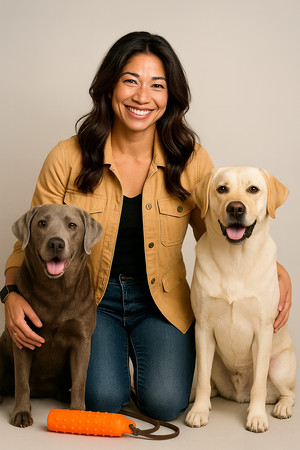

Real Self-Care After Dog Loss: What Actually Helps (And What Doesn't)
As an Amazon Affiliate I earn from qualifying purchases.
n the weeks after Charlie died, people kept telling me to take care of myself.
I understood what they meant. But I didn't know how to explain that I was barely functioning. That showering felt like an accomplishment. That the dog-shaped silence in my house was louder than anything I had ever heard.
Self-care, in the way it's usually described — candles, face masks, bubble baths — felt like a language I didn't speak anymore.
Here's what I've learned, both from my professional background in mental health and from living through the raw, disorienting months of dog loss myself: real self-care during grief doesn't look like indulgence. It looks like survival. It looks like meeting your body's basic needs when grief has made everything feel pointless. It looks like creating small pockets of relief — not because the pain goes away, but because you can carry it a little longer.
If you're in the early, overwhelming days of losing your dog — or if you're months in and still struggling — this is for you.
First: What Self-Care Is Not During Grief
Before we talk about what helps, let's clear away what doesn't.
Self-care during grief is not forcing yourself to stay positive. It is not pretending you're okay because it's been a few weeks, or because someone in your life has decided you should be over it by now. It is not performing recovery for other people's comfort.
Self-care is also not pushing through. Not distracting yourself into exhaustion. Not staying busy so you don't have to feel it.
Real self-care during grief is this: meeting your basic needs even when everything feels pointless. Creating moments of relief in the middle of pain. Being gentle with yourself when you can't do what you used to. Recognizing that healing is not linear, and that some days just getting through is enough.
With that foundation, let's talk about what actually helps — grounded in both research and the messy, imperfect reality of what grief looks like from the inside.
Your Body Is Grieving Too
This is one of the most important things I want you to understand: grief is not only an emotional experience. It is a physical one.
Research published in peer-reviewed medical and psychiatric journals has documented that bereavement is associated with sleep disruption, muscle tension, fatigue, impaired immune function, headaches, and even increased cardiovascular risk in prolonged grief. A comprehensive systematic review published in Frontiers in Psychiatry (Lasselin et al., 2020 — a peer-reviewed, open-access journal) found that grief-related stress activates inflammatory pathways that affect physical health. A separate peer-reviewed systematic review published in Sleep Medicine Reviews (Bartušková et al., 2020) analyzed 85 studies covering over 12,000 bereaved participants and found that sleep disturbances are highly prevalent in bereavement — and that grief intensity is positively correlated with sleep difficulty.
Your body is not being dramatic. It is responding to a real and significant loss. That means your physical state matters — not as a luxury, but as part of how you get through this.

Sleep: The Foundation of Everything
When you can't sleep, everything else becomes harder. Your emotional regulation suffers. Your ability to think clearly narrows. Your capacity to hold the grief without being crushed by it diminishes.
Many grieving dog owners find sleep disrupted in specific ways: lying awake because the quiet where your dog used to be is too loud, waking in the night reaching for them, or sleeping too much because it's the only break from the pain. All of these are normal grief responses.
Here are a few tools that can help:
White noise can mask the specific silence that dog loss leaves — the absence of the breathing sounds, the collar jingle, the movement. A simple white noise machine creates a neutral sound layer that many people find easier to rest in.
➡️ Magicteam White Noise Machine with 20 Non-Looping Natural Sounds
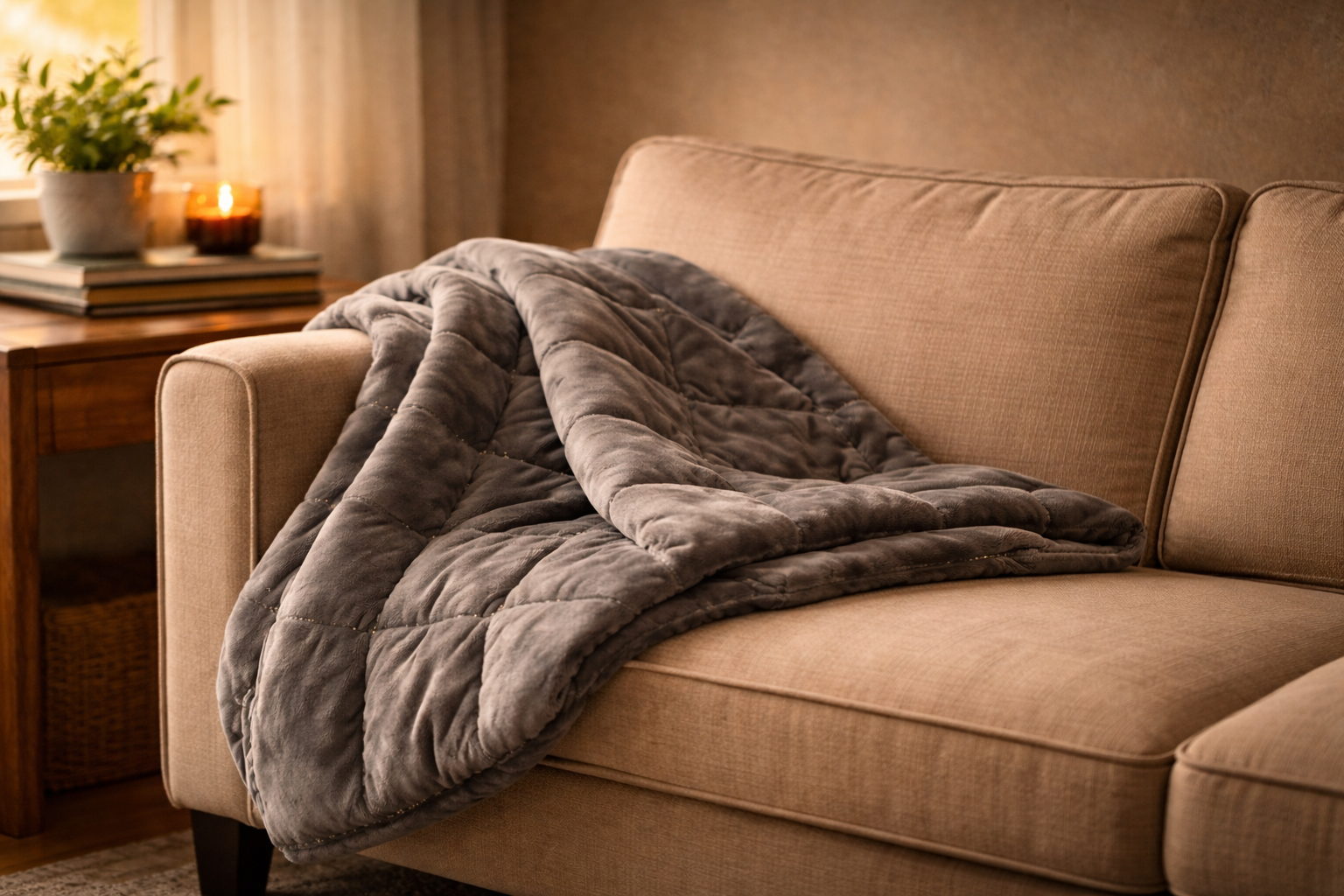
A weighted blanket provides gentle deep-pressure stimulation that research suggests can calm the nervous system. For many people grieving the loss of a dog who slept beside them, the weight also provides a subtle sense of physical comfort where there used to be warmth.
➡️ YnM 15lbs Weighted Blanket with Cooling Glass Beads
And if you're sleeping at odd hours — which is common, and perfectly okay — a soft, comfortable throw blanket to rest on the couch, in a chair, or anywhere that doesn't feel like "the spot" you shared with your dog can help you rest without triggering.
➡️ Exclusivo Mezcla Fleece Throw Blanket — Forest Green
Please give yourself permission to sleep when you can. Your body is doing hard work.
Nourishment When You Don't Want to Eat
Grief often suppresses appetite. Food feels irrelevant. But your body still needs fuel, especially when it is managing the physiological stress of significant loss.
This is not the time to worry about eating perfectly. It is the time to eat something.
Herbal teas offer comfort, hydration, and gentle ritual when eating feels impossible. Chamomile in particular has been used for centuries as a calming support.
➡️ Celestial Seasonings Fruit Tea Sampler — Caffeine Free ➡️ Amazon Grocery Chamomile Herbal Tea
A note on nutrition: Talk to your doctor if your appetite loss is significant and extended. Your general practitioner can help you identify when depleted nutrition is affecting your ability to cope. This is not weakness — it is taking care of the body that is carrying your grief.

Gentle Movement — Not Exercise, Just Movement
I want to be honest with you about something: the walks you used to take with your dog are painful right now. You might avoid them entirely. That is completely understandable.
But movement — even gentle movement — matters during grief.
A peer-reviewed systematic review published in the journal Sports Medicine — Open (Williams et al., 2021) screened 1,299 studies and found that physical activity — including yoga, walking, and gentle martial arts — was associated with reduced anxiety, depression, and PTSD symptoms in bereaved individuals. The researchers noted that activity provided a sense of freedom and an emotional outlet during grief.
You don't need a gym. You don't need a fitness goal. You need your body to move, even a little, even slowly.
Consider a heating pad for the physical tension grief creates — tight shoulders, clenched jaw, lower back pain. These are real, documented somatic responses to emotional pain.
➡️ RENPHO Electric Heating Pad — 6 Heat Levels for Neck, Shoulder, and Back
And when you are ready — even if that is months from now — walking again can become one of the ways you honor your dog's memory while caring for yourself at the same time.

Aromatherapy: A Gentle Nervous System Tool
Scent is one of the most direct pathways to the nervous system. Many people find that gentle aromatherapy — lavender, chamomile, cedarwood — provides a small but real sense of calm during acute grief.
An essential oil diffuser in your space creates a quiet, sensory ritual that some people find grounding when the emotional landscape is unpredictable.
➡️ InnoGear Essential Oil Diffuser — Ultrasonic, for Bedroom ➡️ Majestic Pure Essential Oil with Glass Dropper — 100% Pure and Natural
This is not a cure. It is a small kindness you can offer your nervous system.
A note on magnesium: Some people find magnesium bath soaks supportive for sleep and muscle tension during periods of high stress. If you want to try it, look for genuine magnesium chloride flakes.
➡️ Ancient Minerals Magnesium Bath Flakes
(Consult your doctor before adding supplements if you have any medical conditions.)
Softer Tissues. Seriously.
This sounds small. It is not small. If you are crying multiple times a day — which is completely normal in early grief — having tissues with lotion or aloe protects your skin from the repeated irritation.
Stock them everywhere. Your nightstand, your car, your desk. There is no shame in being prepared for your grief.
➡️ Amazon Basics Facial Tissue with Lotion, 300 Count — 8 Packs
Emotional Tools: Processing, Not Just Enduring
Your emotions need tending just as much as your body does. The goal is not to avoid the grief, but to move through it in a way that does not leave you stranded.
Writing Your Way Through
There is meaningful research supporting writing as a tool in grief — particularly structured writing that helps you externalize and organize what you are carrying. A review published in the journal Bereavement Care (Furnes & Dysvik, 2013) found that systematic writing programs can support the grief process by helping individuals give form and language to their experience.
Important note: A 2018 meta-analysis published in PMC (Reinhold et al.) found that expressive writing alone does not produce large long-term health effects for everyone. Writing works best not as a standalone cure, but as a companion tool — one piece of a broader support structure that may include counseling, community, and time.
With that honest framing: writing can help. Giving your grief somewhere to go — onto paper, in your own words — creates relief for many people.
If you want unstructured writing, a quality journal you actually enjoy writing in makes a difference. The physical experience matters.
If you want something structured — prompts that meet you where you are, organized around how grief actually moves rather than how we wish it did — I created Charlie's Last Walk: A Guided Journal for Pet Loss for exactly this moment.
It is available in print: paperback and hardcover. Or as a digital version at k9hearts.com.
The journal is organized around five grief themes — including anticipatory grief, the impossible choice, waves of grief, guilt, and opening to love again — because grief doesn't move in a straight line, and your support shouldn't have to either.

Remembering and Honoring: Creating a Space for Your Dog's Memory
esearch on continuing bonds — a concept developed in the peer-reviewed bereavement literature (Klass, Silverman & Nickman, 1996) — suggests that healing does not require severing the connection with who we've lost. It requires finding appropriate, living ways to carry that love forward.
Creating a physical space in your home for your dog's memory is not dwelling. It is an act of love.
A pet memorial photo album gives you a place to gather the photos that matter most, organized in a way that honors the story of your dog's life.
➡️ MCS Expandable 10-Page Pet Scrapbook Album with Photo Opening Cover
A shadow box creates a curated memorial display — a collar, a paw print, a favorite photo — that gives your grief a physical home rather than leaving it scattered everywhere.
➡️ Americanflat 11x14 Shadow Box Frame with Shatter-Resistant Glass
A paw print kit captures something that cannot be recaptured any other way. If you haven't done this yet, and your dog is still with you, please do it now.
➡️ Pearhead Pet Paw Print Keepsake Ornament Kit — DIY Hanging Pet Memorial ➡️ Ultimate Pawprint Keepsake Kit — Makes 2, with Display Stands
A digital photo frame allows you to cycle through the full archive of your life together — not just one frozen image, but the whole story.
➡️ 32GB FRAMEO 10.1 Inch Smart WiFi Digital Photo Frame
And if you want your dog's image transformed into something lasting and beautiful — a portrait that honors who they were rather than simply documenting what they looked like — that is exactly what we do at K9Hearts.
Our memorial portrait services are designed to carry the full weight of that love forward. You can learn more and view our work at k9hearts.com.

The Myth of "Getting Over It"
Before we close, I want to name the things that will not help, no matter how often they're suggested.
Staying busy prevents processing and often leads to delayed grief that resurfaces harder later. You need some quiet with your grief — not all the time, but enough.
Toxic positivity — "at least they had a good life," "they're not suffering anymore" — invalidates the loss even when well-intentioned. You are allowed to be devastated. You are allowed to hold both truths: gratitude for the time you had and profound sorrow that it ended.
Getting a new dog right away is a deeply personal decision and one that only you can make. But a new dog does not replace the one you lost, and moving too quickly before grieving can create a complicated emotional situation for you and the new dog.
Just giving it time is also incomplete advice. Time alone does not heal grief. Time, combined with active support, self-compassion, and connection, does.
When to Seek Professional Support
Self-care tools matter. They are real. But sometimes grief is too large to manage with tools alone.
Please consider reaching out to a licensed grief counselor or mental health professional if:
You are unable to manage basic daily functioning for extended periods
You are having thoughts of self-harm — if this is you right now, please call or text 988 immediately
Your grief is intensifying rather than softening over time
You are using substances to manage the pain
You feel permanently stuck
There is no shame in needing more support than any of us can provide ourselves. A therapist who understands pet loss can offer something that tools and journals and weighted blankets cannot — a trained, steady, professional presence in your grief.
You can search the Psychology Today therapist directory at psychologytoday.com and filter by grief specialization.
A Final Word: Permission
The most important self-care tool I can offer you is permission.
Permission to grieve your dog completely. Permission to not be okay. Permission to take exactly as long as you need. Permission to cry at inconvenient times, to cancel plans, to stay in your pajamas, to fall apart and put yourself back together slowly.
Your dog mattered. The love was real. The grief is proportionate to the love — which means it is exactly the right size.
Self-care doesn't make that grief disappear. It helps you carry it with a little more grace.
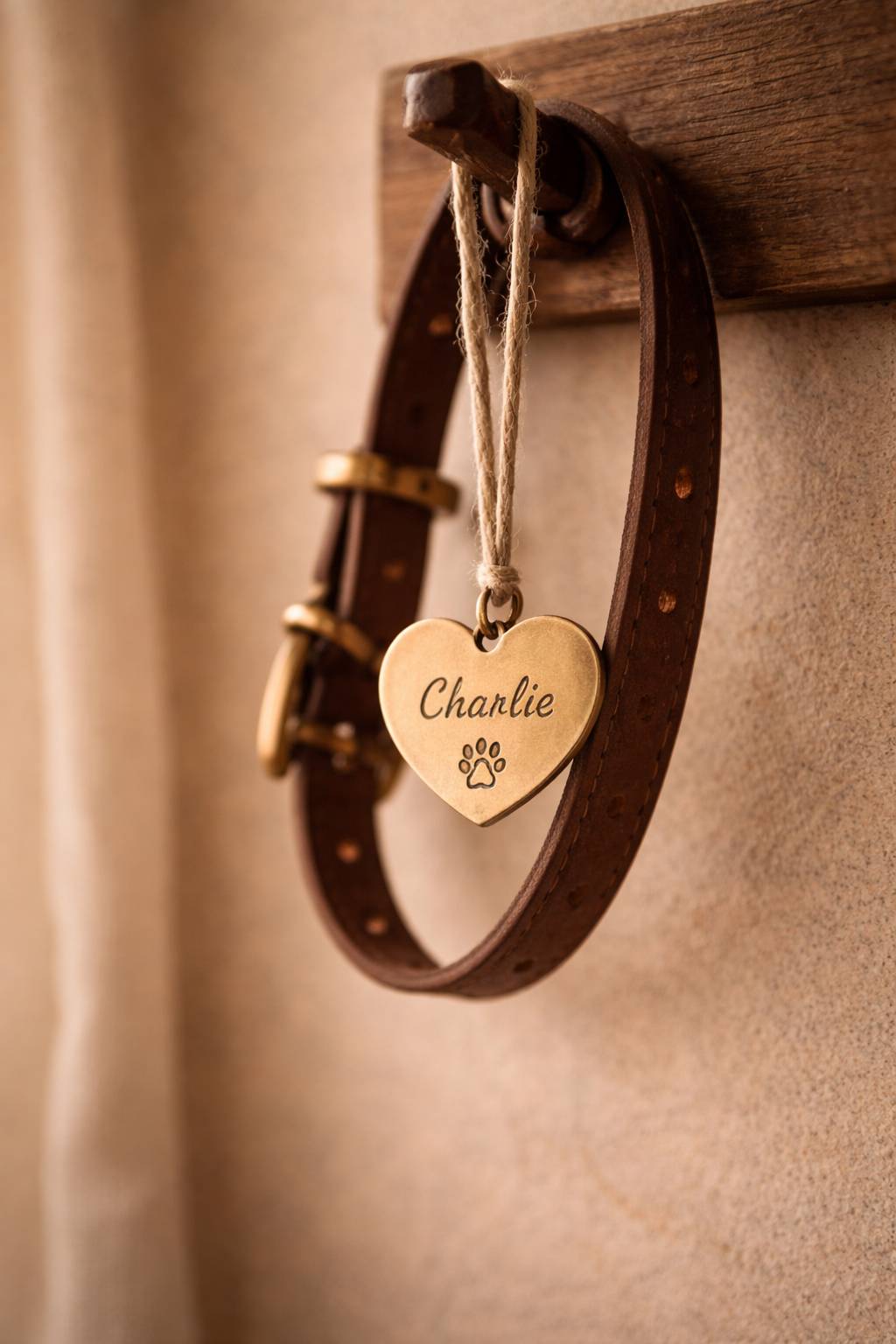
Charlie taught me that love doesn't end when life does. It just changes shape. And taking care of yourself is one of the ways you honor everything that love was.
Be gentle with yourself. You're doing the hardest thing.
Paige Cummings is the founder of K9Hearts and the author of Charlie's Last Walk: A Dog Memoir of Healing After Pet Loss, available in paperback and in digital format at k9hearts.com. With a B.S. in Psychology and an M.A. in Forensic Psychology, plus nearly 30 years of experience working with children and families through the hardest parts of their lives, she brings both professional expertise and deep personal understanding to every resource K9Hearts creates.
FAQ
Q: What is self-care after pet loss? A: Real self-care after losing a dog means meeting your body's basic needs — sleep, movement, and nourishment — while also tending to your emotional experience. It is not about forcing positivity or performing recovery. It is about survival tools that help you get through one day at a time.
Q: Does grief really affect your body physically? A: Yes. Peer-reviewed research shows that bereavement is associated with sleep disruption, fatigue, muscle tension, and even inflammatory responses that affect physical health. Your body is not being dramatic — it is responding to a real loss.
Q: Is it normal to not be able to sleep after my dog died? A: Completely normal. Research analyzing over 12,000 bereaved individuals found that sleep disturbances are highly prevalent after a significant loss. White noise machines, weighted blankets, and gentle sleep routines can help.
Q: Does journaling help with pet loss grief? A: Journaling can be a useful companion tool during grief — helping you externalize difficult emotions and give language to what you are carrying. Research supports it as a supportive practice, particularly when structured. It works best as one part of a broader support approach, not as a standalone cure.
Q: What should I do to take care of myself after my dog dies? A: Focus on the basics first: sleep when you can, eat something even when you don't want to, and move your body gently. Then tend to your emotional needs — journaling, creating a space in your home to honor your dog, and leaning into community or professional support if you need it.
Q: Is it okay to make a memorial for my dog at home? A: Yes — and research on continuing bonds in grief suggests it is actually supportive. Creating a physical memorial space gives your grief a home and honors the ongoing love you have for your dog. Shadow boxes, paw prints, and photo displays are meaningful tools.
Q: When should I seek professional help for pet loss grief? A: If your grief is intensifying rather than softening over time, if you are unable to function in daily life, or if you are having thoughts of self-harm — please reach out to a professional. The 988 Suicide and Crisis Lifeline is available 24/7 by call or text.
Q: How long does grief after losing a dog last? A: There is no fixed timeline. The acute, overwhelming phase typically softens over weeks to months, but many people experience waves of grief for much longer — and that is normal. Grief is not a problem to be solved on a schedule.
References
Bartušková, M., Sauer, K. S., Doering, B. K., & Stangier, U. (2020). Sleep disturbances in bereavement: A systematic review. Sleep Medicine Reviews, 53, 101331. https://doi.org/10.1016/j.smrv.2020.101331 (Peer-reviewed systematic review published in Sleep Medicine Reviews, a MEDLINE-indexed journal. Searched PubMed, Web of Science, and PsychInfo. 85 articles, 12,294 participants.)
Lasselin, J., Schedlowski, M., Karshikoff, B., Engler, H., Lekander, M., & Konsman, J. P. (2020). Comparison of bacterial lipopolysaccharide-induced sickness behavior in rodents and humans: Relevance for symptoms in inflammatory disease — See also: Mäkinen, T. M., et al. (2020). The psychobiology of bereavement and health: A conceptual review from the perspective of social signal transduction theory of depression. Frontiers in Psychiatry, 11, 565239. https://doi.org/10.3389/fpsyt.2020.565239 (Peer-reviewed; Frontiers in Psychiatry is a MEDLINE-indexed, open-access journal.)
Williams, J., Shorter, G. W., Howlett, N., Zakrzewski-Fruer, J., & Chater, A. M. (2021). Can physical activity support grief outcomes in individuals who have been bereaved? A systematic review. Sports Medicine — Open, 7, 26. https://doi.org/10.1186/s40798-021-00311-z (Peer-reviewed systematic review. Springer Nature open-access journal. 1,299 studies screened; 25 met inclusion criteria.)
Klass, D., Silverman, P. R., & Nickman, S. L. (Eds.). (1996). Continuing bonds: New understandings of grief. Taylor & Francis. (Peer-reviewed academic text that introduced the continuing bonds framework; foundational to modern bereavement theory.)
Pennebaker, J. W. (1997). Writing about emotional experiences as a therapeutic process. Psychological Science, 8(3), 162–166. https://doi.org/10.1111/j.1467-9280.1997.tb00403.x (Peer-reviewed. Foundational research on expressive writing by a leading researcher in the field.)
Reinhold, M., Bürkner, P. C., & Holling, H. (2018). Effects of expressive writing on depressive symptoms: A meta-analysis. Clinical Psychology: Science and Practice, 25(1), e12224. (Peer-reviewed meta-analysis. Conclusion: expressive writing has limited large-scale health effects on its own. Cited here to represent the research honestly.)